
隐式编程

Search documents
深度|黄仁勋对话Cisco CEO:未来十年算力将提升100万倍;写代码只是打字,领域知识才是你的“超级力量”
Sou Hu Cai Jing· 2026-02-15 09:00
Core Insights - The conversation at the Cisco AI Summit highlighted the transformation from explicit programming to implicit programming, emphasizing the need for companies to adapt to AI technologies and integrate them into their processes [4][5][15]. Group 1: AI Transformation - The shift from explicit programming to implicit programming allows computers to understand intentions and solve problems autonomously, marking a significant change in computing paradigms [4][5]. - Companies should assume that computational power is infinite and act accordingly to tackle their most impactful challenges [4][5]. - The ROI of new technologies is often difficult to quantify initially, and companies should encourage experimentation in a safe environment to foster innovation [4][16][17]. Group 2: AI Integration in Business - Companies must integrate AI into their workflows rather than treating it merely as a tool, as this will enhance organizational knowledge and efficiency [4][45]. - The concept of "AI in the loop" is proposed as a more effective approach than "Human in the loop," suggesting that AI should be embedded in processes to continuously improve company value [45]. Group 3: Future of Computing - The computing stack is being reinvented, with a focus on creating a new architecture that combines AI capabilities with networking and security [15][42]. - The advancements in AI are leading to a "bounty" of intelligence, where tasks that previously took a year can now be completed in a day, fundamentally changing decision-making processes [20][39]. Group 4: Industry Opportunities - The potential for AI to enhance labor and create new opportunities is significant, with the IT industry poised to tap into a much larger economic scale [39]. - Companies are encouraged to leverage their domain expertise and understanding of customer needs, as this is where true value lies, rather than focusing solely on coding [40].


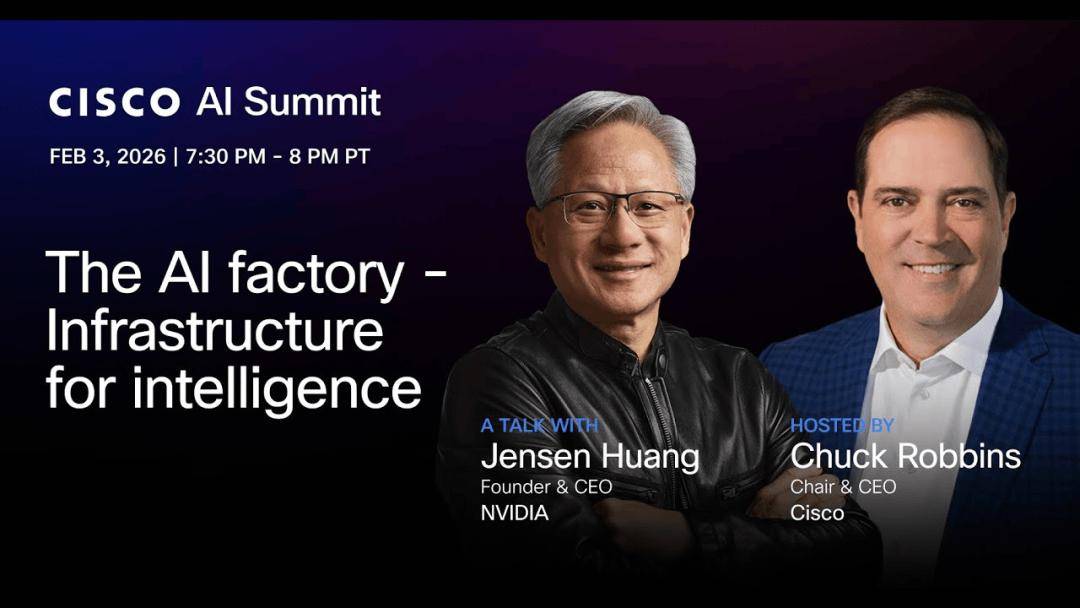
深度|黄仁勋对话Cisco CEO:未来十年算力将提升100万倍;写代码只是打字,领域知识才是你的“超级力量”
Z Potentials· 2026-02-15 03:06
Core Insights - The article discusses the transformation from explicit programming to implicit programming, emphasizing the need for companies to adapt to AI technologies and integrate them into their processes to enhance efficiency and innovation [6][10][19]. Group 1: Transition to Implicit Programming - Companies are moving from explicit programming, where specific instructions are given, to implicit programming, where the intent is communicated to the computer, allowing it to solve problems autonomously [6][10]. - AI advancements are expected to increase computational capabilities by a factor of one million over the next decade, compared to the traditional Moore's Law, which predicts a tenfold increase in the same period [6][25]. - Organizations should foster a culture of experimentation with AI, allowing employees to explore various models in a safe environment, as innovation often occurs outside of strict control [21][22]. Group 2: AI Integration and Enterprise Transformation - The concept of "AI in the loop" is introduced, suggesting that AI should be integrated into business processes to capture employee experiences and enhance company knowledge [49]. - Companies must identify their core competencies and focus on impactful work rather than getting bogged down by the initial ROI of new technologies [21][22]. - The collaboration between Cisco and NVIDIA aims to create a new computing stack that integrates AI capabilities while maintaining control, security, and manageability [19][20]. Group 3: The Future of AI and Business - The future of AI is seen as generative rather than retrieval-based, where software adapts to different contexts and user needs in real-time [33][39]. - The article highlights the importance of understanding the physical world and causal relationships in developing next-generation AI, termed "Physical AI" [42][43]. - Companies are encouraged to leverage their domain expertise and knowledge to effectively communicate their needs to AI systems, thus enhancing their competitive edge [44][45].
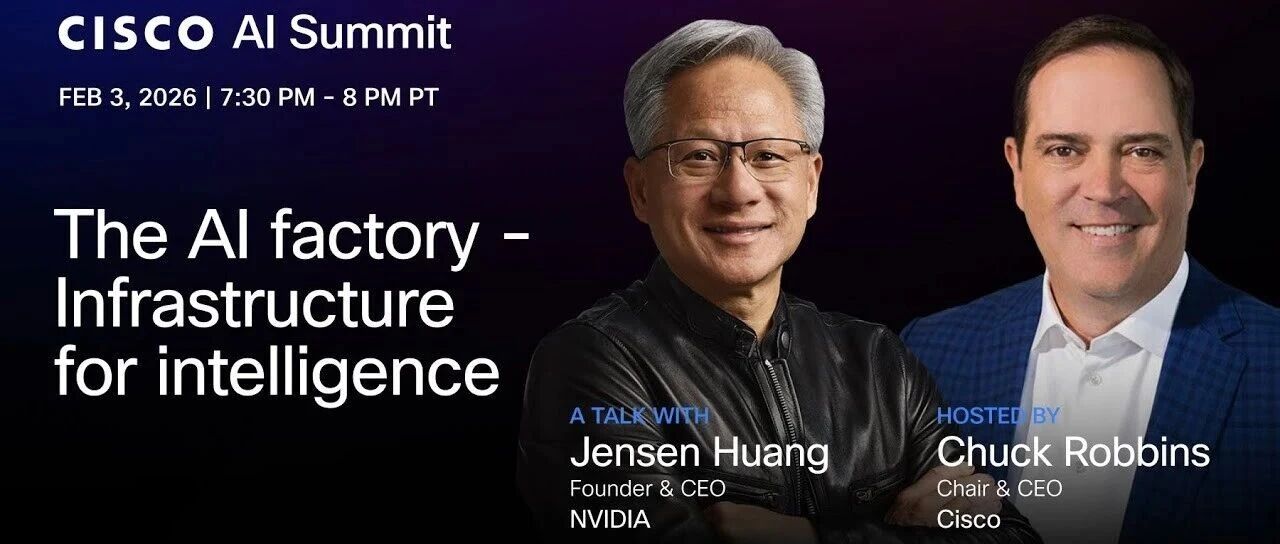
黄仁勋酒后一番暴论
投资界· 2026-02-07 07:31
Core Viewpoint - The conversation between NVIDIA CEO Jensen Huang and Cisco CEO Chuck Robbins emphasizes a fundamental reset in business logic driven by AI advancements, highlighting the need for companies to adapt to a rapidly evolving technological landscape [4][6][16]. Group 1: AI and Business Transformation - Huang argues that the first step for companies moving towards AI should not focus on ROI but rather on fostering an environment where innovation can flourish, allowing for a "let a thousand flowers bloom" approach [6][23][25]. - He emphasizes that traditional metrics like ROI are inadequate in the early stages of AI deployment, suggesting that companies should prioritize exploration and experimentation over strict control [6][23][25]. - Huang describes the concept of an "AI factory," which represents a shift from merely creating tools to generating digital labor, fundamentally transforming how businesses operate [9][10][35]. Group 2: The Nature of AI and Innovation - Huang highlights the transition from explicit programming to implicit programming, where users can communicate their intentions to AI, which will then generate solutions, thus lowering the barrier to entry for technological innovation [16][19][37]. - He asserts that the value of knowledge in industries is shifting, with domain experts who understand customer needs becoming more valuable than traditional programmers [16][37]. - The conversation underscores the importance of allowing teams to experiment with various AI tools without immediate expectations of success, fostering a culture of innovation [6][23][25]. Group 3: Market Opportunities and Future Directions - Huang points out that the global IT industry, valued at approximately $1 trillion, is dwarfed by the total global economy of $100 trillion, indicating a vast potential market for AI applications [10][35]. - He believes that every industry has the opportunity to transform into a technology-driven company by integrating AI, suggesting that companies like Disney and Mercedes aspire to become more like Netflix and Tesla, respectively [10][35]. - The discussion also touches on the need for companies to rethink their core challenges using AI logic, which involves assuming unlimited speed and zero gravity in problem-solving [11][27][28].
半夜11点、5杯酒下肚,黄仁勋“吐真言”:“写代码只是打字,已经不值钱了”
3 6 Ke· 2026-02-06 13:05
Core Insights - The conversation between NVIDIA CEO Jensen Huang and Cisco CEO Chuck Robbins highlighted the transformative impact of AI on computing, marking a significant shift in how technology is developed and utilized [3][6][25] - Huang emphasized that the future of computing is moving from explicit programming to implicit programming, where users express their intentions rather than writing detailed code [6][25] - The concept of "AI-in-the-loop" was introduced, suggesting that companies should integrate AI into their operations to enhance knowledge and efficiency, rather than relying solely on human intervention [36] Group 1: AI and Computing Transformation - Huang stated that we are experiencing the first true reinvention of computing in 60 years, transitioning from explicit to implicit programming [6][25] - The entire computing stack, including processing, storage, networking, and security, is being redefined in the context of AI [6][25] - Huang argued that the real value lies not in the answers provided by AI but in the questions that can be posed, emphasizing the importance of inquiry in the AI era [3][36] Group 2: Business Strategy and AI Implementation - Huang advised companies not to focus on immediate ROI when adopting AI, but rather to encourage experimentation and innovation within their organizations [17][18] - He suggested that businesses should identify their core impactful work and allow for a diverse range of AI projects to flourish, akin to a garden of innovation [17][19] - The notion of "letting a hundred flowers bloom" was presented as a strategy for fostering creativity and exploration in AI applications [17][19] Group 3: Future of Software Development - Huang posited that programming is becoming a less valuable skill as AI takes over code generation, allowing individuals to express their intentions in natural language [33][36] - The future of software will be context-based and generative, moving away from pre-recorded solutions to dynamic, user-specific applications [25][36] - Huang highlighted the opportunity for companies to leverage their domain expertise while allowing AI to handle the coding aspect, thus transforming their operational capabilities [33][36] Group 4: Market Opportunities and AI - Huang indicated that the potential market for AI-enhanced labor is significantly larger than the current IT industry, suggesting a transformative economic opportunity [31][32] - The shift towards a "technology-first" approach is essential for companies to thrive in the evolving landscape, where technology becomes a core competency [32] - Huang emphasized that every company has the chance to become a technology company by integrating AI into their operations, regardless of their traditional industry [32][33]
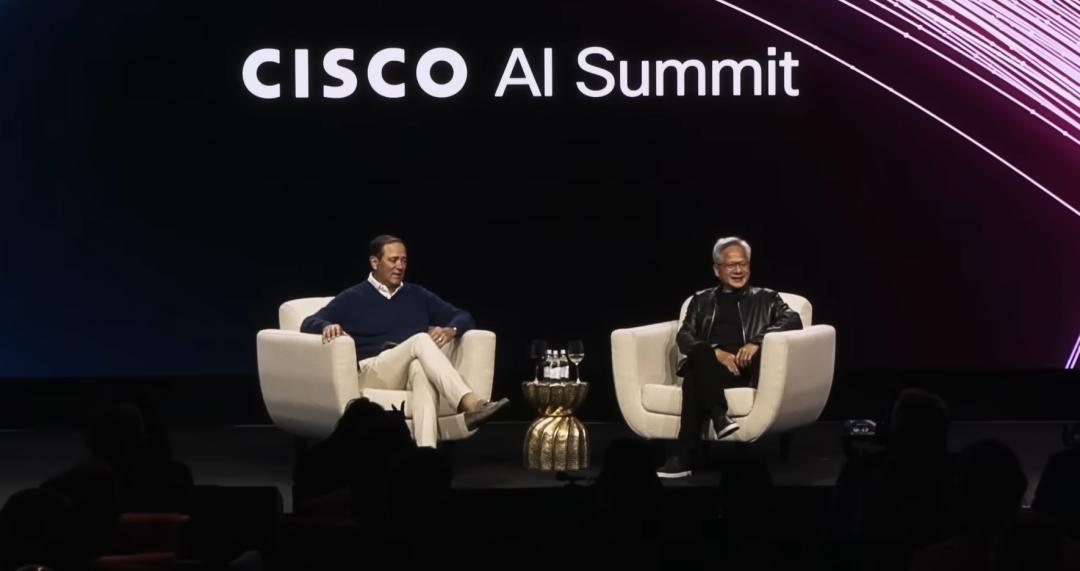
“英伟达 AI 项目数量已失控”,黄仁勋五杯酒下肚,把压箱底的都掏出来了
3 6 Ke· 2026-02-06 05:41
Core Insights - Jensen Huang, CEO of Nvidia, emphasized the transformative potential of AI in redefining industries and enhancing workforce capabilities rather than merely creating smarter software [2][39] - Huang noted that the number of AI projects within Nvidia has become "almost out of control," reflecting a culture of innovation where exploration is encouraged [2][16] - The conversation highlighted the importance of integrating AI into core business functions rather than peripheral tasks, urging companies to adopt AI quickly to avoid being left behind [2][15] Group 1 - Huang stated that programming is akin to typing, which has become a commoditized skill, and emphasized the need for companies to leverage AI to enhance their workforce [2][53] - He described the shift from explicit programming to implicit programming, where users express their intentions and the AI determines how to solve problems [8][24] - Huang warned that companies should not focus solely on ROI in the early stages of AI adoption, but rather on identifying their core impactful work [16][17] Group 2 - The dialogue underscored the necessity for companies to embrace AI as a means to revolutionize their operations, with Huang suggesting that every employee will eventually work alongside multiple AIs [2][58] - Huang highlighted the rapid advancements in AI capabilities, suggesting that the industry is on the brink of a significant transformation, with the potential for AI to create economic value far exceeding that of hardware [19][47] - The conversation also touched on the importance of understanding the underlying technology and the need for companies to build their own AI systems rather than relying solely on cloud solutions [56][57]
黄仁勋酒后暴论:编程只是打字,已经不值钱了
虎嗅APP· 2026-02-05 10:17
Core Viewpoint - Huang Renxun, CEO of Nvidia, expressed that programming is merely typing and has lost its value, emphasizing the need for innovation and adaptation in the face of rapid technological evolution [4][6][20]. Group 1: AI and Innovation - Huang advocates for a management approach that encourages experimentation and exploration within organizations, stating that innovation often occurs outside of strict control [6][7][40]. - He emphasizes the importance of allowing teams to experiment with various AI tools without the immediate pressure of ROI calculations, fostering a culture of "letting a thousand flowers bloom" [6][40]. - The concept of "AI factories" is introduced, where the focus shifts from merely creating tools to generating digital labor, fundamentally transforming industries [9][10][68]. Group 2: Market Potential - Huang highlighted the vast market potential for AI, noting that the global IT industry is approximately $1 trillion, while the total global economy is around $100 trillion, indicating a hundredfold opportunity for AI to penetrate and reshape the remaining sectors [10][11][68]. - He pointed out that every industry has the chance to transform into a technology-driven company, with examples like Disney aspiring to be like Netflix and Mercedes wanting to emulate Tesla [11][68]. Group 3: New Paradigms in Computing - Huang discussed the shift from explicit programming to implicit programming, where users can simply express their intentions and the AI will generate the necessary code, thus lowering the technical barrier [20][70]. - He described the transition from a "pre-recorded" era of software to a "generative" era, where applications will be contextually unique and dynamically generated based on user interactions [17][52]. Group 4: Data Sovereignty and Knowledge Ownership - Huang stressed the importance of data sovereignty and the need for companies to maintain control over their core intellectual property, which he believes lies in the questions posed during interactions with AI rather than the answers themselves [16][73]. - He argued that the most valuable intellectual property is the ability to ask the right questions, which reflects a company's strategic thinking and innovation potential [16][73]. Group 5: Future of Work and AI Integration - Huang predicted that future companies will have numerous AI assistants that learn from employee decisions and inquiries, ultimately becoming unique intellectual assets for the organization [16][73]. - He warned that companies must adapt quickly to AI technologies, as those who fail to do so risk being outpaced by competitors who embrace these advancements [68][73].

软件股大跌之际,黄仁勋驳斥“AI替代”论:这是世界上最不合逻辑的事
美股IPO· 2026-02-04 12:58
Core Viewpoint - Nvidia CEO Jensen Huang refuted the notion that AI will replace software tools, calling it "illogical" and emphasizing the importance of using existing tools rather than reinventing them [1][3][4] Group 1: AI and Software Industry Dynamics - Huang highlighted that the computing industry is undergoing a significant transformation, shifting from explicit programming to implicit programming, where users state goals and systems autonomously plan execution paths [4] - The recent launch of a legal automation tool by AI startup Anthropic triggered widespread panic selling in the software sector, leading to significant declines in major stock indices [3][5] - The iShares Expanded Tech-Software Sector ETF experienced a drop of 5.6%, marking a six-day losing streak with a cumulative decline of over 14% [5] Group 2: Market Reactions and Implications - Major software companies, including Microsoft, faced scrutiny despite solid quarterly earnings, as investors focused on slowing cloud business growth and the return on AI capital expenditures [6] - The overall market sentiment has shifted from concerns about individual AI tools to a systemic reassessment of the software industry's business models, with only 67% of S&P 500 software companies exceeding revenue expectations during the earnings season [6] - Analysts have downgraded several software companies, citing concerns over seat compression and the narrative of "ambient coding" potentially capping industry valuation multiples [6]
软件股大跌之际,黄仁勋驳斥“AI替代”论:这是世界上最不合逻辑的事
Hua Er Jie Jian Wen· 2026-02-04 11:47
Core Viewpoint - The CEO of Nvidia, Jensen Huang, refuted the notion that AI will replace software tools, calling it "extremely illogical" and emphasizing that both humans and AI will continue to use existing tools rather than reinvent them [1][2]. Group 1: Market Reaction - The launch of a new automation tool by AI startup Anthropic triggered widespread concerns about the software industry's future, leading to a global sell-off in software stocks [1][3]. - The iShares Expanded Tech-Software Sector ETF fell by 5.6%, marking a six-day losing streak with a cumulative drop of over 14% [3]. - The S&P North American Software Index experienced a 15% decline in January, the largest monthly drop since October 2008 [3]. Group 2: Corporate Performance - Microsoft, despite reporting solid quarterly earnings, faced scrutiny over slowing growth in its cloud business, resulting in a 10% drop in its stock price on a single day [4]. - Only 67% of S&P 500 software companies that reported earnings exceeded revenue expectations, significantly lower than the overall tech sector's 83% [4]. - Investment firm Piper Sandler downgraded several software companies, citing concerns over "seat compression" and the narrative of "ambient coding" potentially capping industry valuation multiples [4]. Group 3: Strategic Insights - Huang suggested that companies should focus on identifying their most impactful workflows and deploy AI there, advocating for a strategy of broad experimentation [2]. - He compared enterprise software to tools like screwdrivers and hammers, asserting that even advanced AI systems should focus on using tools rather than reinventing them [2].