记忆与个性化能力

Search documents
2026全球AI竞速!科技主线关键仍看基座模型持续迭代及AI应用的渐进落地!
Sou Hu Cai Jing· 2025-12-27 06:43
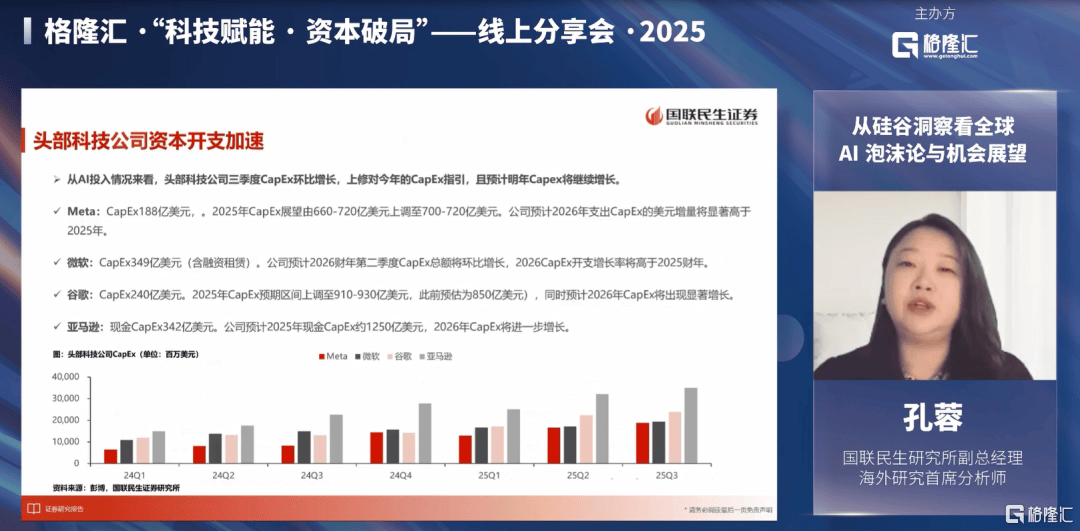
Core Insights - The discussion at the "Technology Empowerment · Capital Breakthrough" event highlighted the ongoing trends in global AI development, key technological advancements, and market opportunities, with a positive outlook for AI beyond 2026 despite current market skepticism regarding potential bubbles and sustainability of capital expenditures [1][3]. Group 1: AI Market Dynamics - The AI competition is expected to intensify in 2024, with significant discussions around whether there is a bubble in AI investments and the sustainability of capital expenditures for 2025-2027 [1][6]. - Major companies like Google, Meta, Microsoft, and xAI are anticipated to accelerate the release of new models, leading to heightened competition in the industry [6][21]. Group 2: Key Technological Advancements - The enhancement of multimodal capabilities is crucial for AI's evolution, impacting content creation across various dimensions and transforming advertising and e-commerce efficiency [8][10]. - Breakthroughs in memory and personalization capabilities will enable AI to transition from general tools to personalized assistants, increasing user engagement and driving commercial viability [15][16]. Group 3: Investment Opportunities in China - China's AI ecosystem is recognized for its strong competitive edge, with domestic models gaining international acclaim and major tech companies committing to sustained AI investments [29][30]. - The valuation of Chinese AI companies is currently more reasonable compared to their U.S. counterparts, providing a favorable investment landscape [31][32].



2026全球AI竞速!科技主线关键仍看基座模型持续迭代及AI应用的渐进落地!
格隆汇APP· 2025-12-27 06:10
Core Viewpoint - The article discusses the optimistic outlook for AI development beyond 2026, despite current market concerns about potential bubbles and sustainability of capital expenditures [2][6]. Group 1: AI Market Trends - There is ongoing debate in the market regarding whether AI is in a bubble and the sustainability of capital expenditures for 2025-2027 [3][4]. - Major tech companies are expected to shift focus from "infrastructure" to "application realization," with key observations on revenue growth from Google Cloud Platform (GCP), Microsoft Azure, and Amazon AWS [11]. - The release pace of large models is anticipated to accelerate, with major players like OpenAI, xAI, Meta, Microsoft, and Google continuing to launch new models, intensifying industry competition [12][28]. Group 2: Key Players and Innovations - Google has demonstrated strong capabilities with its self-developed technology and resources, maintaining a competitive edge [8]. - Meta is expected to regain market confidence by 2026 after restructuring and integrating top AI talent, aiming to launch competitive models [8]. - Microsoft is focusing on its own models while maintaining collaboration with OpenAI, looking for synergies between its large models and ecosystem [9]. - xAI, despite being a latecomer, is rapidly iterating its models and is considered a significant variable in the market [10]. Group 3: Model Capabilities and Applications - The enhancement of multi-modal capabilities is crucial for transforming content production in advertising and e-commerce, as well as improving user experiences with hardware like AR/VR devices [15][18]. - Breakthroughs in memory and personalization capabilities will allow AI to evolve from general tools to personalized assistants, increasing user engagement and driving token consumption [23][24]. - The overall improvement in model capabilities is fundamental for the commercialization of AI, leading to clearer paths for investment returns [25][26]. Group 4: China's AI Ecosystem - China's AI ecosystem is recognized for its strong competitive advantages, with domestic models gaining international acknowledgment [40]. - Major Chinese tech firms like Alibaba and Tencent are committed to ongoing investments in AI, indicating a long-term strategy [40]. - The country boasts the largest pool of engineers and a rapid product iteration culture, which is expected to replicate the "application innovation" seen in the mobile internet era, creating numerous investment opportunities [40][41]. - Current valuations of Chinese AI companies are considered reasonable compared to their U.S. counterparts, providing a favorable investment margin [41].