
多模态能力

Search documents
新华财经早报:2月15日
Xin Hua Cai Jing· 2026-02-15 00:46
Financial Support Mechanisms - The People's Bank of China, along with other regulatory bodies, has issued opinions to establish a regular financial support mechanism aimed at preventing poverty and promoting rural revitalization, focusing on developing long-term financial assistance for key populations [1][1][1] - The opinions include optimizing microcredit for impoverished populations and enhancing small credit loan policies for farmers to support those at risk of falling back into poverty [1][1][1] Market Regulation - The State Administration for Market Regulation has interviewed seven platform companies, including Alibaba and Tencent, to ensure compliance with various laws and to eliminate "involution" competition, promoting a fair market environment [1][1][1] - Companies are reminded to adhere to laws such as the Anti-Unfair Competition Law and the Consumer Rights Protection Law [1][1][1] Industry Upgrades - The Ministry of Industry and Information Technology has released guidelines for the liquor industry, aiming for the establishment of over three trillion-yuan traditional liquor production areas and more than ten hundred-billion-yuan specialty liquor parks by 2028 [1][1][1] - Similar guidelines for the tea industry target the cultivation of over five tea industry clusters with annual revenues exceeding 10 billion yuan by 2028, with the entire industry chain expected to reach a scale of 1.5 trillion yuan by 2030 [1][1][1] Tax Policies - A joint notice from the Ministry of Finance and other departments has introduced tax exemptions for seed imports and military working dogs from January 1, 2026, to December 31, 2030, to enhance agricultural quality and competitiveness [1][1][1] IPO Developments - Manycore Tech Inc. has received approval for its overseas IPO, marking a significant step for the company and positioning it to potentially become the first listed company among the "Hangzhou Six Dragons" [1][1][1] Urban Development - Beijing's housing authority has announced the first batch of urban renewal projects for 2026, totaling 1,321 projects with planned investments of 1,049.5 billion yuan [1][1][1]
豆包大模型2.0重磅登场:多场景适配能力升级,成本降低助力复杂任务新突破
Sou Hu Cai Jing· 2026-02-14 14:33
Core Insights - ByteDance's Doubao model has officially launched version 2.0, marking a significant step towards real-world application of its technology capabilities [1] - The update focuses on three main areas: multimodal understanding, long-range task execution, and improved development efficiency [1] Multimodal Capabilities - Doubao 2.0 has achieved comprehensive breakthroughs in multimodal capabilities, excelling in visual reasoning, spatial perception, and dynamic scene understanding [3] - The model demonstrates significant advantages in processing time-series data, surpassing similar models in TVBench evaluations and even exceeding human average levels in EgoTempo benchmark tests [3] - It supports real-time Q&A and environmental perception for long video scenarios, enabling proactive service such as fitness guidance and outfit suggestions [3] Complex Task Handling - The new version features a differentiated model system, with the flagship Doubao 2.0 Pro optimizing the reasoning engine, scoring higher than GPT 5.2 in SuperGPQA knowledge tests and topping HealthBench medical benchmarks [3] - The model has won gold medals in prestigious evaluations like the IMO math Olympiad and ICPC programming competition, with a 40% improvement in tool invocation accuracy compared to its predecessor [3] - The Lite version reduces reasoning costs to one-tenth of the industry average while maintaining superior performance over version 1.8, making it suitable for large-scale deployments [3] - The Mini version is optimized for low-latency demands, capable of processing thousands of concurrent requests per second [3] Development Efficiency - Doubao 2.0 Code has been deeply integrated with the TRAE development platform, enhancing codebase parsing capabilities and enabling automatic project architecture recognition [4] - In the "TRAE Spring Festival Town" interactive project, developers completed complex scene setups in just five prompts, achieving an 80% efficiency improvement over traditional development processes [4] - The built-in error correction mechanism can detect logical flaws in real-time, reducing debugging time by 65% within the Agent workflow [4] Technical Architecture - Doubao 2.0 employs knowledge distillation and reinforcement learning techniques, increasing real-world data coverage to 92% [6] - Its innovative dynamic attention mechanism automatically adjusts resource allocation, maintaining contextual coherence when processing long texts [6] - The Volcano Engine has opened API services, allowing enterprise developers to flexibly utilize different model capabilities for full-scene deployment from mobile to cloud services [6] - Internal tests indicate a 35% improvement in task completion rates in vertical fields such as logistics path planning and financial risk control compared to previous versions [6]

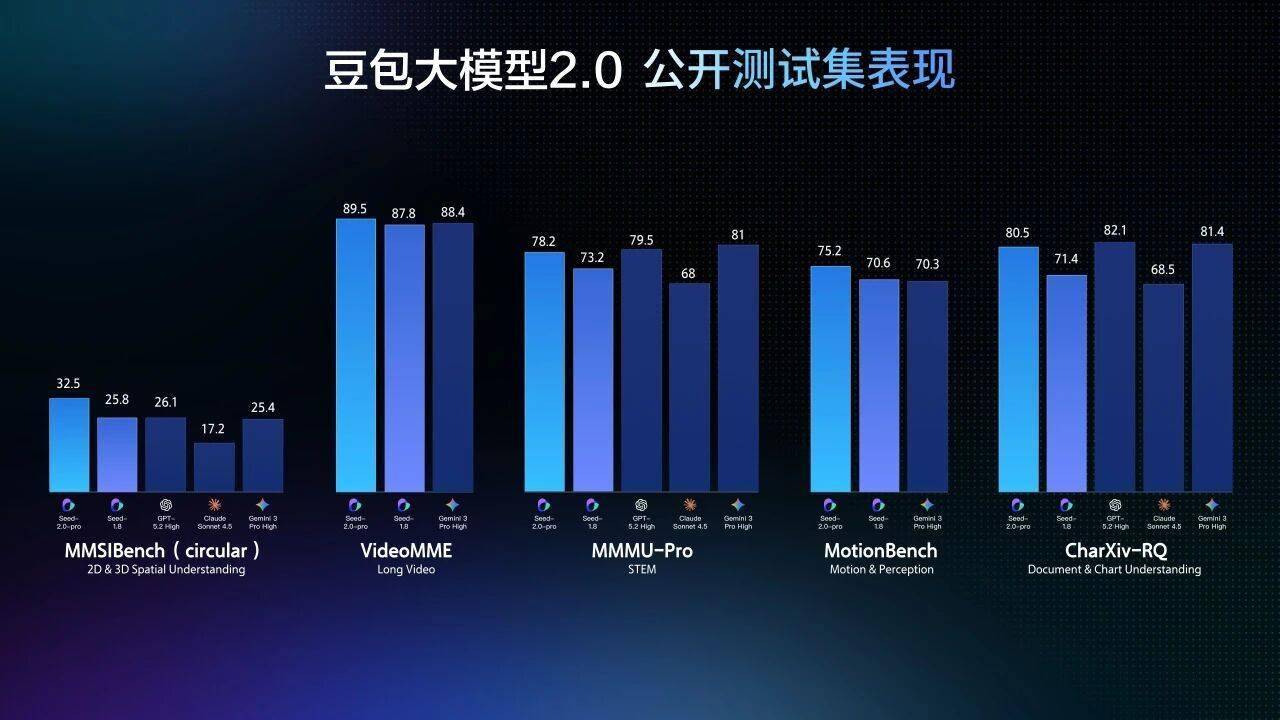
字节豆包2.0发布:推理成本降一个数量级,正面对标GPT-5和Gemini 3
硬AI· 2026-02-14 11:37
Core Viewpoint - ByteDance's Doubao 2.0 has officially entered a new phase, launching a systematic upgrade version aimed at the Agent era, significantly reducing reasoning costs while maintaining performance comparable to GPT-5.2 and Gemini 3 Pro [3][12]. Group 1: Model Features - Doubao 2.0 includes three models: Pro, Lite, and Mini, along with a specialized Code model, with the flagship Doubao 2.0 Pro directly competing with GPT-5.2 and Gemini 3 Pro [3]. - The model has achieved top-tier performance in visual understanding benchmarks and has won gold medals in mathematics and programming competitions [3][10]. - Doubao 2.0 has enhanced multimodal capabilities, excelling in visual reasoning, perception, spatial reasoning, and long-context understanding tasks [6]. Group 2: Cost Efficiency - The reasoning cost of Doubao 2.0 has been reduced by approximately an order of magnitude, which is crucial for large-scale reasoning and long-chain generation scenarios [4][12]. - This cost advantage is expected to become a key competitive edge in the commercial application of large models [4]. Group 3: Performance Metrics - Doubao 2.0 Pro outperformed GPT-5.2 in the SuperGPQA benchmark and ranked first in HealthBench, demonstrating strong performance in scientific fields [10]. - The model achieved a score of 54.2 in the HLE-text evaluation and excelled in tool invocation and instruction-following tests [10]. Group 4: Application and Integration - Doubao 2.0 Pro has been integrated into the Doubao App, desktop, and web versions, featuring an "Expert" mode for end-users [17]. - The Code model has been optimized for programming scenarios, enhancing code library interpretation and application generation capabilities, and is now available in the TRAE product [15][17]. - An intelligent customer service agent has been built on the Doubao 2.0 Pro model, capable of handling customer interactions and proactively seeking human assistance when needed [13].

豆包再扔王炸!2.0发布:推理成本降一个数量级,正面对标GPT-5和Gemini 3
华尔街见闻· 2026-02-14 10:53
Core Viewpoint - ByteDance's Doubao model has officially entered the 2.0 phase, offering a systematic upgrade that maintains performance comparable to GPT-5.2 and Gemini 3 Pro while reducing reasoning costs by approximately an order of magnitude, providing a competitive solution for complex tasks in large-scale production environments [2][12]. Group 1: Model Features and Performance - The Doubao 2.0 series includes Pro, Lite, Mini general-purpose agent models, and a specialized Code model, with the flagship Doubao 2.0 Pro achieving top scores in visual understanding benchmarks and winning gold medals in math Olympiads (IMO, CMO) and programming competitions (ICPC) [2][9]. - Doubao 2.0 has significantly upgraded its multimodal capabilities, excelling in tasks such as visual reasoning, perception, spatial reasoning, and long-context understanding [2]. - In dynamic scene understanding, Doubao 2.0 leads in key assessments like TVBench and surpasses human scores in EgoTempo, demonstrating stable capture of changes, actions, and rhythms [4]. - In long video scenarios, Doubao 2.0 outperforms other top models in most evaluations and excels in real-time Q&A video benchmark tests [5]. Group 2: Cost Efficiency and Application - Doubao 2.0 Pro has enhanced long-tail domain knowledge, scoring higher than GPT-5.2 on SuperGPQA and ranking first on HealthBench, with overall performance comparable to Gemini 3 Pro and GPT-5.2 in scientific fields [8]. - The model achieved a top score of 54.2 on HLE-text (Human Last Exam) and demonstrated excellent performance in tool invocation and instruction-following tests [10]. - The significant cost advantage of Doubao 2.0, with token pricing reduced by about an order of magnitude, will be crucial in large-scale reasoning and long-chain generation scenarios [12]. Group 3: Development and Integration - ByteDance has built an intelligent customer service agent on Feishu based on the OpenClaw framework and Doubao 2.0 Pro model, capable of handling customer dialogues and proactively seeking human assistance when faced with challenges [13][14]. - The Doubao 2.0 Code model is optimized for programming scenarios, enhancing code library interpretation and application generation capabilities, and has been integrated into the TRAE product [15][16]. - Developers using TRAE with Doubao 2.0 Code can create interactive projects with minimal prompts, showcasing the model's efficiency in project development [16][17]. - Doubao 2.0 Pro is now available to end-users on the Doubao App, desktop, and web versions, while API services for enterprises and developers have been launched on the Volcano Engine [18].

字节豆包2.0发布:推理成本降一个数量级,正面对标GPT-5和Gemini 3
Hua Er Jie Jian Wen· 2026-02-14 09:29
Core Insights - ByteDance's Doubao model has officially entered its 2.0 phase, offering a systematic upgrade that maintains performance comparable to GPT-5.2 and Gemini 3 Pro while reducing reasoning costs by approximately an order of magnitude, making it a competitive solution for complex tasks in large-scale production environments [1][7] Model Features - The Doubao 2.0 series includes three general-purpose agent models (Pro, Lite, Mini) and a specialized Code model, with the flagship Doubao 2.0 Pro achieving top scores in visual understanding benchmarks and winning gold medals in mathematics and programming competitions [1][5] - Doubao 2.0 has significantly upgraded its multimodal capabilities, excelling in visual reasoning, perception, spatial reasoning, and long-context understanding tasks [2] Performance Metrics - In dynamic scene understanding, Doubao 2.0 leads in key assessments like TVBench and surpasses human scores in EgoTempo, demonstrating stable capture of information related to changes, actions, and rhythms [4] - The model outperforms other leading models in long video scenarios and excels in real-time video question-answering benchmarks, enabling it to function as an AI assistant for real-time video stream analysis and proactive guidance [4] Cost Efficiency - Doubao 2.0 Pro has surpassed GPT-5.2 in SuperGPQA and achieved first place in HealthBench, with overall performance in scientific fields comparable to Gemini 3 Pro and GPT-5.2 [5] - The model's token pricing has been reduced by approximately an order of magnitude, enhancing its competitive edge in large-scale reasoning and long-chain generation scenarios [7] Application and Integration - The Doubao 2.0 Code model has been optimized for programming scenarios, improving code library interpretation and application generation capabilities, and is integrated into the TRAE product [8] - Developers can create interactive projects with minimal prompts, showcasing the model's efficiency in generating complex applications [8] - Doubao 2.0 Pro is now available to end-users through the Doubao App and web platforms, while API services for enterprises and developers have been launched via Volcano Engine [8]
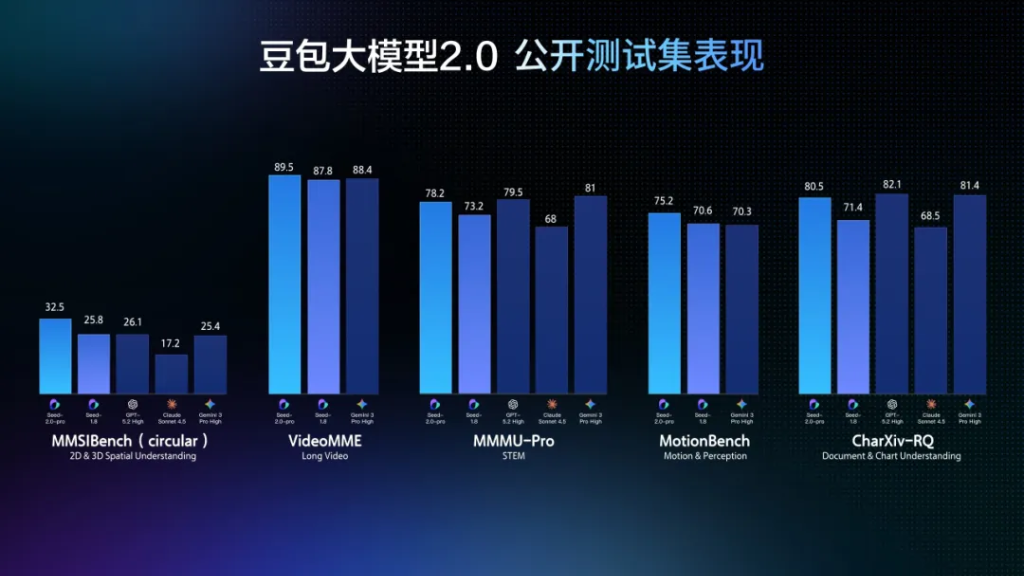
“发展速度太快了”,马斯克点赞Seedance 2.0,字节称“还远不完美”
3 6 Ke· 2026-02-13 01:54
Core Insights - ByteDance's video model Seedance 2.0 has gained significant traction overseas, with Elon Musk commenting on its rapid development, indicating a growing market interest in video generation capabilities [1][7] - The model has been fully integrated into Doubao and Jimeng, and is now available for enterprise trial, showcasing its multi-modal input and long narrative capabilities aimed at professional production scenarios [1][5] Group 1: Product Launch and Features - Seedance 2.0 has officially launched and is now integrated with Doubao and Jimeng products, along with the Volcano Ark experience center for user trials [5][8] - The model emphasizes original sound and image synchronization, multi-camera long narratives, and controllable multi-modal generation, targeting a broader range of creators and commercial content scenarios [5][8] - Key features include support for mixed inputs of text, images, audio, and video, original sound synchronization, multi-track audio output, and enhanced video editing capabilities [10] Group 2: Market Reception and Future Developments - The model's rapid adoption and high exposure have heightened expectations for competition in the video generation sector, with a focus on the pace of product iteration and market response [6][8] - ByteDance acknowledges that Seedance 2.0 is not yet perfect, with areas for improvement including detail stability, multi-character matching, and complex editing effects [9] - Upcoming upgrades for Doubao's large model and Seedance 2.0 are scheduled for February 14, 2026, which will significantly enhance foundational model capabilities and enterprise-level agent functionalities [14]
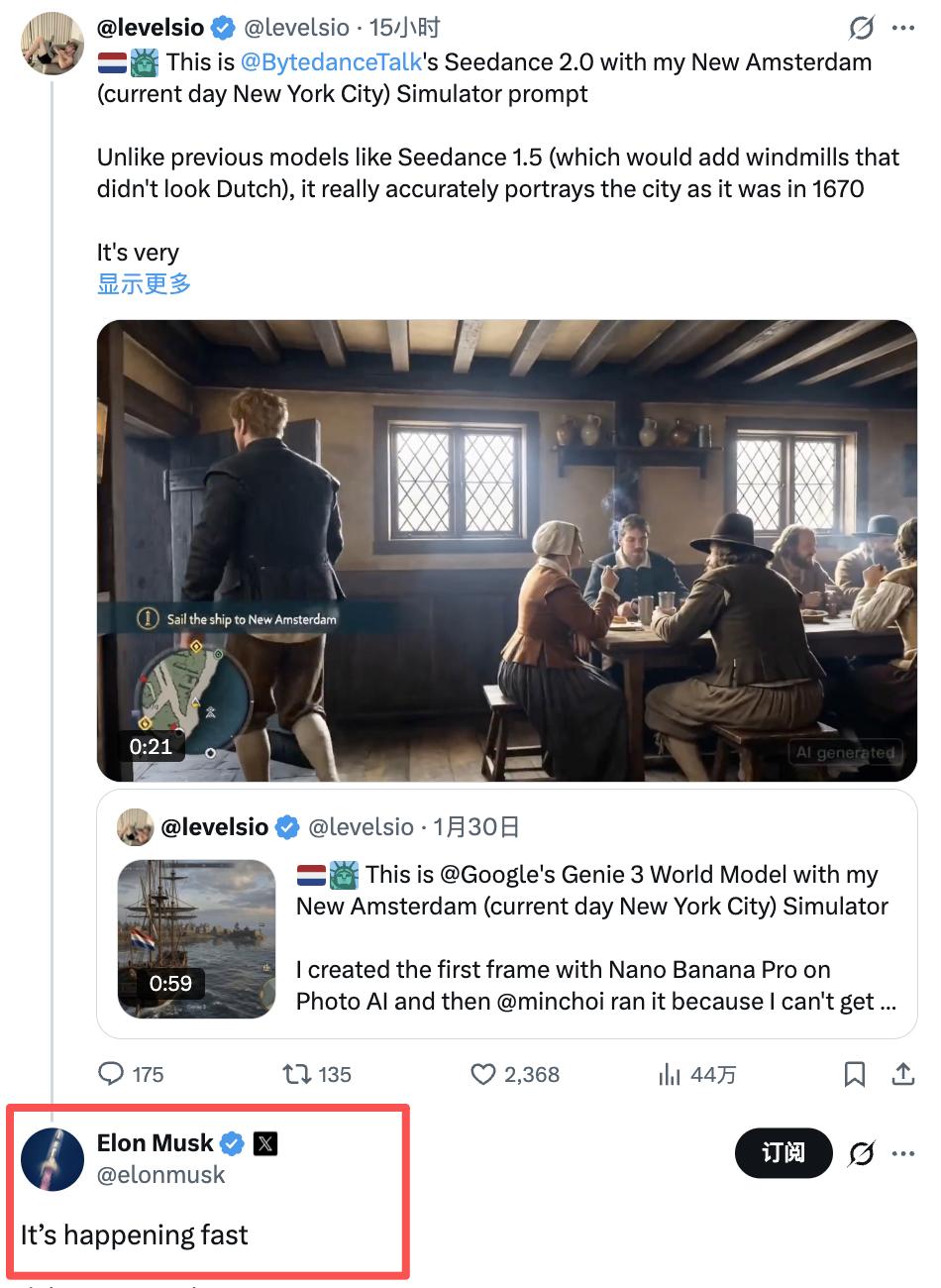
“发展速度太快了”!马斯克点赞Seedance 2.0,字节称“还远不完美”
硬AI· 2026-02-12 15:44
Core Viewpoint - ByteDance's video model Seedance 2.0 has gained significant popularity overseas, with Elon Musk commenting on its rapid development, indicating a growing market interest in video generation capabilities [2][3][10]. Group 1: Product Launch and Features - Seedance 2.0 has been officially released and is fully integrated with Doubao and Jimeng products, along with the launch of the Huoshan Ark experience center for user trials [7][12]. - The model emphasizes capabilities such as original audio-visual synchronization, multi-camera long narrative, and multi-modal controllable generation, targeting a broader range of creators and commercial content scenarios [7][15]. - Key features include: 1. Multi-modal input supporting text, images, audio, and video, allowing for mixed input of composition, actions, camera movements, effects, and sounds [16]. 2. Original audio-visual synchronization with multi-track output, supporting background music, sound effects, or character narration, aligned with visual rhythm [17]. 3. Multi-camera long narrative capabilities that automatically parse narrative logic, generating shot sequences while maintaining character, lighting, style, and atmosphere consistency [17]. 4. Enhanced video editing and extension capabilities, reinforcing "director-level control" workflow attributes [18]. Group 2: Limitations and Future Developments - Despite its leading industry performance, ByteDance acknowledges that Seedance 2.0 is "far from perfect," with areas for improvement including detail stability, multi-character matching, multi-subject consistency, text restoration accuracy, and complex editing effects [20]. - Compliance and usage boundaries have become clearer, with restrictions on using real human images or videos as reference subjects unless verified or authorized, impacting certain commercial material production and deployment [23]. - The upcoming release of Doubao model upgrades on February 14, 2026, will include significant enhancements to the foundational model capabilities and enterprise-level agent capabilities [25].

“发展速度太快了”!马斯克点赞Seedance 2.0,字节:还远不完美
Sou Hu Cai Jing· 2026-02-12 11:52
Core Insights - The generative video model Seedance 2.0 from ByteDance is rapidly gaining popularity in overseas markets, with notable attention from Elon Musk, who commented on its fast development on social media [1][7]. Group 1: Product Launch and Features - ByteDance has officially launched Seedance 2.0, integrating it with Doubao and Jimeng products, and has opened the Huoshan Ark experience center for user trials [5][8]. - The model emphasizes capabilities such as original sound and image synchronization, multi-camera long narratives, and multi-modal controllable generation, targeting a broader range of creators and commercial content scenarios [5][8]. - Key features include: 1. Multi-modal input supporting text, images, audio, and video, allowing for mixed input of composition, actions, camera movements, effects, and sounds [8]. 2. Original sound and image synchronization with multi-track output for background music, sound effects, or voiceovers, ensuring alignment with visual rhythm [9]. 3. Multi-camera long narratives with automatic narrative logic parsing, generating shot sequences while maintaining character, lighting, style, and atmosphere consistency [10]. 4. Enhanced video editing and extension capabilities, reinforcing a "director-level control" workflow [11]. Group 2: Market Reception and Future Developments - The high exposure and rapid productization of Seedance 2.0 have intensified expectations for competition in the video generation sector [6]. - Musk's endorsement has broadened the model's visibility beyond the tech community to a wider audience interested in technology investments and products [7]. - ByteDance acknowledges that Seedance 2.0 is "far from perfect," with ongoing optimization needed in areas such as detail stability, multi-character matching, and complex editing effects [12]. - Compliance and usage boundaries are becoming clearer, with restrictions on using real human images or videos as reference subjects unless verified or authorized [15]. - A significant upgrade for the Doubao model and related generative models is scheduled for February 14, 2026, promising substantial enhancements in foundational model capabilities and enterprise-level agent functionalities [15].
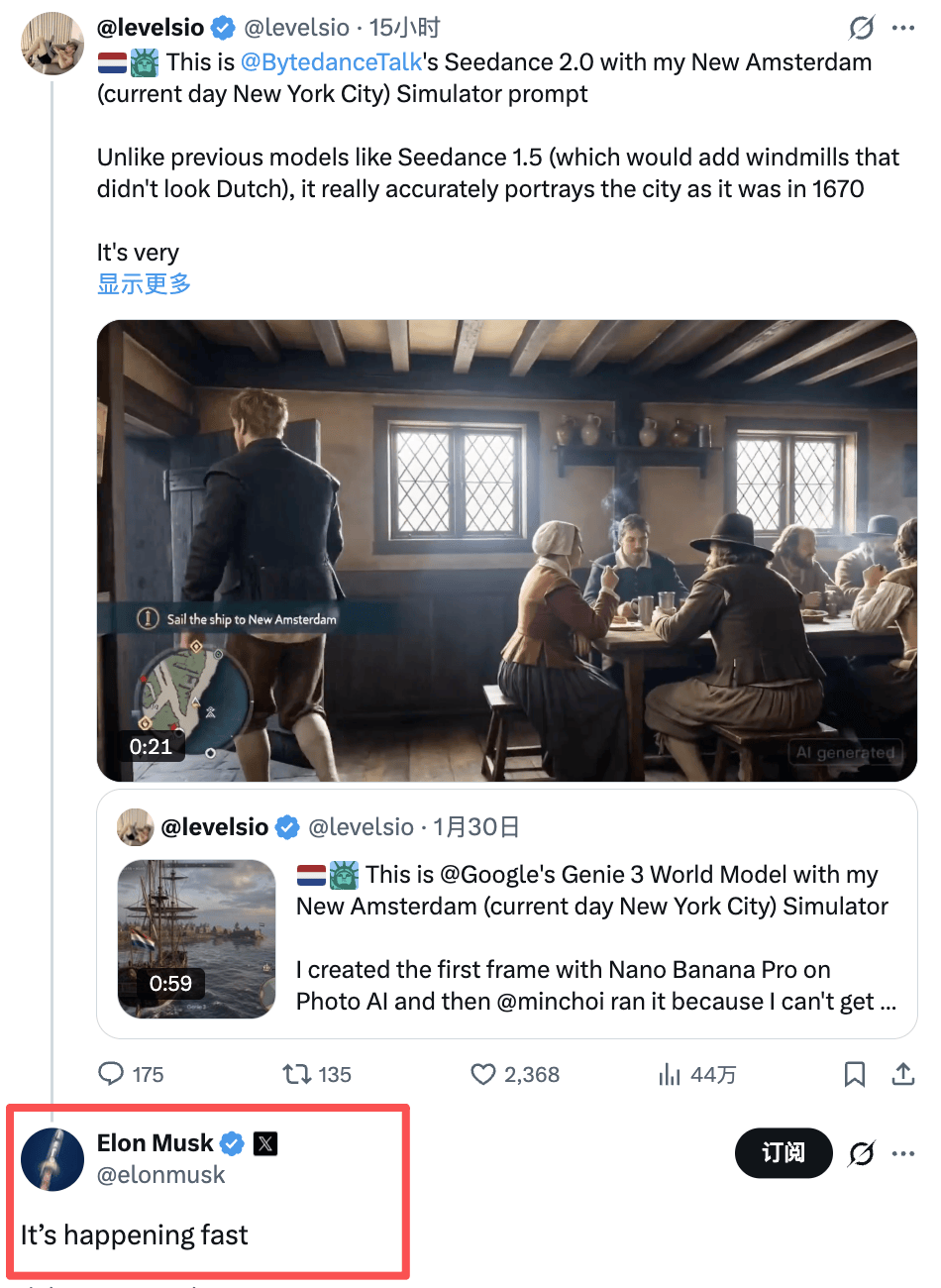
“发展速度太快了”!马斯克点赞Seedance 2.0,字节:还远不完美
华尔街见闻· 2026-02-12 09:55
Core Viewpoint - The rapid advancement and commercialization of generative video models, particularly ByteDance's Seedance 2.0, is capturing significant market attention, especially following Elon Musk's endorsement on social media [1][8]. Product Launch and Features - ByteDance has officially launched Seedance 2.0, integrating it with Doubao and Jimeng products, and has opened the Huoshan Ark experience center for user trials [4][9]. - The model emphasizes capabilities such as original sound and image synchronization, multi-camera long narratives, and multi-modal controllable generation, targeting a broader range of creators and commercial content scenarios [4][10][16]. - Seedance 2.0 supports multi-modal input, including text, images, audio, and video, allowing for a mix of various elements like composition, actions, and effects [10]. - It features original sound and image synchronization with multi-track audio output, ensuring alignment with visual rhythm [11]. - The model can automatically parse narrative logic for multi-camera long storytelling while maintaining consistency in characters, lighting, style, and atmosphere [12]. - New video editing and extension capabilities enhance the workflow for professional-level control [13]. - ByteDance claims that Seedance 2.0 effectively addresses challenges related to physical law adherence and long-term consistency, achieving industry-leading performance in motion scene generation [14]. Limitations and Future Development - Despite its advancements, ByteDance acknowledges that Seedance 2.0 is "far from perfect," with areas for improvement including detail stability, multi-character matching, and complex editing effects [5][15]. - The company is committed to exploring deeper alignment between large models and human feedback [5]. Market Impact and Expectations - The combination of high exposure, rapid productization, and continuous iteration strengthens expectations for accelerated competition in the video generation sector [6]. - Musk's comments have broadened the model's visibility beyond the tech community, potentially influencing valuation expectations across related industries [8]. Compliance and Usage Boundaries - ByteDance has clarified compliance measures, stating that Seedance 2.0 restricts the use of real human images or videos as reference subjects without proper verification or authorization [19]. Upcoming Developments - ByteDance plans to release significant upgrades for Doubao's large model series, including Seedance 2.0, on February 14, 2026, with expectations for substantial improvements in foundational model capabilities and enterprise-level agent functionalities [21].

月之暗面Kimi发布新模型,付费模式更新
Bei Ke Cai Jing· 2026-01-27 11:16
Core Insights - Kimi has released and open-sourced the Kimi K2.5 model, which is described as the most intelligent and versatile model to date [1] - The K2.5 model features breakthroughs in multi-modal capabilities, supporting both visual and text inputs, as well as various operational modes [1] - The model has evolved from a single agent to an agent cluster, capable of dispatching up to 100 avatars to handle tasks concurrently [1] Summary by Sections Model Features - Kimi K2.5 utilizes a native multi-modal architecture, allowing for interaction through visual and text inputs, and supports both thinking and non-thinking modes [1] - The model enhances front-end development by generating complete front-end interfaces from simple natural language dialogues and can analyze user-uploaded screen recordings to recreate interaction logic with code [1] Operational Modes - Kimi K2.5 has introduced four distinct operational modes: - K2.5 Quick for rapid responses - K2.5 Thinking for multi-round search and complex question answering - K2.5 Agent for interpreting various document types - K2.5 Agent Cluster for extensive searches, long-form writing, and batch processing [2] Commercialization and Membership - The update includes changes to Kimi's membership benefits, clarifying its commercialization model. Free users receive limited access to deep research and other services, while paid members can enjoy varying levels of service based on their subscription [2]