诈骗犯罪

Search documents
最高法:侵犯财产犯罪总量下降,但新型犯罪挑战凸显
Xin Lang Cai Jing· 2026-02-27 03:58
Core Viewpoint - The Supreme People's Court is currently drafting opinions on the handling of extortion criminal cases and is seeking feedback on opinions regarding fraud criminal cases, aiming to enhance the legal framework for addressing property crimes in China [1][4]. Group 1: Trends in Property Crimes - From 2021 to 2025, the number of newly accepted first-instance property crime cases reached 1.273 million, with 1.271 million cases concluded, indicating a strong effort to combat such crimes [1]. - The total number of property crime cases has shown a downward trend, with a notable decrease from 322,000 cases in 2016 to 270,000 cases in 2025 [1]. - The number of property crime cases fluctuated during the pandemic, with a peak of 279,000 cases in 2021, dropping to 202,000 in 2022, and then rising again to 283,000 in 2024 before falling to 270,000 in 2025 [1]. Group 2: Challenges in Legal Application - The complexity of legal application in property crimes has increased, particularly with the rise of new types of crimes influenced by rapid economic and technological developments [2]. - The Supreme People's Court established a research team in 2025 to address legal application issues related to property crimes, focusing on various types of fraud and theft [2]. Group 3: Fraud Crime Characteristics - Fraud crimes have consistently ranked among the top five newly accepted criminal cases, with the number of new fraud cases rising from 52,000 in 2022 to 94,000 in 2024, marking an increase of 81.2% over five years [3]. - The methods of fraud have become increasingly diverse and intelligent, with new technologies being employed to enhance the effectiveness of scams [3]. Group 4: Legal Framework for Fraud Cases - The Supreme People's Court is drafting opinions on handling fraud criminal cases to guide courts in accurately applying criminal policies and distinguishing between civil fraud and criminal offenses [4]. Group 5: Growth of Concealment Crimes - From 2021 to 2025, the number of cases related to concealing and hiding criminal proceeds reached 286,000, reflecting a trend towards more organized and industrialized methods of crime [6]. - The structure of upstream crimes has shifted from theft to fraud, particularly in telecommunications and online scams [6].
最高法:前沿科技被滥用 诈骗犯罪呈现智能化多样化新特征
Ke Ji Ri Bao· 2026-02-26 07:37
Core Insights - The improper application of technology is a significant driver of the escalation in fraud crimes, with increasingly diverse and intelligent methods being employed [1][2] - The Supreme People's Court has established a specialized research team to address the legal application of property infringement crimes, focusing on new trends and characteristics in fraud [1] Group 1: Fraud Crime Trends - Fraud methods have become more diverse and intelligent, with traditional scams like false investment and sales still prevalent, while new techniques utilizing emerging technologies are on the rise [1] - The use of advanced technologies such as AI face-swapping and deep forgery in fraud scenarios is becoming more common, leading to higher concealment and success rates for criminals [1] Group 2: Legal and Judicial Response - From 2021 to 2025, the courts received 1.273 million new first-instance property infringement cases and concluded 1.271 million, effectively combating the high incidence of such crimes [2] - The number of property infringement cases showed a trend of sharp decline during the pandemic, followed by a rebound and gradual decrease, with cases dropping from 322,000 in 2016 to 270,000 in 2025 [2] - Continuous efforts in prevention and governance of property infringement crimes are expected to enhance public safety and reinforce China's status as one of the safest countries [2]
最高法:诈骗犯罪智能化特征明显,AI换脸被应用于诈骗场景
Nan Fang Du Shi Bao· 2026-02-26 03:25
Core Viewpoint - The Supreme People's Court emphasizes the increasing sophistication and intelligence of fraud crimes, highlighting the use of emerging technologies such as AI face-swapping and deep forgery in fraudulent activities [1][3]. Group 1: Fraud Crime Trends - Fraud crimes have consistently ranked among the top five new criminal cases received by the People's Courts over the years [3]. - From 2021 to 2025, the number of first-instance fraud criminal cases rose from a low of 52,000 in 2022 to 94,000 in 2024, with a slight decrease to 93,000 in 2025, marking an 81.2% increase compared to the lowest year [3]. - While the number of fraud cases is on the rise, the overall number of new criminal cases in national courts has shown a downward trend during the same period [3]. Group 2: Evolving Fraud Techniques - Traditional fraud methods such as false investment schemes, fake sales, and impersonation of customer service remain prevalent [3]. - New fraud techniques are emerging, utilizing advanced technologies to change methods and "scripts," leading to a more intelligent approach to fraud [3]. - Criminals are employing tools like "traffic scripts" and "promotion gadgets" to disseminate fraudulent information, making it easier to identify potential victims with lower costs and higher efficiency [3]. Group 3: Legal Response and Policy - The Supreme People's Court is actively addressing the new situations and characteristics of fraud crimes by leveraging legal networks and case databases [4]. - A draft opinion on the trial of fraud criminal cases is being prepared, aimed at guiding courts nationwide in implementing a balanced criminal policy, emphasizing the distinction between civil fraud and criminal offenses [4]. - The policy will focus on increasing the application of property penalties and maximizing efforts to recover losses, thereby enhancing the protection of public financial security [4].

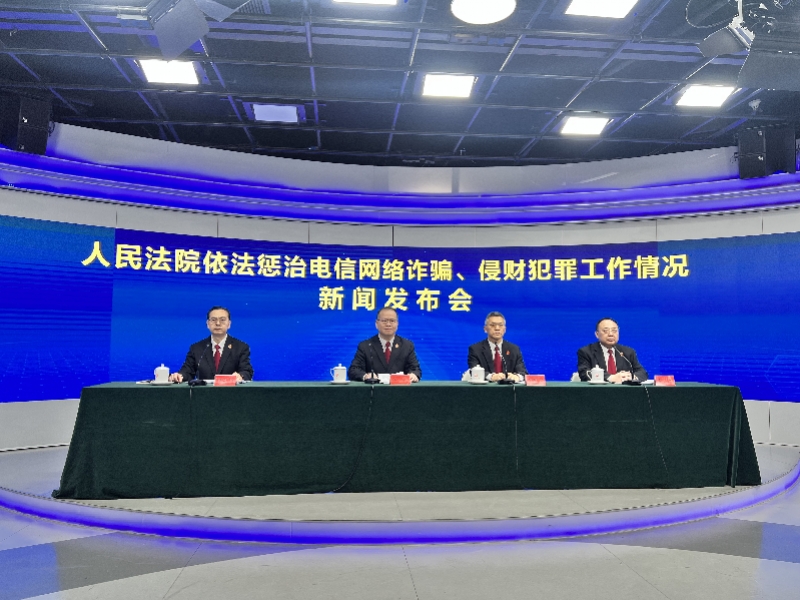
严惩侵犯财产犯罪 人民法院过去五年新收一审案件127.3万件
Xin Lang Cai Jing· 2026-02-26 02:38
Core Viewpoint - The Supreme People's Court has reported on its efforts to combat property crimes, enhance the punishment of fraud crimes, and precisely target the concealment and laundering of criminal proceeds from 2021 to 2025 [1][2] Group 1: Property Crime Cases - From 2021 to 2025, the People's Court received 1.273 million first-instance property crime cases and concluded 1.271 million cases, effectively curbing the high incidence of property crimes and safeguarding public property [1][2] Group 2: Fraud Crime Cases - Fraud crimes have consistently ranked among the top five new criminal cases received by the People's Court. The number of first-instance fraud cases rose from a low of 52,000 in 2022 to 94,000 in 2024, with 93,000 cases expected in 2025 [1][2] Group 3: Concealment and Money Laundering Cases - Between 2021 and 2025, the People's Court accepted 286,000 cases related to the concealment and laundering of criminal proceeds, concluding 285,000 cases, demonstrating a strong legal stance against money laundering activities [1][2]
1年用水400吨民警揪出在逃诈骗犯
Xin Lang Cai Jing· 2026-01-31 04:03
Core Viewpoint - A significant water usage anomaly led to the capture of a fugitive fraud suspect, revealing the connection between excessive water consumption and criminal activity [1] Group 1: Incident Overview - A household registered with only two residents used over 400 tons of water in a year, raising suspicions among property staff [1] - The investigation by the police uncovered that the son, Liu, was a fugitive wanted for a fraud case involving 200,000 yuan [1] Group 2: Criminal Behavior and Consequences - Liu had been evading law enforcement for years after committing fraud under the pretense of job hunting [1] - To avoid detection, Liu refrained from using his phone and sought low-paying jobs, leading to significant mental stress [1] - His coping mechanism involved running the washing machine frequently, which inadvertently revealed his location due to the high water usage [1] Group 3: Law Enforcement Action - Liu has been transferred to the police in Xinzhou for further processing following his capture [1]
35岁女子冒充陕西省领导诈骗424万
Bei Jing Ri Bao Ke Hu Duan· 2026-01-20 23:21
Core Viewpoint - A 35-year-old woman, Wang, was arrested for committing fraud by impersonating a leader from Shaanxi Province, scamming victims out of a total of approximately 4.24 million RMB [1] Summary by Relevant Sections Fraud Details - The suspect, Wang, posed as a government official and claimed she could facilitate the employment of victims' children as civil servants, leading to a significant scam totaling over 4.24 million RMB from one victim [1] - In addition to the main scam, Wang also defrauded two other victims under the pretense of purchasing "top-up housing," amounting to 580,000 RMB and 800,000 RMB respectively [1] Legal Consequences - Wang has been criminally detained by the police, and the case is under further investigation [1] - According to Article 266 of the Criminal Law of the People's Republic of China, the penalties for fraud vary based on the amount involved, with significant penalties for larger sums [1]
警方通报:王某(女,35岁)冒充陕西省领导,称能办理公务员入职,受害人被骗424万元
Huan Qiu Wang· 2026-01-20 13:01
Group 1 - The article highlights the efforts of the Salt Lake Public Security Bureau in combating fraud and maintaining social stability by focusing on public safety and cracking down on crimes such as theft and scams [1][3] - A significant case was reported where a suspect named Wang, a 35-year-old woman from Shanxi Province, was arrested for defrauding victims by posing as a provincial leader, resulting in a total fraud amount exceeding 4.24 million RMB [1][4] - The suspect also deceived two other victims under the pretense of purchasing "top-up houses," collecting 580,000 RMB and 800,000 RMB from them respectively [1][4] Group 2 - The suspect Wang has been criminally detained, and the investigation is ongoing, reflecting the commitment of the Salt Lake Public Security Bureau to uphold law and order [3] - The article emphasizes the importance of addressing both major and minor cases to enhance public safety and instill a sense of security among the community [4] - Legal consequences for fraud are outlined, indicating that significant fraud can lead to imprisonment ranging from three years to life, depending on the severity of the case [4]

为套取政府补贴,餐饮店老板一次性下单1000余份米饭
Xin Lang Cai Jing· 2026-01-15 10:10
Core Viewpoint - The article discusses a fraudulent scheme involving a restaurant owner in Shanghai who exploited the "Le Pin Shanghai" electronic consumption vouchers to illegally obtain government subsidies through false transactions [1][2][3]. Group 1: Fraudulent Activities - The restaurant owner, Zhao, engaged in fraudulent activities by creating fake dining orders to redeem government subsidies associated with the consumption vouchers [1][2]. - Zhao used a strategy of issuing suspiciously high orders, such as "1000 portions of rice" for a nominal price, to facilitate the voucher redemption process [2]. - He illegally profited from the government subsidies by splitting the benefits with sellers of the vouchers, earning between 190 to 250 yuan per transaction [1][2]. Group 2: Legal Proceedings - The case was transferred to the Baoshan District Procuratorate for prosecution after Zhao was apprehended by law enforcement [2][3]. - The procuratorate conducted a thorough examination of evidence, including transaction records and communication logs, to establish the fraudulent nature of Zhao's activities [2]. - Zhao was charged with fraud for illegally obtaining over 110,000 yuan through the redemption of more than 390 fake vouchers, and he has agreed to return the illicit gains [2][3].
一堆假币骗了16万真钱
Xin Lang Cai Jing· 2026-01-02 17:26
Core Viewpoint - A young individual, Song, committed fraud by deceiving friends to cover debts, leading to a conviction for fraud and a prison sentence of four years along with a fine of 20,000 yuan and restitution of over 120,000 yuan to victims [1][2] Group 1: Fraud Scheme Details - Song accumulated significant debt due to extravagant spending, owing friends, including Li, tens of thousands of yuan [1] - To repay Li, Song devised a scheme involving fake cash, using 600,000 yuan worth of point-counting practice vouchers disguised as cash, claiming he needed to mortgage it temporarily [1] - Song misled Li into believing he had a large amount of US dollars to exchange, offering a favorable exchange rate of 5.5 yuan per dollar, which led to further deception involving a business partner, Zou [1][2] Group 2: Legal Proceedings - After Li discovered the deception when opening the mortgaged cash, he alerted Zou, who then confronted Song and reported him to the police [2] - The case was forwarded to the local prosecutor's office, which determined that Song's actions constituted fraud, leading to formal charges [2] - The court ultimately sentenced Song to four years in prison and mandated restitution to the victims, along with the confiscation of fraudulent items [1][2]
浙江90岁老人接到“孙子”紧急来电,毫不犹豫拿出2万养老钱:“我孙子‘按摩’被抓了,要交保证金!”儿子赶紧报警
Xin Lang Cai Jing· 2025-12-20 08:48
Group 1 - A 90-year-old man was scammed out of 20,000 yuan by individuals posing as his grandson and a lawyer, claiming his grandson needed bail money after being arrested [1][3] - The scam involved a series of phone calls where the scammers created a sense of urgency, leading the elderly man to withdraw cash and hand it over to a person who came to collect it [1][3] - After realizing the scam, the man's son reported the incident to the police, who quickly identified and apprehended the suspect who collected the cash [1][3] Group 2 - The suspect, identified as Huang, admitted to handing over the stolen cash to three accomplices, who were also later arrested, with a total of 145,000 yuan seized by the police [3][5] - All four suspects were from outside the province and were recruited by an overseas scam group, lured by high-paying "runner" jobs [5][7] - The police have issued warnings about the risks of participating in money transfer schemes, emphasizing that such actions can lead to severe legal consequences [7]