负伽马敞口

Search documents
美股还会跌多久?历史数据看,大涨后抛售潮平均持续25个交易日,当前已经21天了
Hua Er Jie Jian Wen· 2025-11-14 06:44
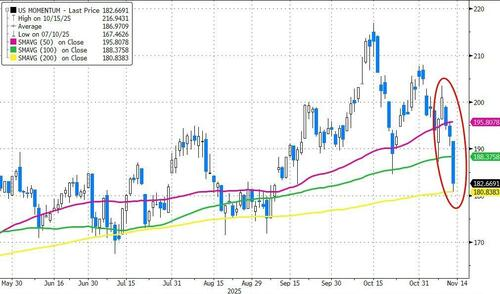
Core Viewpoint - The recent sharp correction in the U.S. stock market, particularly in momentum stocks, has raised investor concerns about future market direction. Morgan Stanley's analysis suggests that this sell-off may be in its "later stages," but the most vulnerable speculative areas still face further "de-bubbling" risks, indicating a pessimistic short-term outlook [1]. Group 1: Market Performance and Trends - Since reaching a peak on October 15, the momentum index, composed of long and short strategies, has declined by over 14% [1]. - The current sell-off has lasted for 21 trading days, approaching the historical average duration of about 25 trading days [4]. - The depth of the current momentum stock sell-off, with a 19% decline from its peak, aligns closely with the historical average drop of -22% during similar sell-offs [6]. Group 2: Investor Positioning and Risks - Both hedge funds and retail investors have highly concentrated positions, with hedge fund long leverage at the 98th percentile over the past five years, nearing peaks not seen since 2006 [9]. - Despite recent selling in popular sectors like AI and technology, hedge funds' overall risk exposure has not significantly decreased, remaining at the 79th percentile for momentum stocks [11]. - Retail investor holdings overlap significantly with hedge funds, indicating a concentration of positions in crowded sectors [16]. Group 3: Market Dynamics and Speculative Stocks - Retail fund flows are becoming a key factor affecting market structure, with nearly half of retail buying concentrated in the top ten companies, primarily large tech stocks like Nvidia and Tesla [17]. - The current market environment shows a reduction in funds flowing into smaller, unprofitable speculative stocks, impacting the performance of a basket of retail-favored stocks, which has lagged the Nasdaq 100 by about 15% since October 15 [20]. - The structure of the options market poses additional risks, with a shift to net short gamma exposure, making the market more susceptible to volatility [22].