媒体与电信

Search documents
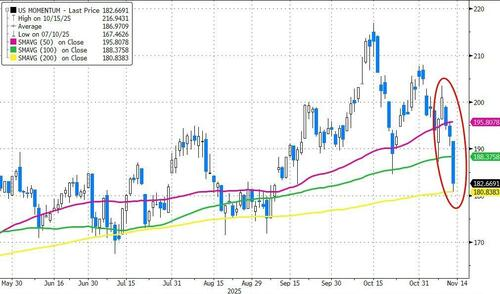
美股还会跌多久?历史数据看,大涨后抛售潮平均持续25个交易日,当前已经21天了
华尔街见闻· 2025-11-14 10:27
Core Viewpoint - Morgan Stanley's latest analysis suggests that the current sell-off may be in its "latter half," but the most vulnerable speculative areas of the market still face further "de-bubbling" risks, indicating a pessimistic short-term outlook [1] Group 1: Market Trends - Since peaking on October 15, the momentum index composed of long and short strategies has declined by over 14% [2] - The current sell-off, led by strong stocks, has lasted for 21 trading days, approaching the historical average duration of about 25 trading days [4] - The depth of the current momentum stock sell-off, with a 19% decline since the peak, aligns closely with the historical average drop of -22% during similar sell-offs [8] Group 2: Investor Positioning - Both hedge funds and retail investors have highly concentrated positions, increasing market risk. Hedge funds' long leverage levels are at the 98th percentile over the past five years, nearing peaks not seen since 2006 [11] - Despite recent selling in popular sectors like AI and technology, hedge funds' overall risk exposure has not significantly decreased, with net exposure in momentum stocks still at the 79th percentile over the past year [15] - Retail investors' holdings overlap significantly with hedge funds, indicating a concentration in crowded sectors [21] Group 3: Retail Investor Behavior - Retail fund flows are becoming a key factor affecting market structure, with nearly half of retail buying concentrated in the top ten companies, including Nvidia (NVDA), Tesla (TSLA), Palantir (PLTR), and Meta [23] - This shift means that funds flowing into smaller, unprofitable speculative stocks are decreasing, impacting the performance of the "retail favorites" portfolio, which has underperformed the Nasdaq 100 by about 15% since October 15 [25] Group 4: Technical Risks - Two technical factors are amplifying market vulnerability: the unprecedented "crowding risk" with 45 stocks appearing in multiple momentum portfolios, historically leading to further declines in the following months [27] - The structure of the options market poses additional risks, as the growth of leveraged ETFs has shifted the market's gamma exposure to net short, making the market more susceptible to severe intraday fluctuations [29]


美股还会跌多久?历史数据看,大涨后抛售潮平均持续25个交易日,当前已经21天了
Hua Er Jie Jian Wen· 2025-11-14 06:44
Core Viewpoint - The recent sharp correction in the U.S. stock market, particularly in momentum stocks, has raised investor concerns about future market direction. Morgan Stanley's analysis suggests that this sell-off may be in its "later stages," but the most vulnerable speculative areas still face further "de-bubbling" risks, indicating a pessimistic short-term outlook [1]. Group 1: Market Performance and Trends - Since reaching a peak on October 15, the momentum index, composed of long and short strategies, has declined by over 14% [1]. - The current sell-off has lasted for 21 trading days, approaching the historical average duration of about 25 trading days [4]. - The depth of the current momentum stock sell-off, with a 19% decline from its peak, aligns closely with the historical average drop of -22% during similar sell-offs [6]. Group 2: Investor Positioning and Risks - Both hedge funds and retail investors have highly concentrated positions, with hedge fund long leverage at the 98th percentile over the past five years, nearing peaks not seen since 2006 [9]. - Despite recent selling in popular sectors like AI and technology, hedge funds' overall risk exposure has not significantly decreased, remaining at the 79th percentile for momentum stocks [11]. - Retail investor holdings overlap significantly with hedge funds, indicating a concentration of positions in crowded sectors [16]. Group 3: Market Dynamics and Speculative Stocks - Retail fund flows are becoming a key factor affecting market structure, with nearly half of retail buying concentrated in the top ten companies, primarily large tech stocks like Nvidia and Tesla [17]. - The current market environment shows a reduction in funds flowing into smaller, unprofitable speculative stocks, impacting the performance of a basket of retail-favored stocks, which has lagged the Nasdaq 100 by about 15% since October 15 [20]. - The structure of the options market poses additional risks, with a shift to net short gamma exposure, making the market more susceptible to volatility [22].
李泽楷,又要IPO了
投资界· 2025-05-22 08:04
Core Viewpoint - The article discusses the upcoming IPO of FWD Group, led by Richard Li, the son of Li Ka-shing, highlighting its growth and expansion in the insurance sector across Asia-Pacific, particularly its significant customer base from mainland China [3][4][6]. Group 1: Company Overview - FWD Group has submitted its prospectus for an IPO on the Hong Kong Stock Exchange, with Richard Li as its leader, who has established the company through strategic acquisitions since 2013 [3][5]. - The company has approximately 60,000 policyholders from mainland China, indicating a strong market presence [4][6]. - FWD Group's business model focuses on customer-centric and digital empowerment strategies, leading to rapid growth in the insurance market [5][6]. Group 2: Financial Performance - From 2014 to 2024, FWD Group's annualized new premiums are projected to grow 5.2 times, from $309 million to $1.916 billion [6]. - The company reported net insurance and investment performance of $493 million, $470 million, and $911 million for the years 2022 to 2024, respectively, with a turnaround to profitability expected in 2024 [7]. - The annualized new premium from mainland Chinese visitors has seen a growth of 6.3 times from 2022 to 2024, showcasing the potential for further expansion in this market [7]. Group 3: Market Context - The Hong Kong IPO market is experiencing a resurgence, with significant listings such as CATL and Heng Rui Pharmaceutical, indicating a robust environment for new public offerings [13][14]. - The total fundraising amount from new IPOs in Hong Kong has exceeded HKD 60 billion, marking a more than sixfold increase compared to the previous year [13][15]. - The sentiment among investors has shifted positively, with a growing interest in Hong Kong listings, contrasting with previous perceptions of low liquidity and valuation issues [15].