财政收入质量

Search documents
河北亮政府“账本”,雄安新区财政收入增长约45%|地方预算观察
Di Yi Cai Jing· 2026-02-04 01:29
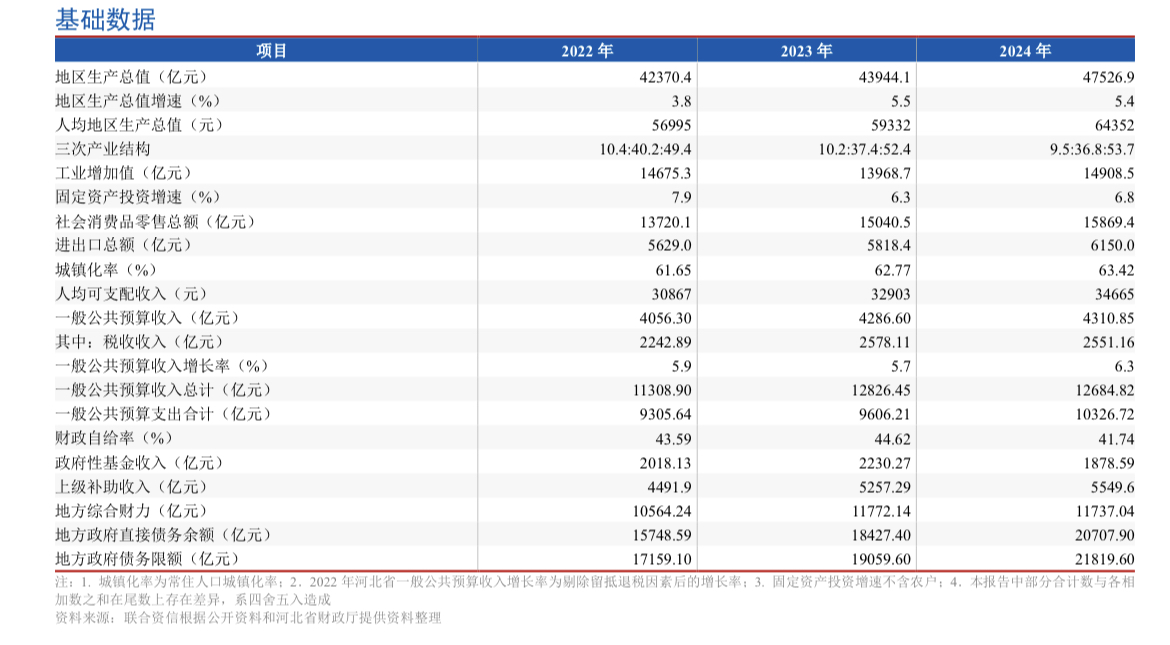
Core Insights - Hebei's fiscal revenue and expenditure remained stable last year, with expectations for land transfer income to grow by 22% this year [1][8] Group 1: Fiscal Performance - Hebei's general public budget revenue for 2025 is projected at 439.86 billion yuan, a 2% increase, aligning with the national average growth rate of 2.2% [2] - Tax revenue in Hebei for 2025 is expected to reach 263.84 billion yuan, growing by 3.4%, while non-tax revenue remains stable at 176.02 billion yuan [3] - Government fund revenue is anticipated to be 184.07 billion yuan in 2025, a decrease of 2%, which is a significant improvement from the previous year's decline of 15.8% [3] Group 2: Investment in Key Areas - The budget report indicates that 2025's general public budget expenditure will be 1,024.36 billion yuan, a slight decrease of 0.8%, but a comparable growth of 7.2% when excluding one-time factors [4] - A significant portion of the budget, 836.96 billion yuan (81.7%), is allocated for public welfare, reflecting a commitment to social spending [4] - In 2026, the budget for general public expenditure is expected to be 987.98 billion yuan, with a focus on major national strategies, technology innovation, and the construction of a modern industrial system [10] Group 3: Economic Growth Projections - The GDP growth for Hebei in 2026 is projected to exceed 5%, following a 5.6% growth in 2025 [8] - The expected general public budget revenue for 2026 is 448.66 billion yuan, maintaining a growth rate of around 2% [8] - The anticipated revenue from the government fund for 2026 is 224.97 billion yuan, reflecting a 22% increase, contingent on stabilization in the real estate market [8]

28省份发布前三季度财政收支
Di Yi Cai Jing Zi Xun· 2025-11-17 14:29
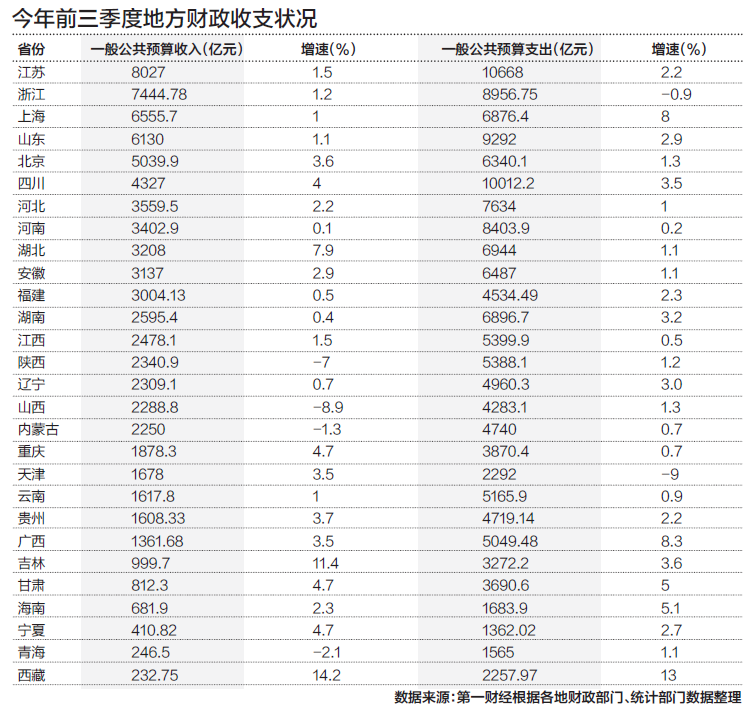
Core Insights - Local government fiscal revenues showed a slight increase in the first three quarters of the year, with overall fiscal expenditures also rising slightly, indicating a focus on stabilizing the economy and ensuring public welfare [1][2] Fiscal Revenue Summary - As of November 17, 28 provinces have disclosed their fiscal revenue and expenditure data, with most showing a revenue growth rate around 2%, while Tibet and Jilin achieved double-digit growth rates of 14.2% and 11.4% respectively [1][4] - Nationally, local general public budget revenue reached 93,039 billion yuan, a year-on-year increase of 1.8%, while expenditures totaled 177,056 billion yuan, up 2.4% [2][4] - The fiscal revenue growth was supported by improved tax revenue growth and a decrease in the proportion of non-tax revenue [1][5] Fiscal Expenditure Summary - Most provinces reported a fiscal expenditure increase, with Sichuan showing the largest deficit of approximately 560 billion yuan, indicating a tight balance between revenue and expenditure [1][4] - Expenditure growth rates varied, with Tibet leading at 13%, followed by Guangxi and Shanghai at around 8%, while many provinces had growth rates below 3% [10] - Local governments are prioritizing spending on public welfare, with significant allocations to health, social security, and education [10][11] Regional Performance - Among the 28 provinces, 24 reported revenue growth, with notable declines in Shanxi (-8.9%), Shaanxi (-7%), and Inner Mongolia (-1.3%), primarily due to falling coal prices affecting tax revenues [5][6] - Jilin's revenue growth was attributed to enhanced management of state-owned assets, leading to a significant increase in non-tax revenue [5][6] Policy and Support Measures - To address fiscal imbalances, local governments are enhancing tax collection, optimizing asset management, and seeking central government support [11][12] - In October, the Ministry of Finance allocated 500 billion yuan to local governments to help alleviate debt and support key projects [12]
详解28省份前三季度财政收支,紧平衡态势依旧
Di Yi Cai Jing· 2025-11-17 12:05
Core Insights - Local governments are achieving fiscal balance primarily due to central government transfers and debt income, but the overall fiscal situation remains tight [1][2][3] - The overall local fiscal revenue has shown slight growth, while expenditures have also increased, with spending generally exceeding revenue to stabilize the economy and ensure public welfare [1][2] Fiscal Revenue - As of November 17, 28 provinces have reported their fiscal revenue for the first three quarters, with most showing stable revenue growth, particularly in Tibet and Jilin, which achieved double-digit growth rates [1][3][4] - Nationally, local general public budget revenue reached 93,039 billion yuan, a year-on-year increase of 1.8%, while expenditures totaled 177,056 billion yuan, growing by 2.4% [3][4] - The revenue growth rate varies significantly among provinces, with some like Shanxi, Shaanxi, Inner Mongolia, and Qinghai experiencing declines due to falling commodity prices [5][6] Fiscal Expenditure - Expenditure growth has generally outpaced revenue growth, highlighting the strong support from central fiscal transfers to ensure key public spending [2][10] - The highest expenditure growth was observed in Tibet at 13%, while most provinces reported growth rates below 3% [10] - Local governments are prioritizing spending on public welfare, with significant allocations to health, social security, and education [10] Regional Variations - Among the 28 provinces, 24 reported growth in general public budget revenue, with Tibet and Jilin leading with increases of 14.2% and 11.4%, respectively [4][5] - The fiscal performance of provinces varies widely, with some regions like Fujian showing significant disparities in revenue growth among its counties [8][9] Strategies for Fiscal Balance - To address fiscal imbalances, local governments are enhancing tax collection, optimizing asset management, and seeking central government support [11] - In October, the Ministry of Finance allocated 500 billion yuan to local governments to help manage existing debts and support key projects [11]