
财政资金使用效率

Search documents
贵州提前下拨近108亿元 困难群众救助补助资金
Xin Lang Cai Jing· 2026-01-23 18:53
Core Viewpoint - The Guizhou Provincial Department of Civil Affairs and the Provincial Department of Finance have jointly issued notifications to allocate budget for social assistance funds for 2026, amounting to a total of 10.799 billion yuan, aimed at ensuring basic living standards for disadvantaged groups [1][2]. Group 1: Financial Allocation - A total of 10.799 billion yuan has been allocated for the 2026 central and provincial social assistance funds, with 9.045 billion yuan from the central government and 1.754 billion yuan from the provincial government [1]. - The early disbursement of these funds is intended to support various livelihood policies, including minimum living guarantees and temporary assistance for vulnerable populations [1]. Group 2: Policy Implications - The advance allocation of funds allows local governments to plan and manage resources more effectively, ensuring that social assistance policies remain uninterrupted and robust [1]. - This initiative reflects the government's commitment to basic living standards, particularly in the context of ongoing economic recovery, and aims to alleviate the living pressures faced by disadvantaged groups [1]. Group 3: Implementation and Oversight - Local civil affairs and finance departments will collaborate closely to enhance fund supervision and performance management, ensuring that assistance funds are distributed accurately and timely [1]. - The goal is to maximize the effectiveness of the funds and ensure that the basic living standards for vulnerable populations are adequately met [1].
11月财政数据点评:紧平衡下关注短期支出端增量政策
LIANCHU SECURITIES· 2025-12-22 09:02
Report Summary 1. Report Industry Investment Rating No relevant information provided. 2. Core Viewpoints As of now, the growth rate of fiscal revenue and expenditure is running weakly. Compared with the budget target at the beginning of the year, it shows the characteristics of "slightly exceeding the revenue target, lagging expenditure progress, and expanding revenue - expenditure gap of government - managed funds". Although the general public budget revenue has exceeded the target, the lagging expenditure progress leads to low efficiency of fiscal funds use. The expanding revenue - expenditure gap of government - managed funds reflects the fragility of land finance. In the future, under the tight fiscal balance, both the revenue and expenditure sides face multiple pressures. In the short term, the focus is on the efficiency of fund implementation. Incremental policies around accelerating fund allocation and promoting the formation of physical workload are expected, which will strongly support fiscal expenditure and economic recovery in the first quarter across the year [1]. 3. Summary by Related Catalogs Fiscal Revenue - The growth rate of fiscal revenue has been running at a low level and slightly exceeded the growth target at the beginning of the year. From January to November, the growth rate of general public budget revenue was 0.8%, 0.1% higher than the predetermined target. The overall revenue growth continued the low - level operation trend. Structurally, the differentiation between central and local revenues increased, with the decline of central revenue expanding and the growth rate of local revenue improving slightly, providing some support for the overall revenue. In terms of rhythm, the completion progress of fiscal revenue was 91.2%, slightly lower than the historical average (91.7%) but slightly higher than the same period in 2024 (90.5%). Overall, fiscal revenue maintained a steady recovery trend, but the progress was slightly behind expectations, mainly affected by factors such as insufficient economic recovery resilience, tax structure differentiation, and weakening non - tax revenue support [2]. - The growth rate of tax revenue continued to improve, while the decline of non - tax revenue expanded, showing obvious structural differentiation. The growth rate of tax revenue increased by 0.1 percentage points to 1.8%, indicating enhanced tax source resilience. Non - tax revenue had negative growth for 7 consecutive months, and the decline further expanded, dragging down the overall fiscal revenue growth rate. Among major taxes, the growth rates of domestic VAT and corporate income tax declined marginally, which was consistent with weak domestic demand and enterprise profit pressure; personal income tax remained the same as the previous value, indicating limited improvement in residents' income; consumption tax increased slightly, showing certain consumption resilience. The shock - strengthening of the equity index drove the stamp duty to maintain a relatively high growth rate. Among foreign - trade - related taxes, the decline of export tax rebates expanded, and the increase of tariffs narrowed, indicating pressure on exports. The decline of vehicle purchase tax expanded, reflecting the weakening of automobile consumption. The growth rates of land value - added tax and deed tax were continuously in the negative growth range, indicating that real - estate transactions and investments were still in the bottom - exploring stage [3]. Fiscal Expenditure - The growth rate of fiscal expenditure declined continuously, and the pressure on local expenditure was significant. From January to November, the growth rate of fiscal expenditure was 1.4%, with a decline of 0.6 percentage points, significantly lower than the predetermined target of 4.4% at the beginning of the year. In terms of central and local levels, the growth rate of central expenditure decreased slightly by 0.1 percentage points to 6.2%, with a continuous decline for 6 months; the growth rate of local expenditure decreased to 0.6%, the lowest in the year, reflecting a significant increase in local fiscal expenditure constraints. The decline in local expenditure was related to the high base last year on the one hand, and reflected the characteristics of marginal weakening in the second half of the year due to the front - loaded fiscal efforts on the other hand [4]. - In terms of expenditure structure, the decline of infrastructure - related expenditure expanded, and the growth rate of livelihood expenditure slowed down from a high level. The growth rates of expenditure on agriculture, forestry, and water affairs and urban and rural community affairs both declined and reached the lowest in the year, dragging down the infrastructure investment growth rate. The obvious contraction of infrastructure expenditure might be related to insufficient connection of new project reserves and more funds being used for debt resolution. In terms of livelihood expenditure, the growth rate of social security and employment expenditure slowed down for 3 consecutive months but still remained at a relatively high level; the growth rate of education expenditure slowed down marginally for 8 consecutive months, indicating that the fiscal expenditure structure was gradually transitioning from bottom - supporting expansion to constraint balance [4]. Government - Managed Funds - The revenue and expenditure of government - managed funds were under pressure, and there was a disconnection between the issuance and use of special bonds. The decline of land transfer revenue continued to expand, dragging down the growth rate of government - managed funds revenue from - 2.8% to - 4.9% (the predetermined target was 0.7%). The growth rate of government - managed funds expenditure decreased marginally to - 15.4% (the predetermined target was 23.1%), and the growth rate slowed down for 4 consecutive months. The growth rates of government - managed funds revenue and expenditure were significantly lower than the targets at the beginning of the year by 0.7% and 23.1% respectively. The lagging expenditure progress was mainly due to the mismatch between the issuance of special bonds by local governments and project implementation. Although the issuance progress of local government special bonds reached 101.6% and the progress of new special bonds was 97% (the historical average was 95.3%), the insufficient land revenue restricted the local supporting fund expenditure ability. Coupled with the fact that some projects were not ready for timely construction, the fund expenditure progress was lagging [5].
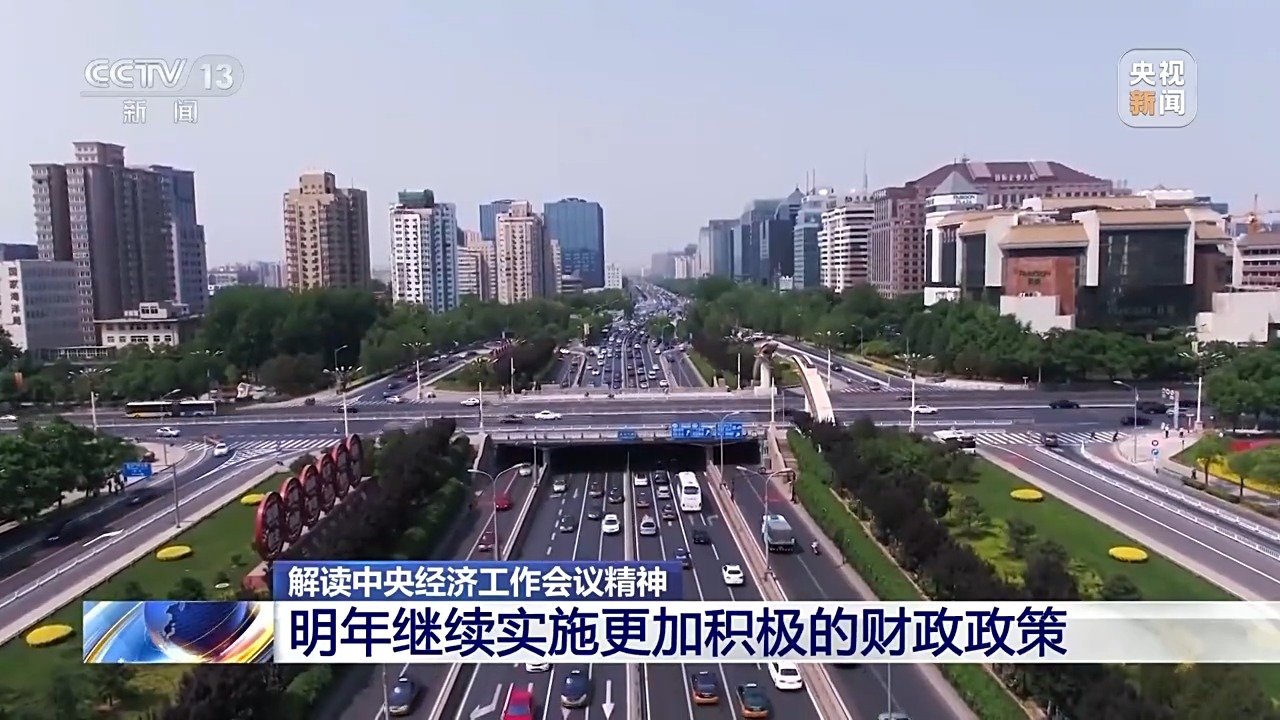
视频丨继续实施更加积极的财政政策,明年具体怎么干?专家最新解读来了
Yang Shi Xin Wen Ke Hu Duan· 2025-12-13 05:39
Core Viewpoint - The Central Economic Work Conference emphasizes the continuation of a more proactive fiscal policy in the coming year, maintaining necessary fiscal deficits, total debt scale, and overall expenditure levels, aligning with the goals set for 2025 [4]. Group 1: Fiscal Policy Direction - The fiscal policy direction for next year is consistent with the goals for 2025, focusing on ensuring necessary fiscal deficits and new debt scales, as well as maintaining fiscal expenditure intensity [4]. - The proactive fiscal policy aims to expand social demand through government spending, such as procurement and infrastructure projects, which will generate income for households and businesses, thus promoting economic circulation [6]. Group 2: Structural Optimization - The policy emphasizes the combination of investment in physical assets and human capital, improving healthcare, education, and elderly care, which alleviates residents' concerns and releases potential consumer demand [6]. - The continuation of a proactive fiscal policy is a strategic choice based on assessments of domestic and international economic conditions, supporting the achievement of economic targets [7]. Group 3: Efficiency of Fiscal Fund Utilization - The conference highlights the need to strengthen fiscal management, optimize expenditure structures, and standardize tax incentives and fiscal subsidy policies to enhance the efficiency of fiscal fund utilization [11]. - Optimizing expenditure structures will free up financial resources that can be directed towards improving public welfare, including healthcare, education, and elderly care [13]. Group 4: Market Integration - Standardizing tax incentives and fiscal subsidies is crucial for promoting the modernization of fiscal and tax systems and facilitating the construction of a unified national market [15]. - The optimization of "two new" and "two heavy" policies aims to enhance consumer experience and ensure that major projects deliver greater benefits, ultimately driving a rebound in consumption and investment [17].

【头条评论】“国补”直达消费终端 让“真金白银”更好惠及百姓
Zheng Quan Shi Bao· 2025-06-09 17:59
Core Insights - The article discusses the transformative impact of the "trade-in" policy in China's consumer market, highlighting its efficiency in utilizing fiscal funds and ensuring direct benefits to consumers [1][3] - The collaboration between central and local governments in financial mechanisms is emphasized, showcasing a model that addresses regional disparities while ensuring nationwide coverage [1][2] Group 1: Policy Implementation - As of May 31, 2025, the trade-in policy has generated sales of 1.1 trillion yuan and distributed approximately 175 million subsidies to consumers [1] - The central government allocated 300 billion yuan through special long-term bonds, increasing funding by 150 billion yuan compared to the previous year, with 162 billion yuan already distributed to local governments [1] - The funding distribution is designed to support underdeveloped regions, with the central government covering 85% in the east, 90% in the central, and 95% in the west [1] Group 2: Financial Mechanisms - Shandong Province's pre-approval mechanism allows enterprises to claim 80% of subsidy funds upfront, changing the traditional model of "business pays first, government reimburses later" [2] - The four-dimensional support system in Zhejiang combines government subsidies, brand discounts, platform support, and financial assistance, allowing consumers to enjoy significant price reductions [2] - Regulatory measures in Heilongjiang and Zhejiang aim to prevent misuse of subsidies and ensure transparency in pricing, contributing to a robust implementation environment [2] Group 3: Broader Implications - The success of the trade-in policy serves as a valuable reference for public finance reform, demonstrating a more direct connection between policy and consumer benefits [3] - The innovative financial mechanisms established through special bonds and local pre-approval processes represent a modern governance model that could be replicated in other areas [3] - The ongoing distribution of special bond funds is expected to enhance the effectiveness of fiscal policies in various sectors, directly benefiting the public [3]