货币互换安排

Search documents
韩美尚未就3500亿美元投资基金相关的外汇问题达成一致
Xin Hua Cai Jing· 2025-10-17 06:17
Core Points - South Korea is in intensive negotiations with the United States to finalize the details of a $350 billion investment commitment, which may include a currency swap arrangement to protect South Korea from potential financial instability [1] - Senior officials from Seoul, including the head of the presidential policy office Kim Yong-beom and Trade Minister Yeo Han-koo, are seeking to finalize the agreement before the Asia-Pacific Economic Cooperation summit [1] - Trade negotiations between the two countries have been stalled for over two months due to disagreements over the implementation of the $350 billion investment fund [1] - This investment commitment is a core component of the trade agreement, which sets a 15% tariff cap on U.S. imports of South Korean products [1] - Due to unresolved details, the U.S. has not reduced the 25% tariff on automobiles, putting South Korean automakers at a competitive disadvantage against Japanese rivals [1]
亚洲盟友“大反水”?承诺对美数千亿美元投资后,日韩开始反悔
Jin Shi Shu Ju· 2025-09-29 04:07
Group 1 - The U.S. President Trump faces new obstacles in securing significant investment commitments from Asian allies, as South Korea describes Washington's terms as unrealistic, and a Japanese political leader hints at a potential re-evaluation of the agreement [1] - South Korea's National Security Office Chief, Suh Hoon, stated that the country cannot afford to pay $350 billion in cash, emphasizing that this is not a negotiable position [1] - The investment commitment of $350 billion from South Korea is part of a broader trade agreement that includes reducing U.S. tariffs from 25% to 15%, but there are still disagreements on how to structure this commitment [1] Group 2 - Japan has also expressed caution regarding its $550 billion investment fund, with a leading political competitor suggesting a possible renegotiation if the agreement does not align with Japan's interests [2] - U.S. Commerce Secretary Ross has indicated that Washington prefers cash investments over loans, prompting South Korea to explore alternative solutions ahead of the APEC summit [2] - The South Korean Finance Minister has concluded discussions with the U.S. regarding foreign exchange issues and will soon announce details related to this matter [2] Group 3 - A memorandum of understanding signed earlier this month stipulates that Japan must raise funds within 45 working days once Trump selects investment projects, with funds to be deposited in U.S.-designated accounts [3] - Japan's Chief Trade Negotiator, Akira Amari, argued that the organizations responsible for funding these investments will not finance projects that do not benefit Japan, indicating that only 1-2% of the $550 billion mechanism represents actual investments [3] - The ruling Liberal Democratic Party is set to vote on its next leader, with key candidates needing to confront Trump regarding the implementation of the trade agreement [3]
黑天鹅!韩国,突发!
中国基金报· 2025-09-28 16:05
Core Viewpoint - South Korea is unable to pay the $350 billion in cash to the U.S. as part of a trade agreement aimed at reducing tariffs, highlighting significant economic constraints and differing expectations between the two nations [2][3]. Group 1: Trade Agreement Details - A South Korean official stated that the country cannot provide $350 billion in cash to the U.S. to lower tariffs from 25% to 15% as previously agreed upon [3]. - The amount requested by the U.S. represents over 80% of South Korea's foreign exchange reserves, making it an unrealistic demand for the Korean economy [3]. - The U.S. Secretary of Commerce has indicated a preference for cash payments rather than loans for the investment, complicating negotiations [3]. Group 2: Negotiation Stalemate - The negotiations between the U.S. and South Korea have reached a deadlock, with South Korea emphasizing that it cannot accept terms similar to Japan's $550 billion investment commitment due to differences in economic scale [4][5]. - South Korea's National Policy Office Director pointed out that the economic environments of South Korea and Japan are fundamentally different, particularly regarding currency swap arrangements and the status of the yen as a reserve currency [5][6]. - The $350 billion fund is a critical component of the trade agreement, yet there are ongoing disagreements about its operational structure and management [6].


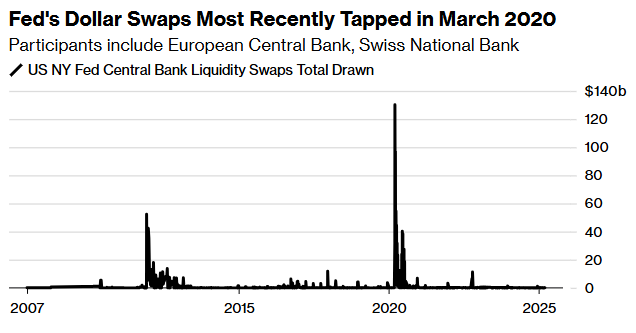
德银:若美联储撤回货币互换 美元储备地位、美国资产面临风险
智通财经网· 2025-03-28 00:08
Core Viewpoint - Deutsche Bank indicates that the Federal Reserve's withdrawal of a long-standing liquidity support measure poses the greatest risk to the dollar's status as a reserve currency since the end of World War II [1] Group 1: Federal Reserve and Liquidity Support - The Federal Reserve's liquidity support measures, particularly currency swap arrangements, have been crucial during financial crises, allowing global institutions to borrow dollars in their local currencies [1][2] - Concerns about the reliability of these currency swap arrangements could damage the dollar, especially if such worries become widespread among U.S. Western allies [1] Group 2: Impact of U.S. Government on Federal Reserve - The Trump administration may indirectly influence the Federal Reserve through moral persuasion or appointments to the management board [5] - If the Federal Reserve stops liquidity support under pressure or uses it as a bargaining chip for other U.S. policy goals, it could lead to significant consequences, including a sharp appreciation of the dollar and potential undervaluation of U.S. assets [5] Group 3: Global Financial System and De-dollarization - Doubts about the Federal Reserve's role as the world's lender of last resort could accelerate efforts by other countries to reduce their dependence on the U.S. financial system [5] - The Federal Reserve has also established other tools to address global market liquidity issues, such as repurchase agreement operations with foreign institutions [5]