
货币政策展望

Search documents
【中国银河宏观】 企业贷款显著改善会成为重要宏观线索吗? ——2026年2月金融数据解读
Xin Lang Cai Jing· 2026-03-13 15:25
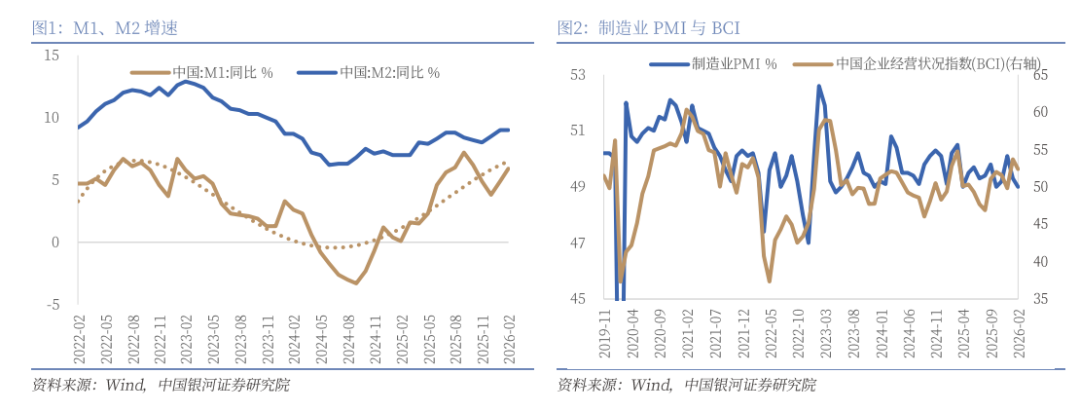
Core Viewpoint - The central theme of the report is the analysis of China's financial data for February 2026, highlighting the trends in money supply, social financing, and loan growth, which indicate a mixed economic outlook with improvements in corporate loans but declines in household loans [1][9]. Group 1: Money Supply - M1 growth increased to 5.9% year-on-year, up from 4.9% previously, while M2 growth remained stable at 9.0% [1][9]. - The rise in M1 is attributed to a significant increase in M0 growth to 14.1%, influenced by seasonal factors such as the Spring Festival [12]. - M2 growth is supported by increased foreign exchange reserves and faster fiscal spending, despite a decrease in loan growth impacting credit-derived money supply [14]. Group 2: Social Financing - New social financing in February reached 2.4 trillion yuan, an increase of 146.1 billion yuan year-on-year, with a social financing growth rate of 8.2% [6][16]. - The components of social financing showed mixed results, with increases in RMB and foreign currency loans, while government and corporate bond financing saw declines [16]. - Effective social financing growth, which includes medium to long-term loans and direct financing, rose to 5.47% [16]. Group 3: Loan Growth - Financial institutions issued 900 billion yuan in new RMB loans in February, a decrease of 110 billion yuan year-on-year, with a loan growth rate of 6.0% [1][21]. - Household loans saw a significant decline, with a year-on-year decrease of 2.6 trillion yuan, while corporate loans improved, particularly in medium to long-term loans, which increased by 3.5 trillion yuan [21]. - The overall loan growth trend indicates a need for further data to assess the sustainability of the improvements in corporate loans [10]. Group 4: Policy Outlook - A reserve requirement ratio (RRR) cut of 50 basis points is anticipated in the first quarter, which could release approximately 1 trillion yuan in liquidity [26]. - Comprehensive interest rate cuts are expected to be delayed, with the focus on stabilizing expectations and employment amid external and internal economic pressures [26]. - The potential for a single interest rate cut of 10-20 basis points throughout the year is projected, which may influence loan and deposit rates [26].


1月金融数据解读:如何解读M1与M2双双回升?
ZHESHANG SECURITIES· 2026-02-14 10:12
Group 1: Monetary Aggregates - As of the end of January, M2 growth rate was 9.0%, up 0.5 percentage points from the previous value of 8.5%[1] - M1 growth rate was 4.9%, an increase of 1.1 percentage points from the previous rate of 3.8%[1] - The M1-M2 spread was -4.1%, narrowing by 0.6 percentage points from -4.7% in the previous month[2] Group 2: Credit and Financing - In January, new RMB loans increased by 4.7 trillion yuan, a year-on-year decrease of 420 billion yuan, with a stock growth rate of 6.1%[3] - New loans to households amounted to 456.5 billion yuan, an increase of 127 billion yuan year-on-year, while medium- and long-term loans decreased by 1,466 billion yuan[3] - Corporate loans totaled 4.45 trillion yuan, down 330 billion yuan year-on-year, with short-term loans increasing by 2.05 trillion yuan[4] Group 3: Social Financing - Social financing increased by 7.2 trillion yuan in January, a year-on-year increase of 1,654 billion yuan, with a month-end growth rate of 8.2%[7] - The largest contribution to social financing came from government bonds, which added 976.4 billion yuan, a year-on-year increase of 2,831 billion yuan[7] - New RMB loans were a drag on social financing, increasing by 4.9 trillion yuan, a year-on-year decrease of 3,194 billion yuan[8]