
货币政策操作

Search documents
中金:中国经验与沃什路径
中金点睛· 2026-02-24 23:41
Core Viewpoint - The article discusses the "Walsh Path," which can be summarized as "interest rate cuts and balance sheet reduction," and analyzes its implications for both China and the U.S. It emphasizes that while the Walsh Path may face challenges, particularly regarding inflation expectations, lessons from China's experience can provide insights into managing liquidity and stabilizing long-term bond yields [2][3][5]. Group 1: Understanding the Walsh Path - The Walsh Path suggests that the U.S. should control the Federal Reserve's balance sheet to enhance its independence from fiscal policy, thereby improving the effectiveness of interest rate cuts [5]. - China's recent experience, characterized by fiscal expansion without balance sheet growth from the central bank, has not led to rising long-term interest rates, providing a reference for understanding the Walsh Path [5][6]. - The article highlights that liquidity management and regulatory optimization are crucial for achieving the Walsh Path without causing significant increases in bond yields [21][22]. Group 2: Liquidity Management - The article outlines that the impact of liquidity on bond yields can be managed through various strategies, including reducing liquidity constraints on banks and adjusting capital requirements for government bond purchases [8][12]. - It emphasizes the importance of the central bank's role in providing liquidity support to banks, which can then facilitate non-bank financial institutions in purchasing government bonds [12][22]. - The article notes that the Chinese central bank has effectively lowered reserve requirements, releasing significant liquidity to support the banking system [8][12]. Group 3: Inflation Expectations - The article identifies the stabilization of inflation expectations as a critical challenge for the Walsh Path, as rising inflation expectations can lead to increased long-term interest rates [3][25]. - It discusses two potential solutions to prevent disorderly inflation expectations: a negative shock to aggregate demand or continuous expansion of aggregate supply, which has been a combination seen in China's recent economic management [28][30]. - The article points out that while the U.S. faces structural challenges in reversing fiscal expansion, maintaining stable inflation expectations is essential for the success of the Walsh Path [26][28]. Group 4: Lessons from China for the U.S. - The article suggests that the U.S. can learn from China's regulatory design and central bank balance sheet management to enhance monetary policy transmission and manage the exit strategy effectively [38][41]. - It emphasizes the need for the U.S. to consider external monetary injections and structural reforms to balance demand expansion and inflation control [42][44]. - The article concludes that both total monetary policy and structural monetary policy are important for economic development, and their coordination is essential for achieving growth while managing risks [44][45].


IMF: 央行数字货币对货币操作的影响
Sou Hu Cai Jing· 2026-01-22 08:20
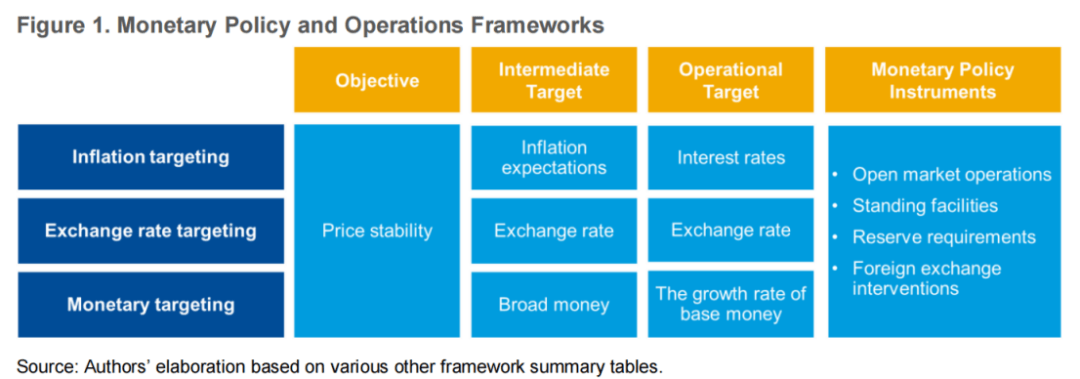
Core Insights - The article discusses the implications of Central Bank Digital Currency (CBDC) on monetary operations, focusing on the challenges central banks may face when introducing CBDCs and how these could impact liquidity supply and demand, as well as short-term interest rates [1][2]. Group 1: CBDC Scenarios - The analysis is based on three scenarios where CBDC could replace cash, commercial bank deposits, or central bank reserves, with the likelihood of each scenario depending on CBDC design features such as accessibility, holding limits, and interest rates [3][9]. - Each scenario's impact on the balance sheets of central banks, banking sectors, and non-banking sectors is examined to understand its effects on reserve demand and short-term interest rates [3][10]. Group 2: Monetary Operations Overview - Central banks aim for price stability, employing various monetary policy frameworks, including inflation targeting, exchange rate targeting, and monetary targeting, with most developed and emerging economies favoring inflation targeting [4][5]. - Monetary operations involve tools to implement these policies, relying on commercial banks as key intermediaries, with major tools including open market operations, standing facilities, reserve requirements, and foreign exchange interventions [6][4]. Group 3: Impact on Short-Term Interest Rates - In the first scenario, CBDC replacing cash has limited direct impact on short-term interest rates, but its demand may be more volatile than cash, complicating liquidity forecasts [11]. - The second scenario, where CBDC replaces bank deposits, could significantly affect short-term interest rates due to reduced reserves in the banking system, leading to potential upward pressure on rates [11][16]. - The third scenario suggests that if CBDC is treated similarly to reserves, short-term interest rates may not be significantly impacted, as the total amount of central bank liabilities remains unchanged [11][16]. Group 4: Adjustments in Monetary Operations and CBDC Design - Central banks may need to enhance liquidity forecasting models and adjust operational frameworks in response to CBDC demand volatility, including shifting to fixed-rate operations and increasing intra-day adjustment windows [14][16]. - Adjustments to CBDC design can mitigate adverse effects on monetary operations, such as limiting access to households or setting holding limits to control deposit substitution [18][19]. Group 5: Considerations for Exchange Rate and Monetary Targeting - If CBDC is accessible to non-residents, it may increase domestic currency liquidity, potentially leading to appreciation pressures or increased exchange rate volatility [19]. - CBDC could alter the stable relationship between base money and broad money, affecting inflation levels and complicating policies targeting monetary aggregates [20]. Conclusion - The introduction of CBDC raises concerns regarding monetary operations, including challenges in liquidity forecasting and potential deviations of market interest rates from policy targets. Adjusting operational frameworks and carefully designing CBDCs can help mitigate these adverse effects while balancing the goals of CBDC development [20].
人民银行9月15日开展6000亿元6个月买断式逆回购操作
Xin Hua Cai Jing· 2025-09-12 11:57
Core Viewpoint - The People's Bank of China will conduct a reverse repurchase operation of 600 billion yuan using a fixed quantity, interest rate bidding, and multiple price bidding method, with a term of 6 months (182 days) [1] Group 1 - The operation amount is set at 600 billion yuan [1] - The reverse repurchase operation will have a term of 6 months [1] - The method of operation includes fixed quantity and interest rate bidding with multiple price bidding [1]
央行拟取消债券回购质押券冻结,与国债买卖有何关联?
Di Yi Cai Jing· 2025-07-21 05:41
Core Viewpoint - The People's Bank of China (PBOC) is seeking to cancel the freezing of collateral for bond repurchase agreements, which is seen as a move to optimize liquidity management and align with international practices, rather than a direct precursor to resuming government bond trading [1][2][4]. Group 1: Policy Implications - The cancellation of the collateral freeze is primarily aimed at enhancing bond liquidity, allowing for more efficient trading and reducing the impact on yield curves during central bank operations [4][5]. - This adjustment is part of a broader strategy by the PBOC to maintain liquidity in the market, following a series of measures including a 0.5% reserve requirement ratio cut and significant reverse repo operations [2][6]. - The move is expected to improve the efficiency of collateral usage in the bond market, potentially leading to a decrease in short-term interest rates and enhancing overall market efficiency [6][7]. Group 2: Market Reactions - Market sentiment has shown initial positive responses to the proposed changes, particularly in the short-end of the yield curve, with a noted decrease in the 1-year government bond yield [6][7]. - The average daily transaction volume in the current pledge-style repurchase market is around 50 to 60 trillion yuan, and allowing for the circulation of pledged bonds could significantly boost overall market liquidity [3][4]. - Analysts suggest that while the cancellation of the collateral freeze may not directly lead to a resumption of government bond trading, it will increase the number of available bonds for trading, thereby enhancing the flexibility of monetary policy operations [5][6]. Group 3: Future Outlook - The PBOC's approach indicates a continued commitment to a "stable yet flexible" monetary policy, balancing domestic liquidity needs with external economic conditions [7]. - The ongoing consultation phase for the proposed changes suggests that the market should closely monitor the PBOC's future policy directions and adjustments [7]. - Long-term expectations indicate that the bond market may continue to experience a narrow range of fluctuations, reflecting the PBOC's cautious stance on monetary policy adjustments [7].
央行征求意见:取消对债券回购的质押券进行冻结的规定
news flash· 2025-07-18 08:10
Group 1 - The People's Bank of China (PBOC) has drafted a proposal to amend certain regulations, which is now open for public consultation [1] - The proposal clarifies the legal status of the Shanghai Clearing House as a bond registration, custody, and settlement institution [1] - The proposal aims to facilitate open market operations involving government bonds and promote a high level of openness in the bond market by removing the requirement to freeze collateral for bond repurchase agreements [1] - The proposal also includes modifications to the regulations regarding the disclosure of financial bond information based on current practices [1]
央行就《中国人民银行关于修改部分规章的决定(征求意见稿)》公开征求意见
news flash· 2025-07-18 08:06
Core Viewpoint - The People's Bank of China (PBOC) is soliciting public opinions on the draft decision to amend certain regulations, which aims to enhance the legal status of the Shanghai Clearing House and improve the bond market's operational efficiency and openness [1] Group 1 - The draft decision clarifies the legal status of the Shanghai Clearing House as a bond registration, custody, and settlement institution [1] - The regulation removes the requirement to freeze pledged securities for bond repurchase agreements, facilitating open market operations for government bonds [1] - Modifications to the information disclosure management of financial bonds are made to align with current practices [1]