购物中心业态调整

Search documents
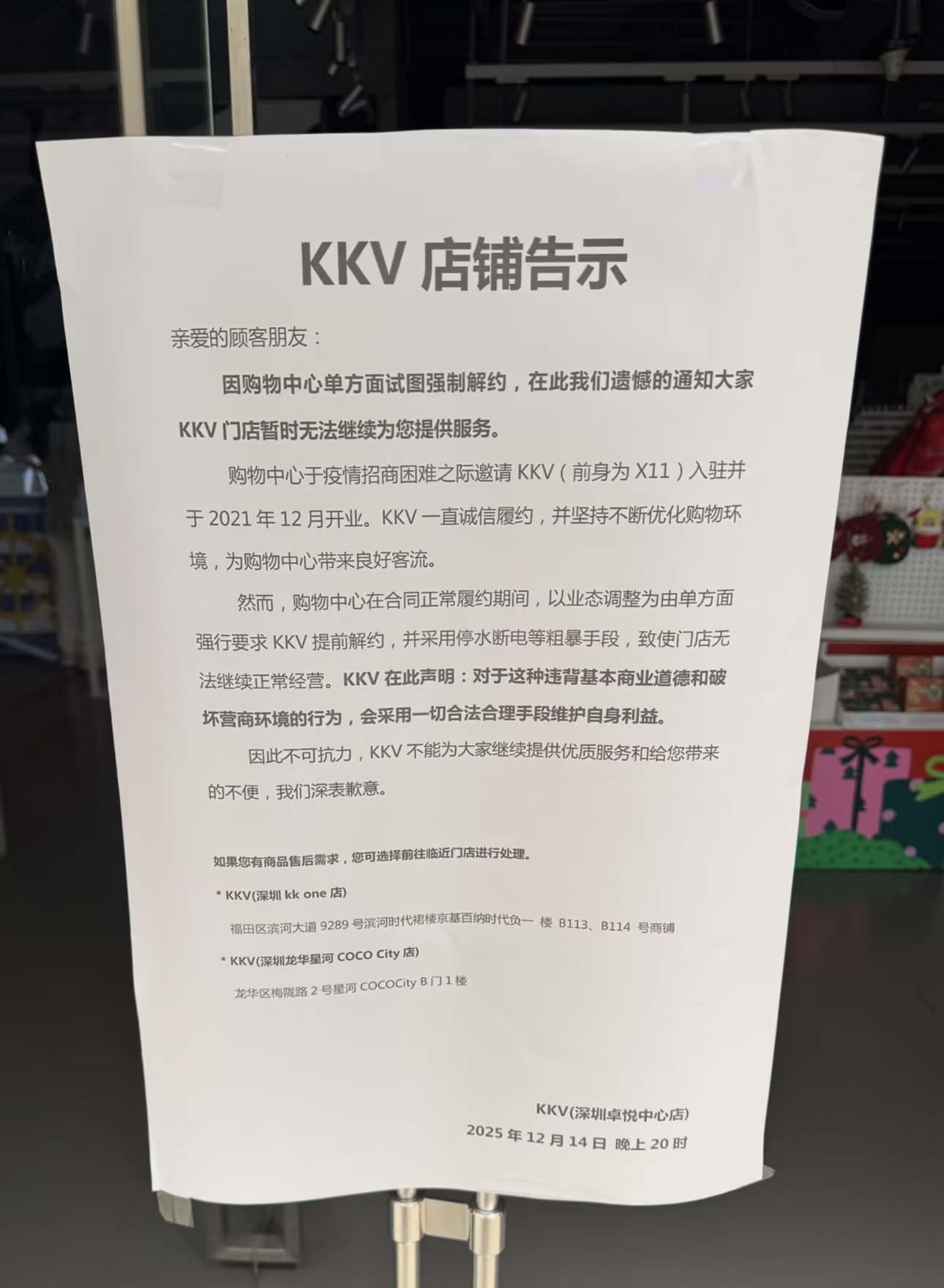
KKV深圳门店称被业主方逼走,双方回应
Xin Lang Cai Jing· 2025-12-18 11:51
Core Viewpoint - KKV's Shenzhen store has suspended operations due to a unilateral termination of the lease by the shopping center, which claims to be adjusting its business model, leading to disputes over the contract [1][4]. Company Summary - KKV's parent company, KK Group, signed a cooperation agreement with the shopping center in September 2021, committing to a partnership from 2021 to 2027, and invested nearly 10 million in operations and IP collaborations [1]. - KK Group's latest financial performance shows a significant improvement, with revenue for January to October 2023 reaching 4.749 billion, a 55.5% year-on-year increase, and an operating profit of 376 million [11]. - Despite recent improvements, KK Group faces challenges such as high sales expenses and a lack of product differentiation, relying heavily on third-party brands for over 80% of its sales [12]. Industry Summary - The shopping center industry is experiencing a shift from development-driven to operation-driven models, with over 3,067 shopping centers in operation as of December 2024, and a slowdown in new openings [6]. - The traditional retail model is being disrupted, emphasizing the importance of social attributes and customer comfort in shopping spaces [6]. - The competition in the retail space is intensifying, particularly in Shenzhen's Futian District, where the shopping center must compete with established centers like Ping An Finance Center and COCO Park [6][8].

户外风刮到购物中心一层
经济观察报· 2025-11-21 12:24
Core Viewpoint - The increasing presence of outdoor brands on the first floor of shopping centers is reshaping the commercial value of these spaces, moving away from traditional luxury and fashion brands to high-end outdoor sports brands [2][4]. Group 1: Market Trends - Beijing Raffles has seen about 40% of its first-floor area occupied by high-end outdoor sports brands after three years of adjustments, indicating a significant shift in tenant composition [6][7]. - The outdoor sports industry in China is experiencing rapid growth, with participation reaching 540 million people in 2023 and an expected market size exceeding 600 billion yuan in 2024, reflecting a compound annual growth rate of over 30% in the past five years [7][8]. Group 2: Brand Strategy - Brands like The North Face are relocating their stores from higher floors to the first floor, focusing on larger spaces and enhanced customer experiences, with sales per unit area increasing enough to offset higher rents [10][16]. - The introduction of flagship stores and concept stores by outdoor brands is prioritized by shopping centers, as these formats emphasize experiential consumption and community engagement [13]. Group 3: Consumer Engagement - Outdoor brands are leveraging their physical spaces to create unique consumer experiences, such as hosting community events and activities that enhance customer engagement and increase dwell time in shopping centers [13][15]. - The clustering effect of outdoor brands in shopping centers is creating a brand community, which helps in attracting high-income consumers who are already familiar with outdoor products [14]. Group 4: Future Outlook - Shopping centers are adapting their space planning and tenant mix in response to the growing presence of outdoor brands, with a focus on health and sports-related retail as essential components of their future strategies [15][16]. - Companies like CapitaLand are planning to introduce additional health and outdoor-related retail brands in their shopping centers to align with evolving consumer preferences towards active lifestyles [15].