
贷款三查

Search documents
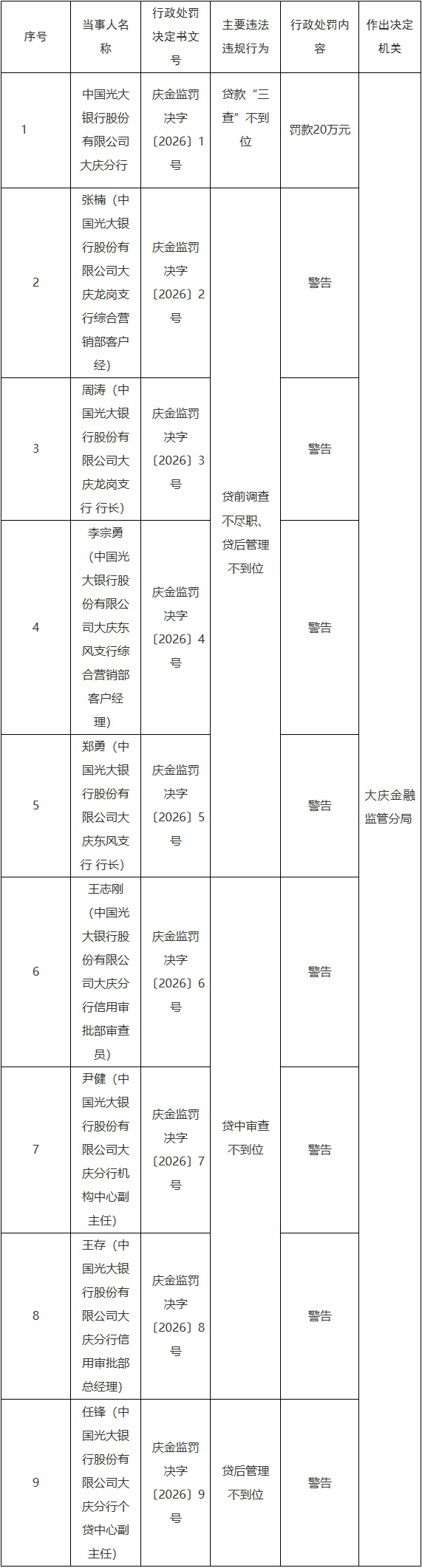
光大银行大庆分行被罚多人被警告 "三查"不到位
Zhong Guo Jing Ji Wang· 2026-02-02 08:08
Core Viewpoint - The Daqing branch of China Everbright Bank was fined for inadequate loan management practices, specifically failing to conduct proper "three checks" on loans [1][2]. Summary by Categories Regulatory Actions - The Daqing Financial Regulatory Bureau imposed a fine of 200,000 yuan on China Everbright Bank's Daqing branch for not meeting loan management standards [1][2]. - Warnings were issued to several individuals associated with the bank, including branch managers and customer managers, for their roles in the inadequate loan management practices [1][2][3]. Individuals Involved - The following individuals received warnings: - Zhang Nan, Customer Manager at Daqing Longgang Branch - Zhou Tao, Branch Manager at Daqing Longgang Branch - Li Zongyong, Customer Manager at Daqing Dongfeng Branch - Zheng Yong, Branch Manager at Daqing Dongfeng Branch - Wang Zhigang, Reviewer at Daqing Branch's Credit Approval Department - Yin Jian, Deputy Director at Daqing Branch's Institutional Center - Wang Cun, General Manager at Daqing Branch's Credit Approval Department - Ren Feng, Deputy Director at Daqing Branch's Personal Loan Center [1][2][3][4].


1.6万亿资产农商行,被罚!
中国基金报· 2025-12-26 04:26
Core Viewpoint - Chongqing Rural Commercial Bank was fined 8.7 million yuan due to multiple business violations, with two responsible individuals banned for life from the banking industry, including former vice president Shu Jing who was already dismissed last year [2][4][8]. Summary by Sections Administrative Penalty - The Chongqing Rural Commercial Bank and its branches were penalized for various illegal activities, including inadequate diligence in the "three checks" for loans, insufficient investigation and accountability for large risk losses, errors in non-on-site statistical data, failure to verify the source of guarantees, and rolling invoices [4][5]. Major Violations - Specific violations included: - Inadequate diligence in the "three checks" for loans - Insufficient investigation and accountability for large risk losses - Errors in non-on-site statistical data - Failure to verify the source of guarantees - Rolling invoices [4][5][7]. Responsible Individuals - The penalties included lifetime bans for Shu Jing (former vice president) and Feng Hongwei (former chief loan officer) from engaging in banking work due to their responsibility for the violations related to the "three checks" [7]. - Additional individuals received warnings or fines of 50,000 yuan, including managers from various departments and branches [7]. Background on Shu Jing - Shu Jing was previously dismissed from her position in March 2024 and was under investigation for serious misconduct, including accepting gifts and bribes, failing to perform her duties properly, and misusing financial resources for personal gain [9]. Bank Overview - Chongqing Rural Commercial Bank, established in 1951 and officially formed in 2008, became the first rural commercial bank listed in Hong Kong and later in Shanghai, achieving "A+H" share status [10]. - As of Q3 2025, the bank reported total assets of 1.66 trillion yuan, a 9.3% increase from the beginning of the year, with total loans amounting to 777.973 billion yuan, an 8.92% increase [10]. - The bank's revenue for the first three quarters was 21.658 billion yuan, a year-on-year increase of 0.67%, and net profit attributable to shareholders was 10.694 billion yuan, up 3.74% year-on-year [10].

重庆农商行领870万元罚单,原副行长与首席审贷官被终身禁业
Xin Lang Cai Jing· 2025-12-25 12:51
Core Viewpoint - Chongqing Rural Commercial Bank was fined a total of 8.7 million yuan due to negligence in loan "three checks" and other compliance issues, leading to significant penalties for several executives [1][4]. Group 1: Regulatory Actions - The bank was penalized for inadequate diligence in loan "three checks," failure to investigate and hold accountable for large risk losses, and errors in non现场 statistical data [1][4]. - Former Vice President Shu Jing and Chief Credit Officer Feng Hongwei were banned for life from the banking industry due to their roles in the negligence [1][4]. - Other executives, including two former general managers of the corporate business department, received warnings and fines of 50,000 yuan each for similar issues [1][4]. Group 2: Background on Loan "Three Checks" - The loan "three checks" is a fundamental risk control mechanism in bank credit management, consisting of pre-loan investigation, in-loan review, and post-loan inspection [1][4]. Group 3: Executive Misconduct - Shu Jing was previously expelled from the party and public office for serious violations, including accepting gifts and engaging in illegal business activities using his position [2][6]. - The bank's board decided to dismiss Shu Jing on March 28, 2024, following investigations into his misconduct [2][6]. Group 4: Financial Performance - For the first three quarters of the year, Chongqing Rural Commercial Bank reported operating income of 21.658 billion yuan, a year-on-year increase of 0.67%, and a net profit attributable to shareholders of 10.694 billion yuan, up 3.74% [3][6]. - As of the end of September, the bank's total assets exceeded 1.65 trillion yuan [3][6].
重庆银行再因贷款违规被罚 220万,万亿规模下风控待加强
Nan Fang Du Shi Bao· 2025-10-23 11:16
Core Viewpoint - Chongqing Bank has faced regulatory penalties due to non-compliance with loan management practices, specifically the "three checks" process, which is critical for risk control in lending operations [1][3]. Group 1: Regulatory Issues - Chongqing Bank was fined 2.2 million yuan for failing to conduct due diligence in its loan "three checks" and for imprudent investment practices [3]. - This is not the first instance of regulatory issues for Chongqing Bank; it previously faced a fine of 400,000 yuan for similar violations in November 2024 [1][2]. Group 2: Financial Performance - As of July 2025, Chongqing Bank's total assets reached 1,008.7 billion yuan, an increase of 152.1 billion yuan, representing a growth rate of 17.76% compared to the end of the previous year [2]. - For the first half of 2025, the bank reported operating income of 7.659 billion yuan, a year-on-year increase of 7.00%, and a net profit attributable to shareholders of 3.19 billion yuan, up 5.39% year-on-year [5]. Group 3: Asset Quality and Capital Adequacy - As of mid-2025, Chongqing Bank's non-performing loan (NPL) ratio was 1.17%, a decrease of 0.08 percentage points from the end of the previous year, while the provision coverage ratio improved to 248.27%, up 3.19 percentage points [4]. - However, the bank's capital adequacy ratios have declined compared to the end of 2024, with the core tier 1 capital adequacy ratio at 8.80%, tier 1 capital adequacy ratio at 9.94%, and total capital adequacy ratio at 12.93% [4]. Group 4: Loan Structure - Chongqing Bank has a significant reliance on loans to state-owned enterprises, with such loans accounting for 78.17% of its total corporate loans as of 2024 [4].

强化金融监管须敢于亮剑
Jing Ji Ri Bao· 2025-10-09 22:36
Core Points - The recent penalties imposed by the Beijing Regulatory Bureau of the National Financial Supervision Administration highlight the serious violations by commercial banks regarding the "three checks" in loan management [1][2] - The "three checks" refer to pre-loan investigation, in-loan review, and post-loan inspection, which are crucial for ensuring the safety of credit funds and maintaining financial stability [1][2] - The financial regulatory authority has emphasized strict enforcement and comprehensive supervision to mitigate financial risks and guide financial resources towards the real economy [1][3] Summary by Sections Loan Management Violations - Commercial banks have been penalized for failing to adhere to the "three checks" process, which is essential for safeguarding deposit security and financial stability [1][2] - The penalties reflect a broader effort to strengthen regulatory oversight and prevent financial risks [1][3] Importance of "Three Checks" - The "three checks" process is vital for the entire credit management system, ensuring that loan funds are allocated safely and effectively [1][2] - Banks conduct pre-loan investigations to assess borrowers' capabilities, which helps in making informed lending decisions [1][2] Regulatory Measures - The financial management department has enhanced its regulatory framework, focusing on five key areas: institutional, behavioral, functional, penetrating, and continuous supervision [3] - Recent legislative progress includes the draft revision of the Banking Supervision Law, aimed at improving regulatory effectiveness and addressing significant financial risks [3]
单月罚单份数逾百 “职业背债”现象引思考
Jin Rong Shi Bao· 2025-08-14 03:06
Regulatory Actions - In July 2025, a total of 132 fines were issued to rural small and medium financial institutions, with 205 individuals penalized and a total fine amounting to 88.0687 million yuan, indicating a significant increase compared to the first half of the year and the same period last year [1] - The fines included 36 from the financial regulatory authority and 96 from the People's Bank of China branches, highlighting a trend of increased regulatory scrutiny [2] - Seven fines exceeded 2 million yuan, with the largest fine of 4.55 million yuan issued to a rural financial institution in Wenzhou for various compliance failures [3] Compliance Issues - Among the 36 fines from the financial regulatory authority, 22 were related to loan management, although the proportion has slightly decreased; however, issues related to concealing bad debts and corporate governance have increased [4] - Specific compliance failures included improper loan classifications, unauthorized issuance of loans to clients with existing issues, and inadequate governance practices in some institutions [4] - The regulatory focus has expanded to include compliance in financial technology and data security, with 22 fines related to these areas in July [4] "Occupational Debt" Phenomenon - The "occupational debt" issue has emerged as a significant concern, where individuals with no actual loan needs are manipulated by illegal loan intermediaries to obtain loans, leading to widespread defaults [5][6] - This phenomenon often involves personal consumption loans and small business loans, which are typically processed online, increasing the risk of inadequate management and oversight [6][7] - The involvement of bank staff in these schemes has been noted, with internal control failures contributing to the problem, necessitating improved internal governance and a shift in performance evaluation metrics [8]