资源安全+全球治理

Search documents
中国布局了整整15年,终于对西方铁矿定价权,发动了致命一击
Sou Hu Cai Jing· 2025-12-17 18:05
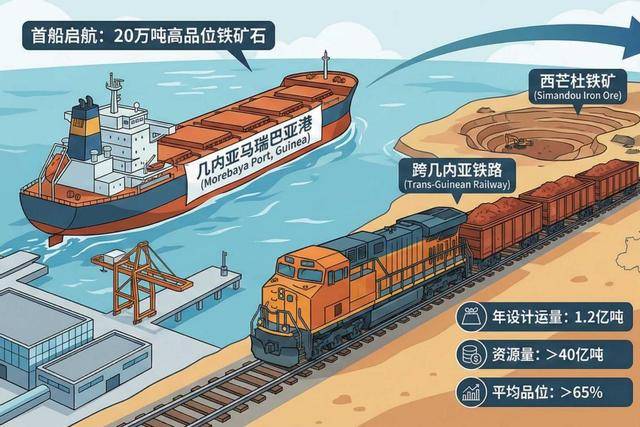
Core Viewpoint - The successful launch of the Simandou iron ore project marks a significant shift in China's iron ore supply strategy, potentially reducing reliance on Australian and Brazilian mining companies [1][16]. Group 1: Project Launch and Infrastructure Development - A cargo ship carrying 200,000 tons of high-grade iron ore departed from Guinea's Marrebaya port, indicating the official commencement of the Simandou iron ore project after 15 years of planning [1][3]. - The project benefited from China's infrastructure capabilities, with China Railway constructing a 650-kilometer railway and China Harbour Engineering building the Marrebaya deep-water port, which has a capacity of 120 million tons per year [5][8]. - The railway and port construction utilized modular construction techniques, significantly reducing the timeline for completion [5][7]. Group 2: Historical Context and Stakeholder Dynamics - Chinese companies gradually gained control over the Simandou project, starting with a 2010 agreement between Chalco and Rio Tinto, leading to the formation of a consortium in 2011 [12][14]. - A pivotal moment occurred in 2019 when a consortium of Chinese firms invested $14 billion to secure the northern block, marking the first time Chinese companies held a dominant position in the project [14]. - By 2024, China Baowu Steel purchased a 49% stake from the winning alliance, establishing a balance of power among Baowu, Rio Tinto, and the Guinean government [14][16]. Group 3: Market Impact and Strategic Significance - The Simandou project is expected to account for approximately 5% of global iron ore supply and 10% of China's imports, which could weaken the market dominance of Australian and Brazilian firms [16]. - Recent changes in pricing strategies, such as BHP accepting payments in RMB, indicate an increase in China's influence over iron ore pricing [16]. - The project enhances China's long-term steel supply security, allowing for potential exports to emerging markets in Southeast Asia and Africa in the future [18][20]. Group 4: Collaborative Model and Global Strategy - The success of the Simandou project is attributed not only to financial investment and technology but also to a balanced approach to local partnerships, creating jobs and improving infrastructure in Guinea [20][22]. - This model of cooperation helps avoid accusations of neo-colonialism while ensuring that local governments and communities benefit from resource development [20][22]. - The launch of the Simandou project exemplifies China's dual strategy of resource security and global governance, showcasing the evolution of Chinese companies from participants to leaders in international projects [22].