
超低价中标

Search documents
设备白送,耗材翻5倍!医疗采购\"1元中标\"的隐秘生意经还能持续多久?
Xin Lang Cai Jing· 2026-02-24 11:06
Core Viewpoint - The recent notice from Hubei Province addresses the issue of "abnormally low bidding" in government procurement, particularly targeting bids as low as "1 yuan" or "0.01 yuan" [1][19]. Group 1: Government Procurement Issues - The focus on abnormally low bids is not new, with previous regulations implemented in regions like Jiangxi, Guangxi, and Jiangsu, emphasizing scrutiny on bids below 50% of the average price or 45% of the maximum limit [2][10]. - A notable case involved a hospital with a budget of 3 million yuan for medical equipment, which was awarded to a bid of only 1,000 yuan, leading to increased costs for consumables later on [2][19]. Group 2: Market Dynamics and Company Performance - Companies like Wandong Medical have seen high bidding rates in 2025, with CT, MR, and DR equipment winning bids at rates of 47%, 56%, and 50% respectively, but this has come at the cost of profitability [3][20]. - Wandong Medical forecasts a net loss of 199 million to 257 million yuan for 2025, marking the worst annual performance since its listing, while Mindray's gross margin has dropped by 4.59 percentage points to 61.21% [3][15][28]. Group 3: Competitive Strategies and Industry Trends - The intense competition in the in-vitro diagnostics (IVD) sector has led to a significant reduction in the number of companies, from 2,320 to 1,530 between 2023 and 2025, with many resorting to extreme pricing strategies to capture market share [5][23]. - Companies often employ a bundling strategy, offering low-priced equipment while charging high prices for consumables, leading to increased overall costs for hospitals [6][24]. Group 4: Regulatory Responses - The national government has begun to take serious measures against low-cost bidding practices, with new regulations set to take effect in 2026 that will enforce scrutiny on bids significantly below average prices [9][25]. - Hubei Province has established specific thresholds for triggering reviews of abnormally low bids, which may be adjusted based on actual circumstances [11][27]. Group 5: Future Directions for the Medical Equipment Market - Companies are increasingly focusing on international markets and developing differentiated products to navigate the pressures of price competition [16][29]. - The need for innovation is emphasized as the industry shifts from a manufacturing to a creative approach, highlighting the importance of driving growth through new product development [30][31].



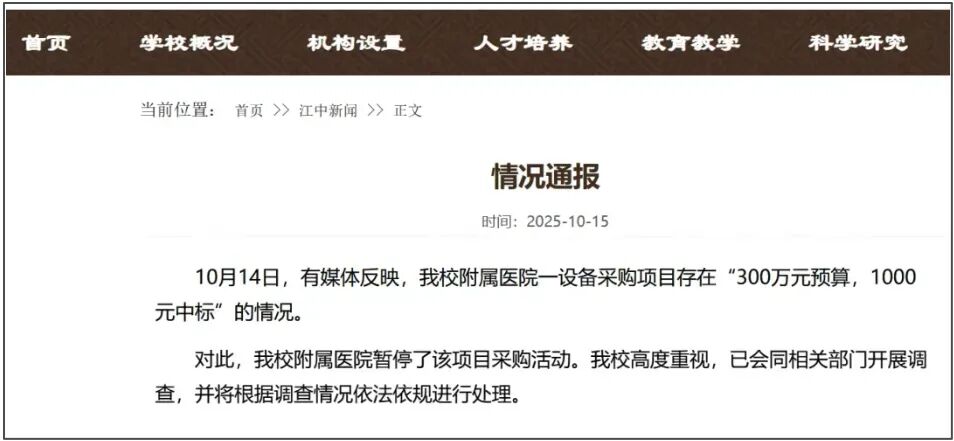
300万元采购医疗设备1000元中标,为何令人担忧
Qi Lu Wan Bao Wang· 2025-10-15 08:40
Core Viewpoint - The incident of "ultra-low bid" in the procurement process of Jiangxi University of Traditional Chinese Medicine Hospital raises serious concerns about the integrity and quality of medical equipment procurement [1][2] Group 1: Incident Overview - Jiangxi University of Traditional Chinese Medicine Hospital had a budget of 3 million yuan for the procurement of fully automatic biochemical immunoassay analysis equipment, but a company won the bid with a price of only 1,000 yuan [1] - The hospital has suspended the procurement activity following the public outcry regarding the suspiciously low bid [1][2] Group 2: Implications of Ultra-Low Bidding - The significant price discrepancy suggests potential collusion between the bidding parties, raising questions about the legitimacy of the bidding process and the quality of the products offered [1][2] - The phenomenon of "ultra-low bidding" in public hospital procurement is not isolated, with extreme cases reported, such as a complete production line being bid at 1 yuan [2] Group 3: Industry Concerns - The prevalence of "ultra-low bidding" undermines the competitive order in the medical industry, potentially leading to inferior quality products entering hospitals, which directly affects patient health [2] - The Ministry of Finance has recognized this issue and is piloting measures in cities like Beijing and Shanghai to address abnormal low-price bids, emphasizing the need for quality over price in procurement [2]