价格战

Search documents
如何展望石膏板价格趋势
2026-04-01 09:59
Summary of Conference Call on Gypsum Board Industry Industry Overview - The gypsum board market in March 2026 experienced its worst performance in a decade, with sales in East China declining by 30%-40% year-on-year due to project payment rates of only 25%-30% and a significant reduction in new projects [1][2][3]. - Major manufacturers like North New and Taishan issued price increase notices to counter rising energy costs and stimulate inventory stocking, but the effectiveness of these measures remains to be seen until the end of May [1][2]. Key Insights and Arguments - **Price Trends**: From 2024 to the end of 2025, the gypsum board and light steel keel industry is expected to be in a downward price trend, with a particularly rapid decline in 2024. Although prices will continue to drop in 2025, the rate of decline is expected to slow down [2][3]. - **Market Demand**: The overall demand for gypsum boards in March 2026 was weak, primarily due to poor project payment conditions and a significant decrease in new projects. Sales in East China are projected to drop to around 60-70 million RMB, down from approximately 100 million RMB in the same month last year [3]. - **Price War Dynamics**: The price war in the industry has led to extremely thin margins, with manufacturers reluctant to engage in bottomless price competition. The average price of ordinary gypsum boards has fallen below 7 RMB per square meter [1][4][5]. - **Foreign Brand Strategies**: Companies like Saint-Gobain and Knauf are shifting their focus from market share to gross profit margins, with Knauf aiming for a 5% increase in gross margin in 2026 [1][4][17]. Competitive Landscape - **Differentiated Pricing Strategies**: Foreign brands maintain stable pricing in the high-end home decoration market while engaging in aggressive pricing for ordinary gypsum boards to compete with local brands [4][5]. - **North New's Market Strategy**: North New attempted to penetrate the high-end home decoration market through price cuts but faced challenges due to brand recognition issues. The overall industry sales are expected to remain flat or slightly decline in 2026 [1][6][17]. Inventory and Sales Dynamics - **Inventory Management**: Manufacturers focus on production line utilization rather than factory inventory levels. Dealers typically aim for a stock turnover period of no more than three months to avoid financial pressure [9][10]. - **Profit Margins**: The profit margin for first-level dealers is very low, typically between 1.5% and 2%. Dealers accept low or negative margins on gypsum board sales as they rely on selling higher-margin complementary products for profitability [11][12]. Future Outlook - **Demand Forecast**: The overall demand for gypsum boards in 2026 is expected to remain stable, with no significant declines or explosive growth anticipated. The industry's demand is closely tied to the real estate market, which is currently facing challenges [16][17]. - **Price Strategy Adjustments**: There is no unified price increase strategy among market participants, and the actual price adjustments will depend on real market conditions observed in the coming months [16][18]. Conclusion - The gypsum board industry is currently facing significant challenges, including weak demand, aggressive pricing strategies, and a competitive landscape that is shifting towards maintaining profit margins rather than market share. The effectiveness of recent price increase notices and the overall market response will be critical to watch in the coming months.

涨幅达百元!两轮电动车将迎涨价潮:门店称已接通知,九号等正缩减优惠
新浪财经· 2026-03-30 10:15
Core Viewpoint - The two-wheeled electric vehicle market is expected to experience a price increase starting from April 2026, driven by rising raw material costs and the expiration of factory rebate policies [3][7][10]. Group 1: Price Increase Announcement - Major brands such as Ninebot, Yadea, Tailg, and Aima are planning to raise prices for several models, with expected increases ranging from 200 to 300 yuan [7][10]. - Ninebot has confirmed a reduction in discounts for some models, effectively raising prices by 100 yuan due to increased raw material costs [9]. Group 2: Consumer Sentiment - Consumer acceptance of price increases is uncertain, especially in light of previous price wars in the industry, with some consumers expressing intentions to boycott brands that raise prices [4][12]. - Social media feedback indicates a strong resistance to price hikes, with consumers stating they would not purchase if prices increase [4][12]. Group 3: Raw Material Costs - The price of battery-grade lithium carbonate has been on the rise, reaching 161,000 yuan per ton, with a recent increase of 5,000 yuan per ton, marking an 11.03% rise over the past week [10]. - The ongoing increase in raw material costs is expected to pressure manufacturers, leading to potential price adjustments in the two-wheeled electric vehicle sector [10]. Group 4: Profit Margins - The intense price competition in the two-wheeled electric vehicle market has compressed profit margins for leading brands like Aima and Yadea, with Aima's gross margin fluctuating between 16.36% and 17.82% from 2022 to 2024, and Yadea's margin dropping from 18.08% to 15.19% [11].





如何遏制创业公司?
乱翻书· 2026-03-30 05:53
Core Viewpoint - The article discusses how dominant tech companies employ various strategies to suppress new entrants in the market, shifting the focus from consumer harm to protecting competition itself [1][3]. Group 1: Market Dominance and Competitive Suppression - Companies with absolute market dominance may use tactics such as exclusive channel agreements, supply chain restrictions, non-compete clauses, capital suppression, price wars, and patent litigation to stifle new competitors [3][5]. - The case of Insta360 founder Liu Jingkang illustrates how established players can create systemic barriers for newcomers, as seen in the drone market where Insta360 faced significant challenges from larger competitors [1][4]. Group 2: Supply Chain and Exclusive Agreements - The concept of "two-choice" in supply chains is presented as a normal market behavior, but it can effectively eliminate competition by forcing suppliers to choose sides, often disadvantaging new entrants [3][4]. - Historical examples show that established companies may impose informal agreements to prevent suppliers from working with competitors, thereby creating a non-competitive environment [4][5]. Group 3: Talent Suppression through Non-Compete Clauses - Non-compete agreements are highlighted as a significant barrier to talent mobility, effectively locking skilled workers in place and preventing them from joining or starting new ventures [9][13]. - The article notes that the proliferation of such agreements leads to a buyer's monopoly in the labor market, stifling innovation and competition [12][13]. Group 4: Capital and Price Wars - Companies may engage in capital warfare by investing in competitors or launching price wars to undermine the financial viability of new entrants [14][16]. - Price wars can lead to unsustainable business practices for startups, as established firms can absorb losses due to their diversified revenue streams, while new companies often cannot [17][18]. Group 5: The Need for Open Competition - The article concludes that competition must remain open for new entrants and smaller competitors to ensure innovation and market diversity, emphasizing the importance of fair access to resources and opportunities [18].

美丽小家电,被扯下遮羞布
投中网· 2026-03-20 08:10
Core Viewpoint - The small home appliance industry is facing significant challenges due to widespread quality issues and deceptive marketing practices, highlighted by the recent revelation of "fake temperature control knobs" in air fryers, which undermines consumer trust and threatens the industry's reputation [4][5][11]. Group 1: Industry Challenges - The discovery of "fake temperature control knobs" in multiple brands, including Rongshida, Zhigao, and Rongsong, has exposed a collective failure in the small appliance sector, further damaging an already struggling industry [4][11]. - Quality issues are rampant, with a reported 50% non-compliance rate in mini washing machines and an overall appliance non-compliance rate of 14.87%, primarily in low-priced products [14][15]. - The phenomenon of "fake functions" and "false parameters" is pervasive, making it difficult for consumers to identify subpar products, leading to safety concerns and potential hazards [12][13]. Group 2: Market Trends - The small appliance industry experienced explosive growth during the pandemic, but since 2022, it has seen a decline in retail sales and volume, with kitchen appliance retail sales dropping by 0.8% in 2024 [19][20]. - The average price of kitchen appliances is expected to rise by 10.6% in 2025, indicating a shift towards higher-end products, while low-end products continue to struggle [27]. - The market is becoming increasingly polarized, with mid-to-high-end products gaining traction due to technological advancements, while low-end brands face declining sales [28][29]. Group 3: Consumer Behavior - Consumers are becoming more discerning, prioritizing practicality and innovation over aesthetics, leading to a high idle rate of around 70% for small appliances [21][22]. - The demand for genuinely useful products is rising, as consumers are less willing to be swayed by marketing gimmicks and are willing to pay more for quality [24][34]. - The shift in consumer expectations necessitates that brands focus on solving real user pain points rather than relying on superficial features [30][34]. Group 4: Future Opportunities - The future of the small appliance market lies in innovation and targeted product development, with companies encouraged to focus on core products and eliminate inefficient offerings [31][32]. - Expanding into international markets is becoming a common strategy among small appliance companies, with some reporting double-digit growth in regions like Southeast Asia and Europe [32]. - Brands must adapt to the changing landscape by enhancing product differentiation and addressing consumer needs to avoid being left behind [35].

BBA中国高层全部换人,换帅如换刀?
阿尔法工场研究院· 2026-03-06 00:03
Core Viewpoint - The article highlights the significant challenges faced by traditional luxury automotive brands (BBA: BMW, Benz, Audi) in the Chinese market, emphasizing the need for leadership changes and strategic shifts towards electrification and market adaptation [4][5][20]. Group 1: Leadership Changes - Recent leadership changes in BBA reflect a response to unprecedented challenges in the Chinese market, with key executives being replaced to bring fresh perspectives and strategies [5][14]. - BMW's Sean Green will be succeeded by Christian Ach as of April 1, 2026, while Beijing Benz's first local CEO, Duan Jianjun, will transition to a strategic advisor role [7][9]. - Audi's Daniel Weissland has been appointed as the general manager of FAW Audi, indicating a broader trend of reshuffling among BBA's leadership in China [13][14]. Group 2: Market Performance - The Chinese market, once a stronghold for BBA, has seen a decline in performance, with Mercedes-Benz's sales dropping by 19.5% to 575,000 units in 2025, returning to 2017 levels [18]. - BMW's sales in China fell by 12.5% to 625,000 units, while Audi's sales decreased by 5% to 617,500 units, marking a concerning trend of negative growth [18][19]. - Profitability has also suffered, with Mercedes-Benz's adjusted EBIT dropping by 40% to €8.2 billion, and net profit nearly halving to €5.33 billion [18]. Group 3: Price War Dynamics - BBA is caught in a dilemma regarding price wars; lowering prices risks their premium market positioning, while not participating could lead to faster declines in market share [22][23]. - The recent price cuts initiated by BMW, with reductions exceeding 20% on several models, followed by similar actions from Mercedes-Benz and Audi, indicate a fierce competitive environment [27][28]. - The ongoing price war is expected to continue in the short term as BBA seeks to attract consumers and regain market share amidst increasing competition from local brands [29][30]. Group 4: Strategic Plans for Electrification - The new leadership is expected to leverage their experience in electric vehicle (EV) transitions to revitalize BBA's presence in the Chinese market [32][34]. - Mercedes-Benz plans to introduce over 15 new and updated models by 2026, focusing on various luxury segments and enhancing cost efficiency [36][37]. - BMW and Audi are also ramping up their electric vehicle offerings, with new models set to launch in 2026, aiming to recover lost ground in the EV market [39][40].

今年首个官宣涨价的车企来了
第一财经· 2026-03-05 08:10
Core Viewpoint - The article discusses the recent price increase of the Chery Automobile's high-end brand, Exeed, specifically for the Exeed ET5 model, highlighting the impact of rising chip costs and the company's strategic decision to ensure long-term product quality and user experience [3][4]. Group 1: Price Adjustment - Exeed announced a price increase for the ET5 model, with the high-end version's price rising by 5,000 yuan, bringing it to 164,900 yuan [3]. - The ET5 was launched in November 2025, with initial prices set at 144,900 yuan for the base model and 159,900 yuan for the high-end version, which included a lifetime free use of advanced driving features [3]. Group 2: Industry Context - The price increase reflects a broader trend in the automotive industry, where companies are responding to supply chain cost pressures after nearly two years of price wars [4][5]. - Industry data indicates a significant rise in automotive storage chip prices since the second half of 2025, with car-grade DRAM prices increasing by 180% over the past three months, and DDR4 and DDR5 memory prices rising by over 150% and 300%, respectively [6]. - Recent reports suggest that the rising costs of metals and storage chips will impose substantial cost pressures on automotive manufacturers, potentially increasing costs by 1,000 to 3,000 yuan, which could adversely affect the cost structure of electric vehicles [6].

台铃上市不为融资拿钱,只为将资产尽快 “货币化”
晚点LatePost· 2026-03-02 14:41
Core Viewpoint - The article discusses the impact of new national standards on the electric two-wheeler market in China, highlighting both the growth potential and the challenges faced by leading companies like Taili Technology in the context of market saturation and regulatory changes [5][9][36]. Group 1: Market Dynamics - The electric bicycle market is currently experiencing a transitional phase characterized by low inventory among dealers and consumer hesitation due to new national standards [5]. - The new standards impose strict technical parameters, which will likely lead to a market consolidation, benefiting leading manufacturers while squeezing out smaller players [5][19]. - By 2025, the total number of electric two-wheelers in China is expected to reach at least 425 million, surpassing the number of cars [5]. Group 2: Competitive Landscape - Taili Technology, as the third-largest player in the industry, has submitted its IPO application, but its timing is seen as lagging compared to competitors [9][10]. - The market is shifting towards a low-growth phase, with the penetration rate of electric two-wheelers exceeding 50% among the population aged 16 to 59 [7]. - The competitive landscape is marked by price wars and a struggle for market share, particularly as the industry approaches a saturation point [19][22]. Group 3: Financial Performance and Projections - Taili's sales for the first three quarters of 2025 reached 7.83 million units, with expectations of around 9 million units for the year [17]. - The company has significantly increased its dealer network, growing from 2,657 to 5,597 dealers by Q3 2025, an increase of 80% [17][28]. - Despite the growth, the overall market is projected to face oversupply, with a return to normal sales levels between 40 million and 50 million units annually [21]. Group 4: Strategic Implications of IPO - The IPO is seen as a strategic move for Taili to enhance its credibility and competitive position in a highly regulated market [36]. - The company aims to monetize its assets and establish a market price for potential future mergers and acquisitions [36]. - The timing of the IPO is critical, as it seeks to capitalize on the current high market demand before entering a phase of price competition and reduced profit margins [31][36].

伟星新材20260228
2026-03-01 17:22
Summary of Conference Call for Weixing New Materials Company Overview - **Company**: Weixing New Materials - **Industry**: Home decoration and construction materials, focusing on both retail (To C) and engineering (To B) sectors Key Points Industry and Market Conditions - The home decoration retail sector is significantly impacted by a weak macroeconomic environment and consumer fatigue, with a further decline observed in Q4 2025, showing no clear signs of recovery [2][3] - The engineering sector is experiencing internal differentiation, with overall construction projects remaining weak and municipal engineering showing a downward trend quarter by quarter [2][4] - The company’s To B business is more sensitive to policies and funding, while the To C business is heavily influenced by consumer demand [2][5] Financial Performance - In 2025, the To C home decoration industry is expected to decline by approximately 15%, with the company's retail segment seeing a decrease of about 9% in customer numbers [2][8] - The company’s retail business accounts for about 70% of its operations, emphasizing brand, channel, and service differentiation from low-price strategies [2][5] Pricing Strategy - A price war is prevalent in the industry, with the company initiating a strategy to gradually restore prices starting in early 2025, leading to price stabilization by Q4 2025 [2][7] - The company’s pricing strategy has shown slight growth in Q4 2025 compared to the previous year, contrasting with the general trend of price reductions among competitors [2][7] Product and Business Development - The company is focusing on product iteration to achieve structural price increases and value transmission rather than direct price hikes on existing products [2][9] - The waterproof business has shown slight growth, while the water purification segment has declined significantly due to adjustments in focus and inventory management [2][10] Strategic Acquisitions - The acquisition of "Toyota Cheng Technology" aims to enhance capabilities in gas and heat pipeline systems, contributing approximately 30 to 40 million in revenue in 2025, with a historical peak of 100 to 200 million [2][11][12] International Expansion - The company plans to accelerate its overseas market presence over the next five years, with Southeast Asia identified as a key market, alongside the Middle East and Europe [2][13] - The strategy avoids engaging in price wars internationally to prevent homogenization with Chinese competitors [2][13] Cash Flow and Financial Health - The company maintains a healthy cash flow and stable accounts receivable, with no significant increase compared to 2024 [2][14] - Historical dividend payout ratios are around 70% to 80%, indicating a sustainable approach to shareholder returns [2][15] Future Outlook - The company adopts a cautious approach towards the macroeconomic outlook for 2026, focusing on innovation and operational efficiency [2][4][16] - Plans to enhance high-end brand positioning and overall solutions rather than competing on price alone [2][16] - The company is also considering market penetration strategies in economically developed rural areas to align with high-end positioning [2][16] Market Share and Competitive Position - The estimated market share for the company in the retail segment is approximately 25% based on new service household counts relative to market renovation households [2][22] Raw Material Costs - Raw material prices are generally low, with notable increases in copper prices affecting certain products, while other materials like PVC remain at historical lows [2][19] Risk Assessment - The overall risk associated with accounts receivable is considered manageable, with no significant changes in scale compared to the previous year [2][24] This summary encapsulates the key insights and strategic directions discussed during the conference call, providing a comprehensive overview of Weixing New Materials' current position and future plans in the home decoration and construction materials industry.

晶科能源12年来首次亏损
Guo Ji Jin Rong Bao· 2026-02-28 03:21
Core Viewpoint - JinkoSolar (688223.SH) reported a significant decline in its 2025 annual performance, with total revenue expected to be 65.492 billion yuan, a year-on-year decrease of 29.18%, and a net profit attributable to shareholders of -6.786 billion yuan, a staggering drop of 6959.50% compared to the previous year [1][3]. Company Performance - The company is facing its first loss in 12 years, with a loss amounting to 6.8 billion yuan, primarily due to intensified price fluctuations in the global photovoltaic industry and trade protection policies in overseas markets [3]. - JinkoSolar's revenue for the first half of 2025 plummeted by 32.63% year-on-year to 31.831 billion yuan, with a net profit attributable to shareholders dropping from a profit of 1.2 billion yuan in 2024 to a loss of 2.909 billion yuan, marking a decline of 342.38% [5]. Industry Context - The photovoltaic industry is experiencing a severe oversupply, with the component segment's oversupply rate exceeding 50% in 2025, leading to aggressive price wars that have severely compressed profit margins [3]. - The average price of photovoltaic components fell to 0.7-0.78 yuan/W, halving from the 2023 peak of approximately 1.5 yuan/W, contributing to the "increased volume, decreased price, and profit loss" scenario [3]. - Rising raw material costs, including a more than 60% increase in polysilicon prices and a 140% rise in silver prices, have further eroded profits, creating a situation where production costs exceed sales prices [5]. Strategic Shifts - JinkoSolar aims to transition from a component supplier to a comprehensive energy solution provider in response to the challenging market conditions [3]. - The company has historically achieved significant milestones, including becoming the world's largest solar module supplier in 2018 and achieving a 62% share of N-type module shipments in 2023, but is now facing threats from emerging technologies [4].

外卖大战成“利润收割机”?瑞幸净利下跌
Jin Rong Jie· 2026-02-28 00:25
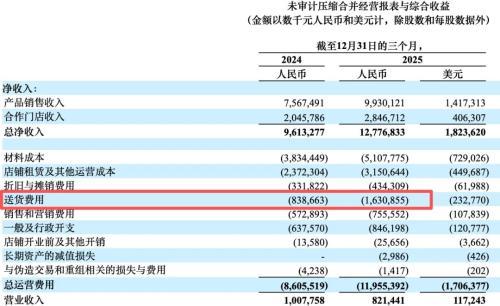
Core Viewpoint - Luckin Coffee achieved record revenue in 2025 but faced profit erosion due to the "delivery war," indicating a challenging balance between growth and profitability [1] Financial Performance - In Q4 2025, Luckin Coffee reported total net revenue of 49.288 billion RMB, a 43% year-on-year increase, with a net profit of 3.6 billion RMB, up 21.8%, but a declining net profit margin of 7.3% [1] - The company experienced a significant drop in net profit in Q4 2025, falling to 518 million RMB, a 39% year-on-year decrease [1][2] - The delivery costs surged to 1.631 billion RMB in Q4 2025, a 94.5% increase year-on-year, accounting for 12.8% of total revenue, compared to a normal rate of about 8% [2] Market Dynamics - The "delivery war" has negatively impacted Luckin's profitability, despite the company being a key partner for major internet platforms in the instant retail business [2][5] - The company’s sales and marketing expenses rose to approximately 756 million RMB in Q4 2025, a 31.9% increase, primarily due to higher commissions paid to third-party delivery platforms [6] Store Expansion and Performance - As of the end of 2025, Luckin Coffee had over 31,000 stores globally, with a net increase of 8,708 stores in the year, surpassing Starbucks' total store count in China over 27 years [7] - Despite the rapid expansion, same-store sales growth was only 1.2% in Q4 2025, indicating challenges in maintaining sales performance amid increased competition [11] Competitive Landscape - Luckin Coffee faces intensified competition from brands like Kudi Coffee and Nova Coffee, which are expanding rapidly and impacting Luckin's market share [11] - The company has launched over 140 new products in the past year, with non-coffee products now accounting for over 20% of sales, but few have gained significant market recognition [10] Future Outlook - Management indicated that gaining market share remains a priority, but acknowledged potential challenges in same-store sales and profit performance in 2026 due to high baseline from 2025's subsidies [12] - Luckin Coffee is accelerating its international expansion, with 160 overseas stores, but the focus remains on the Chinese market as the most promising for growth [13]