跨大西洋套利

Search documents
原油运费偏强,跨大西洋套利打开
Heng Li Qi Huo· 2026-03-26 02:22
Group 1: Report Industry Investment Rating - No relevant content Group 2: Core View of the Report - The Baltic crude oil freight index increased by 722 points last week, a rise of 25.33%. Geopolitical conflicts and the continuous closure of the Strait of Hormuz provided high - level support to market sentiment. The trans - Atlantic arbitrage window opened, driving up the freight rates on the route from the US Gulf to Europe [1] Group 3: Summary by Directory Data Review - The Baltic crude oil freight index rose 722 points last week, with a 25.33% increase. Geopolitical conflicts and the closure of the Strait of Hormuz supported market sentiment [1] - TD3C (Middle East to China), TD15 (West Africa to China), and TD22 (US Gulf to China) freight rates changed by - 20.60%, + 25.06%, and - 3.73% respectively. In the Middle East route, the arrival of April cargoes at Yanbu Port eased the tight crude oil situation in the Middle East, leading to an overall decline in Middle East VLCC freight rates [1] - The TD25 freight rate from the US Gulf to ARA increased by 184.71%. The trans - Atlantic arbitrage window opened due to the regional differentiation of crude oil prices between Europe and the US, pushing up the freight rates on the US Gulf to Europe route [1]
瑞士金条疯狂涌向美国!单月出口环比暴增170倍
Jin Shi Shu Ju· 2025-08-21 08:48
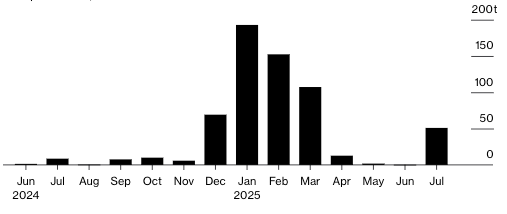
Group 1 - Switzerland's gold exports to the U.S. surged to nearly 51 tons in July, the highest level since March, highlighting trade imbalance issues that prompted President Trump to impose a 39% tariff on the country [1][3] - In the first quarter of this year, Switzerland's gold bar exports were valued at over $36 billion, accounting for more than two-thirds of its trade surplus with the U.S. [3] - The significant increase in gold exports was driven by a potential arbitrage opportunity amid fears that gold might be included in a comprehensive tariff regime [3] Group 2 - The Swiss refining industry plays a crucial role in the cross-border flow of gold, with gold being imported from South America and Africa, refined, and then exported to the U.S. [3][4] - Despite the large amounts involved in gold trade, the refining industry itself is relatively small, with only five companies producing investment-grade gold, employing only a few hundred workers [4] - The Swiss National Bank indicated that the unusually large gold exports to the U.S. should not be considered in evaluating the trade relationship between the two countries [4]