车市政策支持

Search documents
崔东树:2025年1-11月汽车生产同比增11% 新能源汽车生产同比增27% 渗透率47%
智通财经网· 2025-12-15 08:45
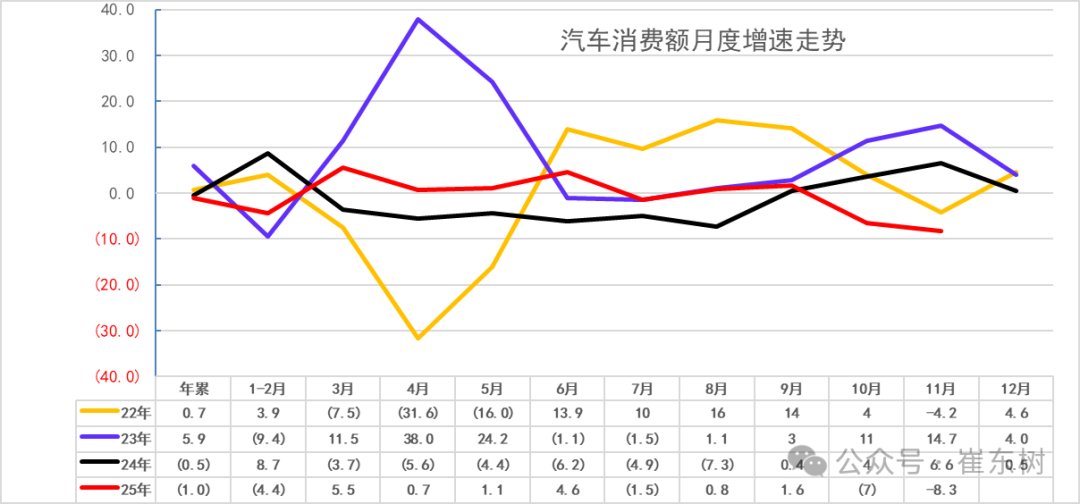
Core Viewpoint - The automotive industry is experiencing a mixed performance in production and consumption, with significant growth in new energy vehicles but challenges in overall market demand and investment stability [1][4][17]. Automotive Production - In November 2025, automotive production reached 352,000 units, a year-on-year increase of 2%, with new energy vehicles (NEVs) accounting for 184,000 units produced, up 17% year-on-year, achieving a penetration rate of 52% [1][15]. - From January to November 2025, total automotive production was 31.09 million units, a year-on-year increase of 11%, with NEVs at 1.453 million units, up 27%, and a penetration rate of 47% [1][15]. - The automotive manufacturing industry saw an increase in value added of 12% in November 2025, contributing to a total increase of 11.8% from January to November 2025 [8][17]. Automotive Consumption - Automotive consumption in November 2025 decreased by 8.3% year-on-year, while the total consumption from January to November 2025 saw a decline of 1% [4][23]. - The overall retail sales of consumer goods in November 2025 reached 43.898 billion yuan, with automotive consumption at 4.454 billion yuan, reflecting a year-on-year decrease of 8% [23]. Investment Trends - Fixed asset investment in the automotive sector grew by 15.3% from January to November 2025, significantly higher than the overall investment decline of 2.6% [17]. - The automotive investment growth is positioned at a historical high compared to other manufacturing sectors, indicating strong sectoral resilience [17]. Market Challenges - The automotive industry faces challenges from a complex external environment, including rising protectionism and insufficient domestic demand, which complicates the growth trajectory [1][4]. - The pressure on the automotive market is expected to increase in 2026, necessitating supportive policies to stimulate consumer demand, such as tax reductions and incentives for purchasing vehicles [1][4]. Economic Context - The overall fixed asset investment in China (excluding rural households) was 444,035 billion yuan from January to November 2025, reflecting a decline of 2.6% year-on-year, with private investment down by 5.3% [17]. - The relationship between real estate and automotive sales has shown improvement, with the ratio of housing area to vehicle sales decreasing from 70 square meters per vehicle in 2020 to 25 square meters in 2025 [22].