
房地产业

Search documents
热点思考 | 投资“开门红”可否持续?(申万宏观·赵伟团队)
申万宏源宏观· 2026-03-29 16:03
Group 1 - The fixed asset investment growth rate rebounded significantly in early 2026, with a historical increase of 16.9 percentage points to 1.8% compared to December 2025, marking a notable recovery across all major sectors including real estate, services, broad infrastructure, and manufacturing [1][8][12] - The construction and installation investment, which had previously declined sharply, saw a remarkable rebound of 28.6 percentage points to 0.6%, contributing significantly to the overall fixed asset investment growth [1][13][19] - The eastern region showed a stronger recovery in investment compared to the central and western regions, with a rebound of 35.6 percentage points in early 2026 [1][13] Group 2 - Investment from different entities showed a clear recovery, with government and state-owned enterprises rebounding earlier than private investments, which began to recover in early 2026 [2][19][23] - Government investment growth reached 3.1% in early 2026 after a decline to -31.3% in October 2025, while private investment saw a year-on-year increase of 14.6% to -2.6% [2][19][23] Group 3 - The rebound in investment was driven by improved conditions regarding previous issues of "lack of funds" and "lack of projects," with the easing of the "broad debt" effect on investment funding [3][31][40] - The issuance of special refinancing bonds improved the funding situation, allowing for a significant rebound in construction and installation investment [3][31][40] - Policies supporting private financing were implemented in early 2026, including a special quota of 1 trillion yuan for small and micro enterprises, which contributed to an investment increase of over 280 billion yuan [3][50][57] Group 4 - The early 2026 launch of a batch of "two heavy" construction projects helped alleviate the previous shortage of project reserves, with the number of projects increasing to 281 and funding raised to 220 billion yuan [4][63][66] - The investment growth rate for new and expanded projects rebounded to around 6% in early 2026, following a significant decline in the latter half of 2025 [4][63] Group 5 - The gap between fixed asset investment and historical trends is estimated to be close to 4 trillion yuan, indicating that while there has been a recovery, significant investment shortfalls remain in manufacturing, broad infrastructure, and real estate [5][67][68] - Incremental fiscal funds are expected to fill the investment gap, particularly in the new infrastructure sector, with a focus on integrating infrastructure investments [5][77][78] - The improvement in cash flow for manufacturing aligns with the investment gap, suggesting a potential for continued upward investment trends, especially in equipment manufacturing [5][86][90]


日美房地产止跌回稳路径复盘:核心城市引领止跌回稳,龙头房企先行弹性十足
Shenwan Hongyuan Securities· 2026-03-24 14:45
Investment Rating - The report maintains a "Positive" rating for the real estate and property management sectors [4][5]. Core Insights - The report draws parallels between Japan and the US, indicating that leading companies' stock prices bottom out before core city housing prices, which in turn precede national housing price bottoms. This pattern suggests that leading real estate companies exhibit significant stock price elasticity [4][6]. - Core cities are expected to lead the recovery in housing prices, driven by factors such as population inflow and improvements in residents' balance sheets. The report anticipates that cities like Shanghai will be at the forefront of this trend [4][5][6]. - The report highlights that the current environment presents attractive investment opportunities, as many quality companies are trading at historical low price-to-book (PB) ratios, making the sector appealing for investment [5][6]. Summary by Sections 1. Japan Crisis Insights - The report reviews Japan's real estate crisis, noting that housing starts, sales, and investments fell by over 50% during the downturn. The stock prices of leading companies began to recover before housing prices did, with significant increases observed from 2003 to 2007 [13][20][24]. 2. US Crisis Insights - Similar patterns were observed in the US, where leading companies' stock prices outperformed housing prices in major cities. The report notes that the stock prices of companies like Horton and Lennar surged significantly during the recovery phase [4][6][20]. 3. China Cycle Insights - The report suggests that the trend of declining household balance sheets in China is nearing an end, with core cities like Shanghai expected to lead the recovery in housing prices. The report emphasizes the importance of population growth, stable rents, and declining interest rates as key factors for this recovery [4][5][6]. 4. Investment Analysis - The report recommends investing in quality real estate companies, commercial real estate, second-hand housing intermediaries, and property management firms, highlighting specific companies such as Jianfa International, Binhai Group, and China Resources Land as potential beneficiaries of the anticipated market recovery [5][6].
房地产行业报告(2026.3.16-2026.3.22):交易修复强于价格修复,边际改善信号增多
China Post Securities· 2026-03-24 04:07
Investment Rating - The industry investment rating is "Outperform the Market" and is maintained [1] Core Insights - The market in March has shown increased activity compared to January and February, indicating that the "small spring" phenomenon is not a false narrative, particularly with strong volume in second-hand housing in Shanghai [3] - The structural characteristics of the current recovery are distinct: second-hand housing is outperforming new housing, Shanghai is outperforming other first-tier cities, low total price properties are outperforming high total price properties, core areas are outperforming peripheral areas, and transaction recovery is stronger than price recovery [3] - The industry index has not yet escaped downward pressure, with low land acquisition premium rates and willingness indicating a lack of confidence in the sustainability of sales recovery and profit realization [3] - Signs of marginal improvement in the industry fundamentals are increasing, suggesting that the bottom is gradually approaching [3] Industry Fundamentals Tracking New Housing Transactions and Inventory - Last week, the new housing transaction area in 30 major cities was 186.28 million square meters, with a cumulative year-to-date transaction area of 1,562.67 million square meters, down 17.7% year-on-year [4] - The average transaction area over the past four weeks in 30 major cities was 146.34 million square meters, down 21.4% year-on-year but up 43.6% month-on-month [4] - First-tier cities saw an average transaction area of 38.85 million square meters, down 30.2% year-on-year, but up 46.2% month-on-month [4] Second-Hand Housing Transactions and Listings - Last week, the second-hand housing transaction area in 20 cities was 266.5 million square meters, with a cumulative year-to-date transaction area of 2,282.91 million square meters, down 6.7% year-on-year [5] - The average transaction area over the past four weeks in these cities was 209.16 million square meters, down 21.6% year-on-year but up 46.6% month-on-month [5] Land Market Transactions - Last week, 100 major cities saw 21 new residential land supplies and 27 residential land transactions, with an average transaction price of 9,567 yuan per square meter and a premium rate of 8.26% [24] - The average transaction price for commercial land was 1,431.25 yuan per square meter, with a premium rate of 0.25% [24] Market Review - Last week, the A-share real estate index fell by 4.21%, while the CSI 300 index fell by 2.19%, indicating that the real estate index underperformed the CSI 300 by 2.02 percentage points [27] - The Hong Kong Hang Seng property services and management index fell by 1.39%, while the Hang Seng composite index fell by 1.69%, with the property services and management index outperforming the composite index by 0.3 percentage points [27]
全球经济观察2026年第5期:转鹰信号重挫金价
Huafu Securities· 2026-03-21 12:52
Global Asset Performance - Gold prices fell significantly by 10.5% this week due to hawkish signals from major central banks[3] - Brent crude oil prices increased by 8.2% this week, with a cumulative rise of 49.1% this month[3] - The U.S. stock market indices all closed lower, with the S&P 500 down by 1.9% and the Dow Jones down by 2.1%[3] Central Bank Monetary Policies - The Federal Reserve maintained the federal funds rate at 3.50% to 3.75%, with expectations for rate cuts pushed to October 2027[4] - The European Central Bank kept key rates unchanged but raised inflation forecasts due to geopolitical tensions, indicating rising stagflation risks[4] - The Bank of Japan reiterated its commitment to potential rate hikes if inflation meets expectations, with a 60% probability of a rate increase in April[4] U.S. Economic Dynamics - New single-family home sales in January decreased by 17.6% month-on-month, with a year-on-year decline of 11.3%[21] - The Producer Price Index (PPI) rose by 0.6 percentage points to 3.4% in February, marking the highest level since March 2025[21] - Concerns over inflation are reignited due to rising oil prices amid ongoing geopolitical conflicts[21] Other Regional Economic Dynamics - The Eurozone's ZEW economic sentiment index dropped to -8.5 in March, indicating a pessimistic outlook due to rising energy prices[39] - Japan recorded a trade surplus of 573 billion yen in February, with exports growing by 4.2% year-on-year[41] - The geopolitical situation has led to a 17% decrease in Qatar's LNG production capacity, significantly impacting European gas prices[25]
今年1-2月财政收入同比增长0.7%,资金面平稳宽松,债市走势分化
Dong Fang Jin Cheng· 2026-03-20 12:26
1. Report Industry Investment Rating - No relevant content provided 2. Core Viewpoints of the Report - On March 19, the capital market showed a mixed performance. The capital market was stable and loose, the bond market had a differentiated trend with short - term bonds remaining strong and long - term bonds weakening. The convertible bond market followed the decline of the equity market, and most convertible bond individual securities fell. The yields of U.S. Treasury bonds of different maturities were also differentiated, and the 10 - year Treasury bond yields of major European economies generally increased [1]. 3. Summary by Directory 3.1 Bond Market News 3.1.1 Domestic News - From January to February this year, the national general public budget revenue was 4.4154 trillion yuan, a year - on - year increase of 0.7%. Among them, national tax revenue was 3.6393 trillion yuan, a year - on - year increase of 0.1%, and non - tax revenue was 776.1 billion yuan, a year - on - year increase of 3.4%. Central general public budget revenue decreased by 1.7% year - on - year, while local general public budget revenue increased by 2.6% year - on - year [3]. - The central bank will continue to implement a moderately loose monetary policy, firmly maintain the stable operation of financial markets such as stocks, bonds, and foreign exchange, and study the establishment of a liquidity support mechanism for non - bank financial institutions in specific scenarios [4]. - The CSRC held a symposium on the "15th Five - Year Plan" of the capital market with investment institutions, and participants put forward suggestions on deepening investment - side reform and enhancing the internal stability of the capital market [5]. - The State Administration of Foreign Exchange will further improve the expectation management mechanism, maintain the stable operation of the foreign exchange market, deepen foreign exchange reform and innovation, and promote high - level opening - up in the foreign exchange field [6]. - The Ministry of Commerce stated that China and the U.S. will continue to play the role of the Sino - U.S. economic and trade consultation mechanism, strengthen dialogue and communication, and promote the stable and positive development of bilateral economic and trade relations [7]. 3.1.2 International News - On March 19, the European Central Bank kept the deposit rate unchanged at 2% for the sixth consecutive time. It warned that the Middle East conflict has significantly increased the uncertainty of the euro - zone economic outlook, with upward inflation risks and downward economic growth pressure [8]. 3.1.3 Commodities - On March 19, WTI April crude oil futures fell 0.18% to $96.14 per barrel, Brent May crude oil futures rose 1.18% to $108.65 per barrel, spot gold fell 3.42% to $4,653.01 per ounce, and NYMEX April natural gas futures fell 2.31% to $3.128 per million British thermal units [9]. 3.2 Capital Market 3.2.1 Open Market Operations - On March 19, the central bank conducted 13 billion yuan of 7 - day reverse repurchase operations at a fixed - rate and quantity - tender basis, with an operating rate of 1.40%. The net withdrawal of funds on the day was 1.15 billion yuan due to the maturity of 24.5 billion yuan of reverse repurchases [10]. 3.2.2 Capital Interest Rates - On March 19, the capital market was stable and loose. DR001 rose 0.03bp to 1.320%, and DR007 fell 0.61bp to 1.427%. Other capital interest rates also showed different changes [11][12]. 3.3 Bond Market Dynamics 3.3.1 Interest - Bearing Bonds - **Spot Bond Yield Trends**: On March 19, the yields of major inter - bank interest - bearing bonds showed a differentiated trend. Short - term bonds were strong due to the loose capital market, while long - term bonds weakened due to profit - taking. For example, the yield of the 10 - year Treasury bond active bond 250022 rose 0.80bp to 1.8360%, and the yield of the 10 - year CDB bond active bond 250220 rose 0.65bp to 1.9780% [14]. - **Bond Tendering Situations**: Multiple bonds were tendered on March 19, with different issuance scales, winning yields, full - field multiples, and marginal multiples [16]. 3.3.2 Credit Bonds - **Secondary Market Transaction Abnormalities**: On March 19, the transaction prices of two industrial bonds deviated by more than 10%. "H2 Vanke 02" fell by more than 10%, and "H1 Vanke 06" rose by more than 11% [17]. - **Credit Bond Events**: Multiple companies announced events such as loan defaults, bill payment defaults, redemption option decisions, and bond issuance cancellations [20]. 3.3.3 Convertible Bonds - **Equity and Convertible Bond Indexes**: On March 19, the three major A - share indexes fell, and the convertible bond market also weakened. The CSI Convertible Bond Index, Shanghai Stock Exchange Convertible Bond Index, and Shenzhen Stock Exchange Convertible Bond Index fell 1.64%, 1.53%, and 1.84% respectively. Most convertible bond individual securities fell [19]. - **Convertible Bond Tracking**: On March 20, Tonglian Convertible Bond was listed. On March 19, Huaxiang Co., Ltd.'s convertible bond issuance was approved by the exchange, and Hongtu Convertible Bond announced a downward revision of the conversion price [26]. 3.3.4 Overseas Bond Markets - **U.S. Bond Market**: On March 19, the yields of U.S. Treasury bonds of different maturities showed a differentiated trend. The 2 - year U.S. Treasury bond yield rose 3bp to 3.79%, and the 10 - year U.S. Treasury bond yield fell 1bp to 4.25%. The yield spreads of 2/10 - year and 5/30 - year U.S. Treasury bonds narrowed [23][24]. - **European Bond Market**: On March 19, the 10 - year Treasury bond yield of Spain remained unchanged, while the 10 - year Treasury bond yields of other major European economies generally increased [27]. - **Daily Price Changes of Chinese - funded U.S. Dollar Bonds**: As of the close on March 19, the prices of Chinese - funded U.S. dollar bonds showed different changes, with some rising and some falling [29].
1—2月经济数据点评:供给韧性延续,需求修复仍待观察
LIANCHU SECURITIES· 2026-03-17 09:03
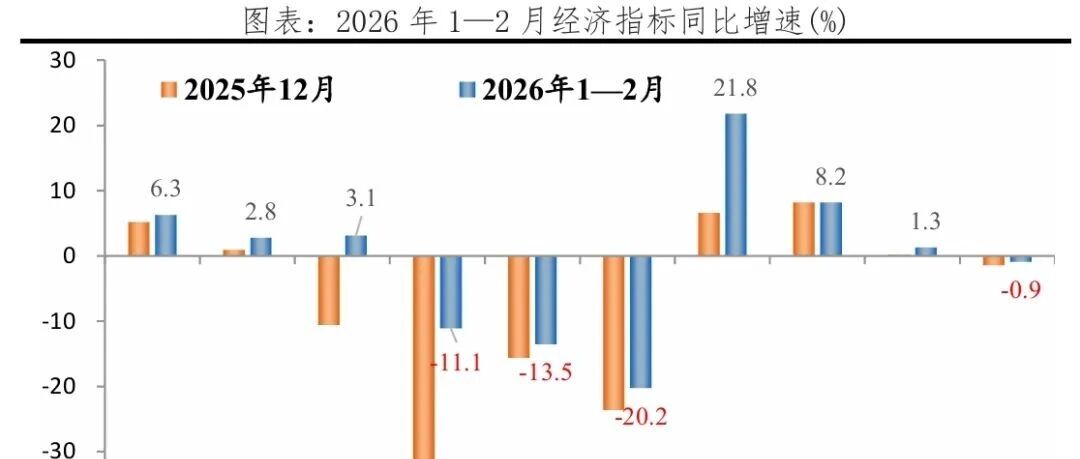
Production - Industrial production maintained resilience with a year-on-year growth of 6.3% in January-February, and a month-on-month increase of 0.8% in February, significantly above historical seasonal levels[1] - The manufacturing value added grew by 6.6%, outperforming mining (6.1%) and utilities (4.7%), with high-end equipment and electronics manufacturing as key supports[1] - High-tech manufacturing products showed rapid growth, with industrial robots, integrated circuits, and power generation equipment increasing by 31.1%, 12.4%, and 21.6% respectively[1] Investment - Fixed asset investment rose by 1.8% year-on-year in January-February, recovering from negative growth in 2025[2] - Infrastructure investment surged, with narrow and broad infrastructure investments growing by 11.4% and 9.8% respectively, significantly improving from last year[2] - Manufacturing investment increased by 3.1%, a notable improvement from the 0.3% growth in 2025, driven by a 11.5% rise in equipment purchases[2][3] Real Estate - Real estate investment declined by 11.1%, but the drop was 6.1 percentage points less than the full-year decline in 2025, indicating some stabilization[4] - New construction area and completed area fell by 23.1% and 27.9% respectively, reflecting weak new construction intentions[4] - The amount of funds available for real estate decreased by 16.5%, with personal mortgage loans dropping by 41.9%, indicating weak leverage willingness among residents[4] Consumption - Overall retail sales grew by 2.8% year-on-year, slightly below the 3.7% growth in 2025, primarily due to a slowdown in automobile consumption[5] - Restaurant income increased by 4.8%, significantly higher than the previous year, driven by strong demand during the Spring Festival[5] - Essential and policy-related consumption performed relatively well, while some discretionary spending remained weak, particularly in real estate-related sectors[5]
经济开门红——全面解读1-2月经济数据
泽平宏观· 2026-03-16 16:06
Economic Overview - The national economy showed a "new strong, old weak, external strong, internal stable" trend in the first two months of 2026, with high-tech manufacturing and equipment manufacturing leading the growth [2][3] - Industrial production accelerated, with a year-on-year increase of 6.3% in industrial added value, up 1.1 percentage points from December [2][8] - Fixed asset investment turned positive, growing by 1.8% year-on-year, a significant recovery of 16.9 percentage points from December [2][12] Industrial Production - High-tech manufacturing and equipment manufacturing sectors experienced significant growth, with high-tech manufacturing value-added increasing by 13.1% year-on-year [6][9] - The production of upstream raw materials improved due to rising international oil prices, while midstream machinery and equipment sectors benefited from policy effects [9][10] Investment Trends - Fixed asset investment (excluding rural households) showed a year-on-year increase of 1.8%, with high-tech industry investment growing by 5.1% [12][20] - Infrastructure investment surged by 11.4% year-on-year, driven by the acceleration of major projects and statistical adjustments [17][18] Real Estate Market - The decline in real estate investment narrowed, with sales area and sales amount decreasing by 13.5% and 20.2% respectively, but showing improvement from December [15][16] - Real estate companies are still cautious in land acquisition, with a significant drop in land transaction volume [16] Export Performance - Exports exceeded expectations, with a year-on-year growth of 21.8%, driven by global manufacturing recovery and enhanced competitiveness [25][26] - Exports to countries along the Belt and Road increased by 28.5%, accounting for over 50% of total exports [25][26] Consumer Spending - Social retail sales increased by 2.8% year-on-year, with service consumption performing well due to the long Spring Festival holiday [23][24] - Traditional consumer goods saw a significant demand boost during the holiday period, with restaurant income rising by 4.8% [23] Financial Data - Social financing maintained a stable growth rate of 8.2%, supported by government bonds and bank loans [28][29] - M2 growth remained at 9.0%, while M1 increased by 5.9%, indicating a shift in deposit trends towards non-bank institutions [29] Price Trends - CPI rose by 1.3% year-on-year, the highest in nearly three years, influenced by the timing of the Spring Festival [31][32] - PPI decline narrowed, reflecting input inflation and strong demand in certain technology sectors [31][32]
每日债市速递 | 央行:前两个月人民币贷款增加5.61万亿元
Wind万得· 2026-03-15 22:55
Group 1: Open Market Operations - The central bank conducted a 375 billion yuan 7-day reverse repurchase operation on March 13, with a fixed rate of 1.40%, and the full bid amount was 375 billion yuan [1] - On the same day, 448 billion yuan in reverse repos matured, resulting in a net withdrawal of 73 billion yuan for the day, and a total net withdrawal of 1,011 billion yuan for the week [1] - For the week of March 16-20, 1,765 billion yuan in reverse repos will mature [1] Group 2: Funding Conditions - The interbank market remains relatively loose, with the weighted average rate of DR001 slightly declining to around 1.32% [3] - Overnight quotes on the anonymous click system (X-repo) stabilized at 1.3%, with supply exceeding 1 trillion yuan [3] - The overnight financing rate in the U.S. stands at 3.64% [3] Group 3: Interbank Certificates of Deposit - The latest transaction for one-year interbank certificates of deposit among major banks is around 1.535%, down 1.75 basis points from the previous day [7] Group 4: Bond Market Overview - The yields on major interbank bonds show divergence, with medium to long-term government bonds performing weakly [11] - The closing prices for government bond futures indicate a decline, with the 30-year main contract down 0.25% and the 10-year main contract down 0.07% [14] Group 5: Recent Economic Data - In the first two months, RMB loans increased by 5.61 trillion yuan, and RMB deposits rose by 9.26 trillion yuan, with the social financing scale increasing by 9.6 trillion yuan, 3,162 billion yuan more than the same period last year [15] - The M2 balance at the end of February was 349.22 trillion yuan, a year-on-year increase of 9% [15] - The central bank plans to conduct a 500 billion yuan fixed-rate, multi-price reverse repurchase operation on March 16, with 6,000 billion yuan in 182-day reverse repos maturing on the same day [15] Group 6: Global Macro Insights - Goldman Sachs has lowered its 2026 U.S. economic growth forecast from 2.8% to 2.6% due to the negative impact of ongoing conflicts in the Middle East [19] - Amazon issued $54 billion in bonds in the U.S. and Euro markets, setting a record for corporate bond issuance in Europe, driven by its significant investments in artificial intelligence [19]

深度专题 | 地产“落”,消费“升”(申万宏观·赵伟团队)
赵伟宏观探索· 2026-03-09 16:03
Core Viewpoint - The article argues that contrary to common belief, consumer spending in China may not continue to suffer due to the downturn in the real estate market. Instead, international experience suggests that consumer sentiment tends to improve during the latter stages of real estate adjustments, indicating that China may be at a turning point for consumer spending [1][9]. Group 1: International Experience and Economic Effects - International experience shows that consumer sentiment typically exhibits a "U-shaped" pattern around real estate turning points, with consumer spending improving before income does [2][10]. - The impact of real estate market changes on the economy can be categorized into three effects: "income effect," "wealth effect," and "crowding-out effect." The "income effect" influences total demand and employment, affecting consumer income and spending. The "wealth effect" refers to increased consumer spending due to rising property values, while the "crowding-out effect" indicates reduced spending by potential homebuyers due to high property prices [2][11]. - In the first five years of the "post-real estate era," the "income effect" dominates, leading to lower consumer spending. After the peak of the real estate cycle, consumer disposable income growth typically declines for about ten years, with average growth rates dropping from 8%-10% to 3%-4% [2][11]. Group 2: Consumer Sentiment Improvement - In the 5-10 years following the peak of the real estate market, the "crowding-out effect" weakens, allowing consumer sentiment to improve before income does. This shift is particularly evident among potential homebuyers aged 25-40, who are key contributors to social consumption [3][16]. - Evidence suggests that China may currently be at the starting point of a "U-shaped" reversal in consumer sentiment, with significant changes in the impact of real estate on the economy and policy environment since 2021 [4][40]. Group 3: Economic Indicators and Trends - The year 2015 marked a critical turning point in the impact of real estate on the macroeconomy, with the "income effect" and "wealth effect" dominating until then. Post-2015, the "crowding-out effect" became more pronounced, leading to a decline in consumer sentiment as housing costs rose [4][41]. - By 2026, a new cycle of improved consumer sentiment may begin as the "crowding-out effect" diminishes, with indicators such as the housing price-to-income ratio returning to pre-2015 levels, suggesting a stabilization of the three economic effects [5][83]. Group 4: Policy Support and Consumer Behavior - The Chinese government has been actively implementing policies to boost domestic demand and consumer spending, including optimizing personal consumption loan subsidies and increasing fiscal support for consumption [6][155]. - The shift in population and industry towards non-first-tier cities is also expected to alleviate the pressure on consumer sentiment caused by high housing prices, further supporting consumer spending [5][94].

资金面继续保持宽松,债市有所走弱
Dong Fang Jin Cheng· 2026-03-09 14:58
Report Summary 1. Investment Rating The provided content does not mention the industry investment rating. 2. Core View On March 6, the capital market showed a situation where the capital side remained loose, the bond market weakened, the convertible bond market followed the rise, and the yields of US Treasury bonds of various maturities were differentiated, with the 10 - year Treasury bond yields of major European economies generally rising [1][2]. 3. Summary by Directory 3.1 Bond Market News - **Domestic News** - The central bank will implement a moderately loose monetary policy, use various policy tools, and expand the scale of re - loans from 500 billion yuan to 800 - 1000 billion yuan [4]. - The Ministry of Finance will continue to implement a more proactive fiscal policy this year, with the expenditure total, new government bond scale, and central transfer payments to local governments reaching new highs, and launching a package of policies to promote domestic demand [5]. - The CSRC will deepen the reform of the Growth Enterprise Market and optimize the refinancing mechanism [6]. - The National Development and Reform Commission will set up a national - level merger fund, expected to leverage over 1 trillion yuan of funds [7]. - As of the end of February 2026, China's foreign exchange reserves were 3.4278 trillion US dollars, an increase of 2.87 billion US dollars from the end of January, and gold reserves increased for the 16th consecutive month [8]. - **International News** - In February, the US non - farm employment decreased by 92,000, the unemployment rate rose to 4.4%, and the average hourly wage increased, intensifying stagflation concerns [9][10]. - In January, US retail sales decreased by 0.2% month - on - month, the first negative growth since October 2025 [11]. - **Commodities** - On March 6, international crude oil futures prices continued to rise, and NYMEX natural gas futures prices increased. COMEX spot gold also rose [12]. 3.2 Capital Side - **Open Market Operations** - On March 6, the central bank conducted 44.8 billion yuan of 7 - day reverse repurchase operations, with an operating rate of 1.40%. There were 269 billion yuan of reverse repurchases due on the same day, resulting in a net withdrawal of 224.2 billion yuan [14]. - **Funding Rates** - On March 6, the capital side remained loose. DR001 rose 4.94bp to 1.319%, and DR007 fell 0.58bp to 1.415% [16]. 3.3 Bond Market Dynamics - **Interest - rate Bonds** - **Spot Bond Yield Trends** - On March 6, the bond market weakened. The yield of the 10 - year Treasury bond active bond 250016 rose 0.50bp to 1.7880%, and the yield of the 10 - year CDB bond active bond 250220 rose 0.25bp to 1.9540% [19]. - **Bond Tendering** - The 3 - year 25进出13(增11) was issued with a scale of 6 billion yuan, a winning yield of 1.5543%, a full - field multiple of 4.26, and a marginal multiple of 1.74. The 30 - year 26附息国债02(续2) was issued with a scale of 34 billion yuan, a winning yield of 2.2756%, a full - field multiple of 5.15, and a marginal multiple of 2.1 [21]. - **Credit Bonds** - **Secondary Market Transaction Abnormalities** - On March 6, the transaction prices of 6 industrial bonds deviated by more than 10%. "H3 万科 01" fell more than 24%, and several other bonds of Vanke rose [21]. - **Credit Bond Events** - Many companies such as Agile Group, Oriental Fashion, Lingnan Co., Ltd., and Sunac Real Estate announced debt - related issues [22]. - **Convertible Bonds** - **Equity and Convertible Bond Indexes** - On March 6, the A - share market rose, and the convertible bond market also strengthened. The CSI Convertible Bond Index, Shanghai Stock Exchange Convertible Bond Index, and Shenzhen Stock Exchange Convertible Bond Index rose 0.26%, 0.19%, and 0.36% respectively [23]. - **Convertible Bond Tracking** - On March 9, Changgao Convertible Bond will start online subscription. On March 6, Yuhetian's convertible bond issuance was approved, and several convertible bonds announced conditions such as approaching the conversion price downward revision and early redemption [28]. - **Overseas Bond Markets** - **US Bond Market** - On March 6, the yields of US Treasury bonds of various maturities were differentiated. The 2 - year yield fell 1bp to 3.56%, and the 10 - year yield rose 2bp to 4.15%. The 2/10 - year and 5/30 - year yield spreads both expanded by 3bp [26][27]. - **European Bond Market** - On March 6, the 10 - year Treasury bond yields of major European economies generally rose. Germany, France, Italy, Spain, and the UK increased by 1bp, 4bp, 7bp, 5bp, and 9bp respectively [30]. - **Chinese - funded US Dollar Bonds** - As of the close on March 6, the daily price changes of Chinese - funded US dollar bonds showed different trends, with some rising and some falling [32].