轨道资源稀缺

Search documents
Starlink降轨与20万颗申报:中国低轨竞争的下一回合
Tai Mei Ti A P P· 2026-01-13 02:27
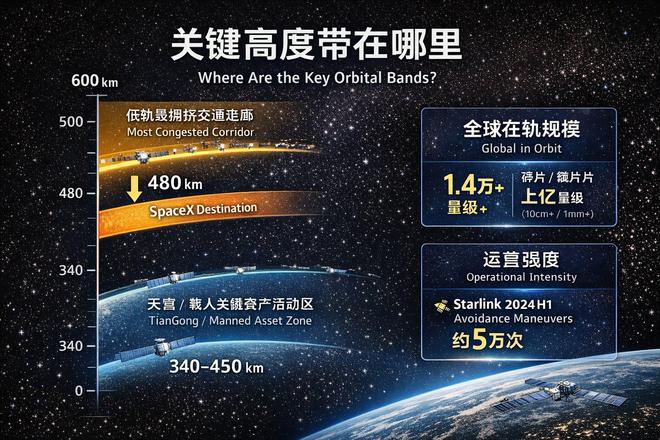
Core Viewpoint - SpaceX's plan to lower approximately 4,400 Starlink satellites from 550 km to 480 km is aimed at optimizing space safety and debris management, which has raised concerns about resource competition and the dual-use nature of satellite systems [1][2][3] Group 1: Resource Scarcity - Low Earth Orbit (LEO) is not an infinite space, and the increasing density of satellites is leading to higher collision risks and coordination costs [1][2] - As of now, over 14,000 satellites are in orbit, with debris and micro-debris exceeding one million, indicating a critical need for effective space traffic management [1][2] - The deployment of large satellite constellations creates a "first-come, first-served" scenario, increasing the costs for later entrants [1][2] Group 2: Dual-Use Nature - Starlink, while primarily a commercial communication system, has demonstrated military capabilities, particularly in the context of the Russia-Ukraine conflict [2][3] - The dual-use nature of satellite systems adds a layer of strategic sensitivity, especially when operated by a single nation [2][3] Group 3: Impact of Lowering Orbits - The lowering of orbits will lead to a redistribution of the orbital environment, increasing density in the 480 km range, which is already crowded [7][9] - Lowering the altitude can accelerate the natural decay of defunct satellites, reducing long-term debris risk, but it also requires more maneuvering and coordination, increasing short-term collision risks [9][10] - The presence of Starlink satellites will solidify existing resource occupation, making it difficult for new entrants to secure orbital positions [10][11] Group 4: Governance and Coordination Challenges - The increase in satellite density necessitates improved space traffic management and coordination among operators to prevent collisions [11][12] - The lack of timely information sharing and coordination can amplify risks, turning individual incidents into systemic issues [12][13] - The governance of space traffic will require a shift from self-regulation to public governance to address the complexities of increased satellite operations [11][12] Group 5: Strategic Responses - Countries are increasingly sensitive to low Earth orbit resources, viewing them as strategic assets rather than merely commercial opportunities [11][15] - The recent surge in satellite applications, including China's proposal for over 200,000 satellites, reflects a long-term strategy for resource occupation rather than a reaction to SpaceX's actions [16][17] - To effectively manage the challenges posed by increased satellite density, countries need to enhance their governance capabilities, establish clear rules for space traffic management, and prioritize safety in their space operations [18][20]