
低轨卫星竞争

Search documents
Starlink降轨与20万颗申报:中国低轨竞争的下一回合
Tai Mei Ti A P P· 2026-01-13 02:27
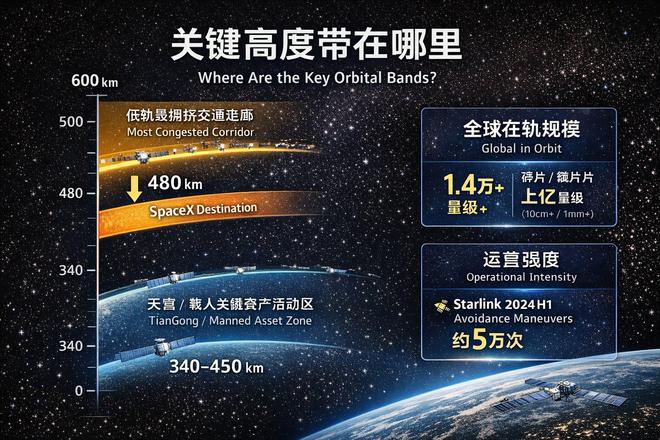
Core Viewpoint - SpaceX's plan to lower approximately 4,400 Starlink satellites from 550 km to 480 km is aimed at optimizing space safety and debris management, which has raised concerns about resource competition and the dual-use nature of satellite systems [1][2][3] Group 1: Resource Scarcity - Low Earth Orbit (LEO) is not an infinite space, and the increasing density of satellites is leading to higher collision risks and coordination costs [1][2] - As of now, over 14,000 satellites are in orbit, with debris and micro-debris exceeding one million, indicating a critical need for effective space traffic management [1][2] - The deployment of large satellite constellations creates a "first-come, first-served" scenario, increasing the costs for later entrants [1][2] Group 2: Dual-Use Nature - Starlink, while primarily a commercial communication system, has demonstrated military capabilities, particularly in the context of the Russia-Ukraine conflict [2][3] - The dual-use nature of satellite systems adds a layer of strategic sensitivity, especially when operated by a single nation [2][3] Group 3: Impact of Lowering Orbits - The lowering of orbits will lead to a redistribution of the orbital environment, increasing density in the 480 km range, which is already crowded [7][9] - Lowering the altitude can accelerate the natural decay of defunct satellites, reducing long-term debris risk, but it also requires more maneuvering and coordination, increasing short-term collision risks [9][10] - The presence of Starlink satellites will solidify existing resource occupation, making it difficult for new entrants to secure orbital positions [10][11] Group 4: Governance and Coordination Challenges - The increase in satellite density necessitates improved space traffic management and coordination among operators to prevent collisions [11][12] - The lack of timely information sharing and coordination can amplify risks, turning individual incidents into systemic issues [12][13] - The governance of space traffic will require a shift from self-regulation to public governance to address the complexities of increased satellite operations [11][12] Group 5: Strategic Responses - Countries are increasingly sensitive to low Earth orbit resources, viewing them as strategic assets rather than merely commercial opportunities [11][15] - The recent surge in satellite applications, including China's proposal for over 200,000 satellites, reflects a long-term strategy for resource occupation rather than a reaction to SpaceX's actions [16][17] - To effectively manage the challenges posed by increased satellite density, countries need to enhance their governance capabilities, establish clear rules for space traffic management, and prioritize safety in their space operations [18][20]

通用航空ETF基金(561660)今日收涨超9.9%,商业航天近期迎来密集催化
Xin Lang Cai Jing· 2026-01-12 12:50
Group 1 - The core viewpoint of the news highlights a significant rise in the Zhongzheng General Aviation Theme Index, which increased by 8.73%, with key stocks such as Huali Chuangtong and Plittech rising by 20% [1] - The General Aviation ETF Fund has also seen a 9.99% increase, marking its third consecutive rise, with the latest price reported at 1.62 yuan [1] - The commercial aerospace sector is experiencing a surge in activity, with China applying for frequency resources for over 200,000 low-orbit satellites by December 2025, indicating a strategic positioning in low-orbit space [1] Group 2 - The approval of SpaceX by the FCC to deploy an additional 7,500 second-generation Starlink satellites, bringing the total to 15,000, reflects the competitive landscape in low-orbit satellite communications [2] - The General Aviation ETF closely tracks the Zhongzheng General Aviation Theme Index, which includes 50 companies involved in various aspects of general aviation, indicating a broad representation of the sector [2] - As of December 31, 2025, the top ten weighted stocks in the Zhongzheng General Aviation Theme Index account for 43.4% of the index, showcasing the concentration of investment in key players like Aerospace Electronics and Haisi Communication [2]
中美加速,“十万星级”时刻来临
HUAXI Securities· 2026-01-11 09:26
Investment Rating - The report rates the computer industry as "Recommended" [2] Core Insights - The low Earth orbit (LEO) satellite sector has officially entered a "super-large constellation" competition phase, accelerating the global power struggle for satellite resources. China's application for 200,000 satellite frequency and orbit resources marks a strategic elevation in satellite resource allocation, while SpaceX continues to expand its Starlink constellation with an additional 7,500 satellites, indicating a shift from technical validation to a strategic game focused on scale, first-mover advantage, and resource positioning [2][3] - SpaceX's expansion of the Starlink constellation reflects that the low Earth orbit communication business model has completed initial validation and is now entering a phase of scale enhancement. The decision to increase satellite density and network redundancy aims to improve system capacity, service quality, and user experience, establishing significant competitive barriers in the low Earth orbit communication field [3] - The application potential for low Earth orbit satellites is broadening, positioning them as a new generation of global information infrastructure. These satellites can provide broadband connectivity to areas where traditional networks cannot reach, with applications in remote communication, maritime operations, aviation broadband services, and emergency communication. The strategic value of low Earth orbit satellites will continue to grow as coverage density increases and latency decreases, supporting long-term investment logic for industry chain companies [4] Summary by Sections - **Event Overview**: China applied for over 200,000 low Earth orbit satellite frequency and orbit resources, significantly surpassing previous domestic plans. This shift indicates a transition from demonstration phases to a long-term, systematic capacity positioning [1] - **Investment Recommendations**: Beneficiaries include companies involved in rocket manufacturing, satellite technology, and related services, such as Aerospace Power, Superjet, Western Materials, and others [5][6]