
Starlink卫星

Search documents
2025商业航天报告:中国商业航天行业发展研究报告
Sou Hu Cai Jing· 2026-02-26 08:28
Core Insights - The report highlights that China's commercial space industry is entering a period of rapid development, driven by accelerated construction of space-based networks and the rise of private enterprises as key engines of growth [1][2]. Group 1: Industry Overview - The global space economy is projected to reach $415 billion by 2024, with commercial space contributing approximately 70% of this revenue, establishing itself as the dominant force in the industry [1]. - The emergence of private companies, exemplified by SpaceX, has led to a significant transformation in the space sector, shifting from government-led initiatives to market-driven activities [1][12]. Group 2: Policy Support - China's commercial space development has been significantly bolstered by clear and robust policy guidance since 2014, encouraging private capital participation and designating commercial space as a "strategic emerging industry" [2][23]. - Multiple provinces, including Beijing, Shanghai, and Guangdong, have introduced specialized action plans to foster regional commercial space industry clusters, enhancing the overall ecosystem [2][25]. Group 3: Technological Advancements - Key technological breakthroughs, particularly in reusable rocket technology, are essential for reducing launch costs and expanding market opportunities [3]. - Companies like Blue Arrow Aerospace and Galactic Glory are making significant progress in critical technology areas, such as liquid oxygen-methane engines and vertical landing recovery systems [3]. Group 4: Future Trends - The integration of commercial space with cutting-edge information technologies is expanding application boundaries, with AI models being utilized for satellite image analysis, enhancing data processing efficiency [4]. - A vision for a seamless information network integrating air, space, land, and sea is emerging, with satellite communication playing a crucial role in bridging the digital divide [4]. Group 5: Challenges Ahead - Despite the promising outlook, challenges remain, including the need for reliable rocket recovery, management of large satellite constellations, and addressing space debris [5]. - The commercial space sector faces high investment costs and long cycles, with economies of scale yet to fully materialize, placing ongoing pressure on companies [5].


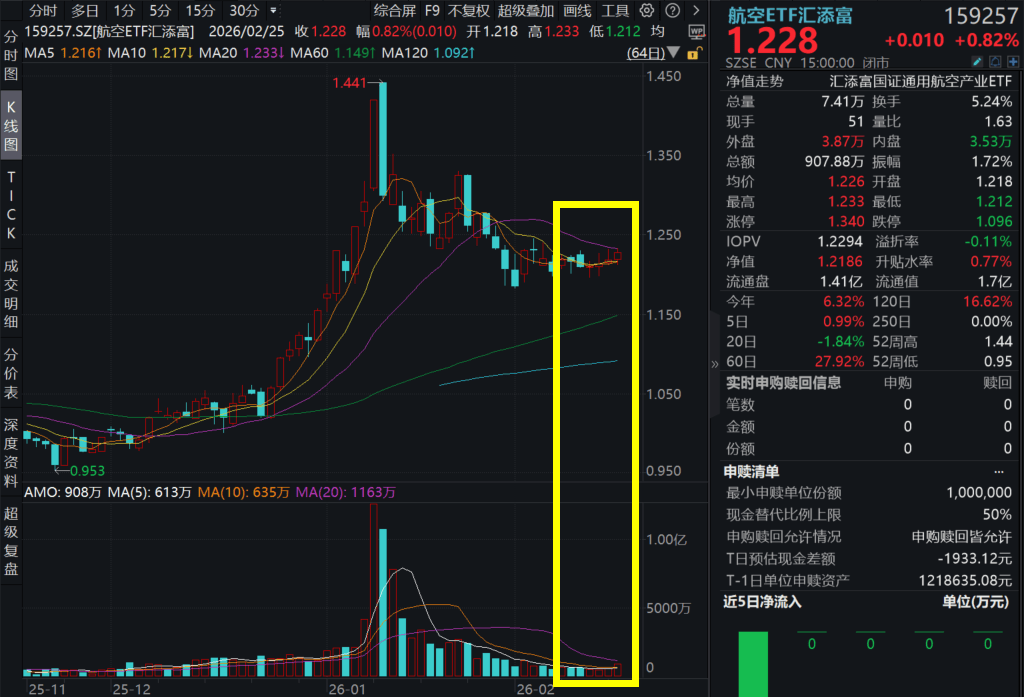
重复使用火箭朱雀三号将再开展回收试验!商业航天板块反攻,航空ETF汇添富(159257)涨近1%喜提四连阳!商业航天面面观,迈入商业化新纪元?
Sou Hu Cai Jing· 2026-02-25 08:20
Core Viewpoint - The A-share market continues to rise, with the commercial aerospace sector showing significant gains, particularly the Aviation ETF Huatai (159257), which has achieved a four-day consecutive increase [1]. Group 1: Market Performance - The A-share market has seen over 3,700 stocks closing in the green, indicating a strong market sentiment [1]. - The Aviation ETF Huatai (159257) closed at 1.228, up 0.82% from the previous day, marking a notable performance in the commercial aerospace sector [1]. Group 2: Commercial Aerospace Developments - Blue Arrow Aerospace announced plans for the second quarter recovery test of the reusable rocket Zhuque-3, aiming for its first recovery flight by the end of this year [3]. - The urgency to deploy satellites is emphasized due to the competitive landscape, with the U.S. leading in satellite launches and China planning significant satellite constellation projects [3][4]. Group 3: Industry Trends - The global demand for space computing is rising, with many tech companies announcing plans for space computing deployments by the end of 2025, which could significantly enhance satellite capabilities [4]. - The commercial aerospace sector is entering a new development phase, driven by policy support and technological advancements, with a notable increase in launch activities expected in 2025 [5]. Group 4: ETF Composition and Industry Weighting - The Aviation ETF Huatai (159257) has a significant focus on the defense and military industry, which constitutes 61.2% of its index, along with notable weights in the computer and automotive sectors [10]. - The low-altitude economy concept stocks account for 52% of the ETF's index, indicating a strong alignment with emerging market trends [8].


Space X收购xAI,“火箭+AI+社交平台”超级巨头成型,马斯克剑指太空数据中心
硬AI· 2026-02-03 07:45
Core Viewpoint - SpaceX has acquired AI company xAI for $250 billion, aiming to integrate rocket, satellite internet, AI technology, and social media platforms, positioning itself as a leading private enterprise in the industry [2][3][4]. Group 1: Acquisition Details - The acquisition price of $250 billion is based on xAI's recent funding round of $20 billion [4]. - Musk's statement emphasizes the goal of creating "the most ambitious vertically integrated innovation engine on Earth and beyond" [4]. - The acquisition is part of Musk's broader strategy to restructure his business empire, following the previous merger of xAI with X [5][17]. Group 2: AI Data Center Strategy - Musk plans to establish a space-based AI data center, utilizing solar energy from space to meet global AI power demands without burdening communities and the environment [5][10]. - The strategy involves launching a constellation of 1 million satellites, which will generate significant AI computing power, estimated at 100 gigawatts annually [11]. - Musk predicts that within 2 to 3 years, space will become the most cost-effective method for generating AI computing capabilities [11]. Group 3: Starship's Role - The success of the space data center relies on the capabilities of the Starship rocket, which is expected to significantly increase payload capacity compared to current Falcon rockets [13][14]. - Starship will facilitate the launch of next-generation satellites, enhancing global connectivity and supporting the deployment of AI satellites into deeper space [13][14]. Group 4: Market Reactions and IPO Plans - Following the announcement of the merger, shares of EchoStar, a major shareholder in SpaceX, dropped nearly 12%, reflecting investor concerns about the complexity of the IPO process [6][7]. - SpaceX is planning an IPO that could raise up to $50 billion, with a projected valuation of approximately $1.5 trillion [6]. Group 5: Integration of Musk's Business Empire - This acquisition marks Musk's third significant corporate restructuring in recent years, further consolidating his various ventures into a cohesive business model [16][20]. - Musk's approach involves reallocating resources and personnel across his companies, which include Tesla, SpaceX, xAI, Boring Company, and Neuralink, creating a unified operational strategy [18][19].

马斯克放大招:SpaceX+xAI 合体,剑指太空数据中心
是说芯语· 2026-02-03 04:28
Core Viewpoint - SpaceX has acquired Elon Musk's AI company xAI for $250 billion, aiming to create the world's most valuable private enterprise by integrating rocket, satellite internet, AI technology, and social media platforms [2][12]. Group 1: Acquisition Details - The acquisition price of $250 billion is based on xAI's recent funding round of $20 billion [2]. - Musk's statement emphasizes the goal of creating a vertically integrated innovation engine for ambitious projects both on Earth and in space [2][3]. Group 2: AI Development Strategy - Musk highlights the need for AI computing capabilities to transition to space to meet global energy demands sustainably, as current ground-based solutions are insufficient [3][6]. - SpaceX plans to launch a constellation of 1 million satellites to create an orbital data center, utilizing near-constant solar energy, which will significantly reduce operational costs [6]. Group 3: Technical Roadmap - The plan includes launching 100 tons of satellites annually, each generating 100 kilowatts of computing power, which would add 100 gigawatts of AI computing capacity each year [6]. - Musk predicts that within 2 to 3 years, space will become the most cost-effective method for generating AI computing power, enabling unprecedented speed and scale in AI model training [6]. Group 4: Starship's Role - The Starship rocket is identified as a critical tool for deploying the necessary satellites for the space data center [7]. - Musk anticipates that Starship will significantly increase payload capacity, with plans to deliver millions of tons of cargo to orbit annually [8]. Group 5: Long-term Vision - Musk envisions using Starship to establish a permanent research and manufacturing base on the Moon, which could produce satellites for deeper space deployment [9]. - The potential exists to send 500 to 1000 terawatts of AI satellites into deep space annually through lunar manufacturing [9]. Group 6: Business Integration - This acquisition marks Musk's third major corporate restructuring, following the merger of xAI with X last year [10][11]. - The integration of SpaceX, xAI's Grok chatbot, and social media platform X creates a highly valuable private enterprise, with Musk's companies operating as a cohesive unit [12][15].

SpaceX 宣布收购 xAI,马斯克剑指太空数据中心
华尔街见闻· 2026-02-03 02:28
Core Viewpoint - SpaceX has acquired AI company xAI for $250 billion, based on xAI's recent $20 billion funding round, aiming to create a vertically integrated innovation engine for both Earth and space [1][2]. Group 1: Acquisition Details - The acquisition is part of Musk's strategy to restructure his business empire, following the merger of xAI with X last year, which valued the AI company at $80 billion and the social media platform at $33 billion [3][16]. - Musk emphasized that relying solely on ground solutions for AI will not meet global energy demands, suggesting that space-based AI is the only scalable solution [3]. Group 2: Space Data Center Strategy - SpaceX plans to launch a constellation of 1 million satellites to create a space-based data center, utilizing near-constant solar energy and minimizing operational costs [8]. - Musk estimates that launching 1 million tons of satellites, each generating 100 kW of computing power, will add 100 GW of AI computing capacity annually [9]. Group 3: Starship's Role - The success of the space data center relies on the capabilities of the Starship rocket, which will begin delivering more powerful V3 Starlink satellites this year [10][11]. - Starship is expected to achieve a launch frequency of once per hour, transporting millions of tons of payload annually, which will support the deployment of the necessary satellites for the data center [12]. Group 4: Long-term Vision - Musk envisions establishing a permanent research and manufacturing base on the Moon, utilizing lunar resources to produce satellites for deeper space deployment [13]. - The potential to launch 500 to 1000 terawatts of AI satellites into deep space annually through lunar manufacturing is highlighted [13]. Group 5: Business Integration - This acquisition marks Musk's third major corporate restructuring in recent years, further integrating his various companies, including SpaceX, xAI, and Tesla [15][19]. - The transaction creates the world's most valuable private company, consolidating resources and personnel across Musk's ventures [17].

怎么看SpaceX申请部署100万颗卫星
2026-02-03 02:05
Summary of Key Points from Conference Call Records Industry Overview - The commercial space industry is experiencing accelerated growth driven by increasing AI demand and the rising energy costs for data centers. Low Earth orbit (LEO) satellite internet is gaining attention from data centers and large enterprises, with North American companies spending approximately $40-50 billion annually on ground communications [6][8]. Company Insights SpaceX - SpaceX plans to deploy 1 million satellites, with the Falcon 9 rocket executing 165 launches in 2025, transporting approximately 2,500 tons of payload. By the end of 2025, there will be 9,000 Starlink satellites in orbit, with two-thirds being second-generation satellites equipped with laser payloads [4][5]. - The success of SpaceX has encouraged other companies, such as Blue Origin and domestic firms like Landspace, to enter the commercial space sector [5]. Multi Book and Tencent's Yuanbao - Multi Book, an AI social platform derived from Cloud Bot, has around 1.5 million AI users. It allows AI to interact and browse the web, supporting a business model through user engagement [3]. - Tencent's Yuanbao is an AI social tool that facilitates group activities without personal friend connections, focusing on collective interactions like ordering food together [3]. Market Trends and Opportunities - The satellite internet market is expected to see significant growth, particularly in navigation and communication sectors. The on-board payloads are identified as having the highest revenue elasticity, with new payloads accounting for nearly 50% of total costs [6][7]. - Domestic suppliers are positioned to benefit from advancements in navigation and communication technologies during the next wave of satellite internet development [8]. CDN Demand in the AI Era - The demand for Content Delivery Networks (CDN) is anticipated to increase significantly due to the rise in the number and usage of agents, leading to higher data transmission requirements. Companies like Wangsu Science & Technology are expected to benefit from this trend [11]. Key Takeaways - The commercial space industry is poised for growth, with LEO satellite internet as a promising alternative for ground communications. - SpaceX's advancements are setting a precedent for other companies in the sector. - Innovations in AI social platforms are creating new user engagement models. - The demand for CDN services is expected to rise sharply, driven by increased data interaction needs in the AI landscape [2][11].
SpaceX被曝6月IPO:恰逢金木合相及马斯克生日,估值约1.5万亿美元
Jin Rong Jie· 2026-01-28 05:40
Core Viewpoint - Elon Musk is considering scheduling SpaceX's IPO for mid-June, coinciding with a rare astronomical event and his birthday, aiming to raise up to $50 billion with a valuation of approximately $1.5 trillion, potentially making it the largest IPO in history [1][2]. Group 1: IPO Details - The IPO is expected to raise up to $50 billion, which is approximately 348.31 billion yuan, with a projected valuation of around $1.5 trillion, equivalent to about 10.45 trillion yuan [1]. - If successful, this IPO would surpass the previous record set by Saudi Aramco's $29 billion IPO in 2019 [1]. - SpaceX is reportedly considering major banks like Bank of America, Goldman Sachs, JPMorgan, and Morgan Stanley as underwriters for the IPO [1]. Group 2: Timing and Challenges - June is also Musk's birthday (June 28), which is a factor in the timing decision for the IPO [2]. - Some bankers and investors believe that the June timeline may be too tight, as SpaceX still needs to file the S-1 document with the SEC and conduct a global roadshow [2]. - The IPO's progress may be influenced by market conditions and investor sentiment, particularly amid rising uncertainties due to political factors [2]. Group 3: Funding and Development - One of the motivations for the IPO is to secure additional funding for the development of the Starship system, which is intended to support future Mars missions [3]. - SpaceX is also working on technology for deploying data centers in space, which will connect through its approximately 9,400 Starlink satellites, a capability deemed crucial for competing in the AI sector [3]. - SpaceX's valuation discussions in December indicated a significant increase, with estimates reaching around $800 billion, which is double the previous valuation of approximately $400 billion [3].
Starlink降轨与20万颗申报:中国低轨竞争的下一回合
Tai Mei Ti A P P· 2026-01-13 02:27
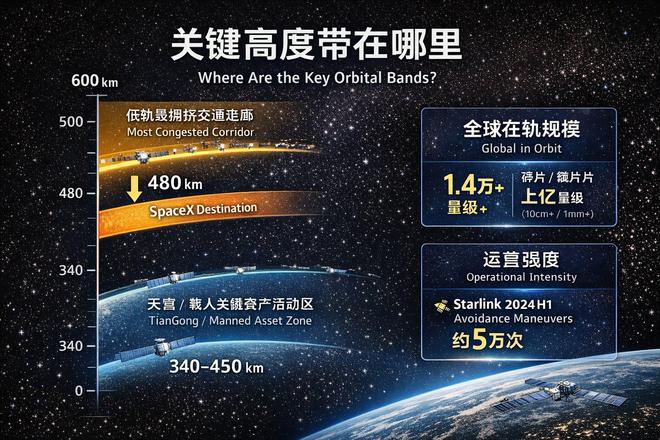
Core Viewpoint - SpaceX's plan to lower approximately 4,400 Starlink satellites from 550 km to 480 km is aimed at optimizing space safety and debris management, which has raised concerns about resource competition and the dual-use nature of satellite systems [1][2][3] Group 1: Resource Scarcity - Low Earth Orbit (LEO) is not an infinite space, and the increasing density of satellites is leading to higher collision risks and coordination costs [1][2] - As of now, over 14,000 satellites are in orbit, with debris and micro-debris exceeding one million, indicating a critical need for effective space traffic management [1][2] - The deployment of large satellite constellations creates a "first-come, first-served" scenario, increasing the costs for later entrants [1][2] Group 2: Dual-Use Nature - Starlink, while primarily a commercial communication system, has demonstrated military capabilities, particularly in the context of the Russia-Ukraine conflict [2][3] - The dual-use nature of satellite systems adds a layer of strategic sensitivity, especially when operated by a single nation [2][3] Group 3: Impact of Lowering Orbits - The lowering of orbits will lead to a redistribution of the orbital environment, increasing density in the 480 km range, which is already crowded [7][9] - Lowering the altitude can accelerate the natural decay of defunct satellites, reducing long-term debris risk, but it also requires more maneuvering and coordination, increasing short-term collision risks [9][10] - The presence of Starlink satellites will solidify existing resource occupation, making it difficult for new entrants to secure orbital positions [10][11] Group 4: Governance and Coordination Challenges - The increase in satellite density necessitates improved space traffic management and coordination among operators to prevent collisions [11][12] - The lack of timely information sharing and coordination can amplify risks, turning individual incidents into systemic issues [12][13] - The governance of space traffic will require a shift from self-regulation to public governance to address the complexities of increased satellite operations [11][12] Group 5: Strategic Responses - Countries are increasingly sensitive to low Earth orbit resources, viewing them as strategic assets rather than merely commercial opportunities [11][15] - The recent surge in satellite applications, including China's proposal for over 200,000 satellites, reflects a long-term strategy for resource occupation rather than a reaction to SpaceX's actions [16][17] - To effectively manage the challenges posed by increased satellite density, countries need to enhance their governance capabilities, establish clear rules for space traffic management, and prioritize safety in their space operations [18][20]
低轨道通信算力卫星进展
2026-01-08 02:07
Summary of Key Points from the Conference Call Industry Overview - The conference call discusses advancements in low Earth orbit (LEO) satellite communication, specifically focusing on the Starlink V3 satellite system and its implications for the satellite internet industry in China. Core Insights and Arguments - **Starlink V3 Satellite Upgrades**: The V3 version features significant upgrades, including an increase in solar panel area from over 200 square meters in V2 to between 300 and 500 square meters, aimed at enhancing spectral utilization and photoelectric conversion efficiency [1][2][4] - **Data Throughput**: The inter-satellite laser communication rate has been upgraded to 400 Gbps, doubling the capacity from the V2 mini version, which was at 200 Gbps [1][2] - **Computational Power**: The V3 version will incorporate a more powerful computing system to support additional computational loads, potentially reducing customer service costs and enabling full rocket recovery [1][3][2] - **Satellite Deployment Plans**: The first generation of the Starlink system is expected to be completed by 2026, with a total of 180,168 satellites planned for launch, primarily to support broadband wireless internet services for national and key monitoring areas [1][6] - **Commercialization Prospects**: The first generation will not initially target commercial use, while the second generation may achieve commercial application, including B2C services [6] Additional Important Content - **Laser Communication Terminals**: Each satellite in the new system will be equipped with four or more laser communication terminals, with individual terminal costs ranging from 1 to 1.5 million yuan, where optical-mechanical antennas account for about 70% of the total cost [1][6][7] - **Domestic Production and R&D**: Major Chinese companies like Huawei and ZTE are involved in the deep R&D of laser communication technology, aiming to enhance capabilities from 10G to 100G to match or exceed the performance of competing systems [1][8] - **Market Competition**: The domestic laser communication terminal market is characterized by a complex and diversified competitive landscape, with both large enterprises and startups actively participating [1][11] - **Challenges in Supply Chain**: The supply of core components for laser terminals is heavily reliant on foreign products, but domestic alternatives are expected to increase significantly in the next two to three years due to high costs and long supply cycles of foreign products [1][15] - **Space Computing Projects**: The development of space computing projects is still in its early stages, with various types of space data centers being explored, including distributed computing centers and integrated space data centers [1][12][13] This summary encapsulates the key points discussed in the conference call, highlighting advancements in satellite technology, market dynamics, and future prospects in the low Earth orbit satellite communication industry.
史上最大IPO?马斯克 最新暗示→
Zheng Quan Shi Bao· 2025-12-11 09:17
Core Viewpoint - Elon Musk hinted that SpaceX may go public in 2026, with potential fundraising aimed at building data centers to support ambitious plans in AI, robotics, and Mars colonization [1][3]. Group 1: IPO Plans - Musk's interaction on social media suggested that SpaceX is considering an IPO, with reports indicating a target valuation of $1.5 trillion and potential fundraising exceeding $30 billion [3]. - The anticipated IPO could mark a significant shift in Musk's approach, as he has previously resisted public listing due to concerns over shareholder expectations [5]. - Analysts believe that the IPO could be driven by the surge in revenue from SpaceX's Starlink satellite network, which is expected to generate between $22 billion and $24 billion in revenue next year [5]. Group 2: Strategic Shifts - The rise of artificial intelligence has influenced Musk's decision to consider an IPO, as he aims to integrate AI advancements into SpaceX's operations [5][7]. - SpaceX's plans to develop next-generation Starlink satellites as a foundation for a space data center highlight the company's strategic direction [5]. - The potential for building satellite factories on the Moon and utilizing advanced technologies to accelerate AI capabilities is part of Musk's broader vision [5]. Group 3: Funding Needs - Significant capital is required for designing and manufacturing satellites and launching rockets to deploy space data centers, making the IPO crucial for funding [5]. - Musk's long-term vision for Mars colonization necessitates substantial resources, with estimates suggesting that achieving a self-sustaining settlement on Mars could require around $1 trillion in launch costs alone [9]. - The IPO is seen as a way to mobilize resources necessary for Musk's ambitious goals, including the establishment of a Martian city [9].