进出口基本平衡战略

Search documents
刘世锦:建议实施进出口基本平衡的新战略 加快人民币国际化进程
Xin Lang Cai Jing· 2026-01-17 04:21
Core Viewpoint - China needs to implement a new strategy for balanced imports and exports, increasing imports settled in RMB while maintaining export competitiveness and a significant trade surplus [1][2] Group 1: Economic Strategy - The goal for the 14th Five-Year Plan period should be to build a strong consumer economy, which will play a foundational role in achieving growth targets and support actual growth rates through human capital enhancement [1] - There is an urgent need to address structural consumption gaps, as China cannot yet be considered a major consumer nation relative to its development stage and economic scale [1] Group 2: Focus on Service Consumption - Emphasis should be placed on developing service consumption, particularly developmental consumption, which can be viewed as both consumption and investment in human capital [1] - Investment in education, healthcare, and social security is essential for improving human capital, aligning with the demand for innovation-driven growth [1] Group 3: RMB Internationalization - China, being the world's largest goods exporter, has a significant gap in the internationalization of the RMB that needs to be narrowed during the 14th Five-Year Plan [2] - A new strategy for balanced imports and exports is necessary to increase the use of RMB for imports, thereby enhancing the international status of the currency [2] - Expanding the offshore RMB financial product ecosystem, including bonds, stocks, funds, and derivatives, will increase RMB liquidity and usability, promoting reasonable appreciation of the currency [2]
刘世锦:人民币进入升值通道利大于弊,中长期将促进生产率提升与竞争优势迭代
Xin Lang Cai Jing· 2026-01-15 02:26
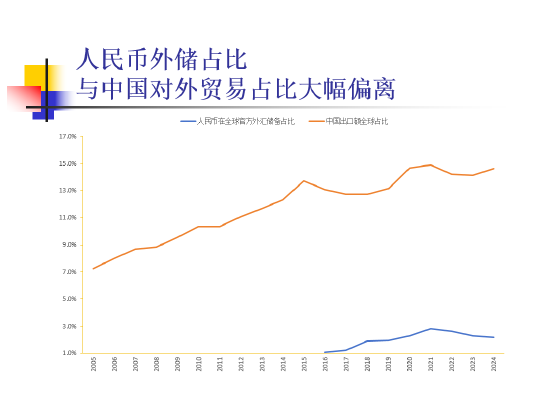
Core Viewpoint - The "Sina Finance 2025 Conference and the 18th Golden Unicorn Forum" will be held on January 15, 2026, in Beijing, focusing on the theme of "Starting the 14th Five-Year Plan, New Economic Voyage - Reshaping Growth Paradigms, Co-creating Future Prosperity" [1][6]. Group 1: Foreign Trade Insights - Despite a challenging international environment, China's exports have shown strong momentum this year, reflecting improvements in technology and industrial competitiveness [3][8]. - A significant trade deficit indicates a reduction in domestic consumption, which is one of the reasons for insufficient domestic demand. This trend is unsustainable in the long term [3][8]. - It is recommended that China implement a basic balance strategy for imports and exports, enhancing export competitiveness while expanding imports and increasing the use of the Renminbi for payment settlements [3][8]. Group 2: Renminbi and Economic Strategy - There is a notable disparity between the proportion of Renminbi foreign reserves and the proportion of foreign trade, indicating a need to shift from retaining foreign exchange to using Renminbi for settlements [5][10]. - Currently, the manufacturing sector accounts for about 30% of the economy, but the monetary function's share is below 5%, which needs to be addressed to align with China's global economic share [5][10]. - The goal is to elevate the Renminbi to become a strong international currency, facilitating its appreciation and sharing the international premium of China's large-scale economy [5][10]. - The transition to a Renminbi appreciation channel is expected to have more benefits than drawbacks, potentially impacting exports in the short term but enhancing productivity and competitive advantages in the medium to long term [5][10].

刘世锦建议实施外贸新战略:推动进出口基本平衡,并更多以人民币支付结算
Xin Lang Cai Jing· 2026-01-15 02:21
Core Viewpoint - The "Sina Finance 2025 Conference and the 18th Golden Unicorn Forum" emphasizes the need for China to balance its import and export strategies while enhancing the use of the Renminbi in international trade [1][4]. Group 1: Trade and Economic Strategy - Despite a challenging international environment, China's exports have shown strong momentum, reflecting improvements in technology and industrial competitiveness [1][4]. - A significant trade deficit indicates a reduction in domestic consumption, which is a contributing factor to insufficient domestic demand [1][4]. - It is suggested that China should implement a basic balance strategy for imports and exports, maintaining export competitiveness while expanding imports and increasing Renminbi payments [1][4]. Group 2: Renminbi Internationalization - There is a notable disparity between the proportion of Renminbi reserves and the share of foreign trade, indicating a need to shift from holding foreign exchange to using Renminbi for settlements [3][6]. - Currently, China's manufacturing sector accounts for about 30% of the economy, but the monetary function of the Renminbi is below 5%, which needs to be addressed [3][6]. - The goal is to align the Renminbi's functions with China's global economic share, promoting its status as a strong international currency and facilitating reasonable appreciation [3][6]. Group 3: Long-term Economic Impact - The transition to a Renminbi appreciation phase is expected to have more benefits than drawbacks, potentially impacting exports in the short term but enhancing productivity and competitive advantages in the long run [3][6].