
通用机器人大脑

Search documents
Skild AI成最快千亿独角兽,获14亿美元C轮融资,软银英伟达三星联手押注
机器人圈· 2026-01-16 09:10
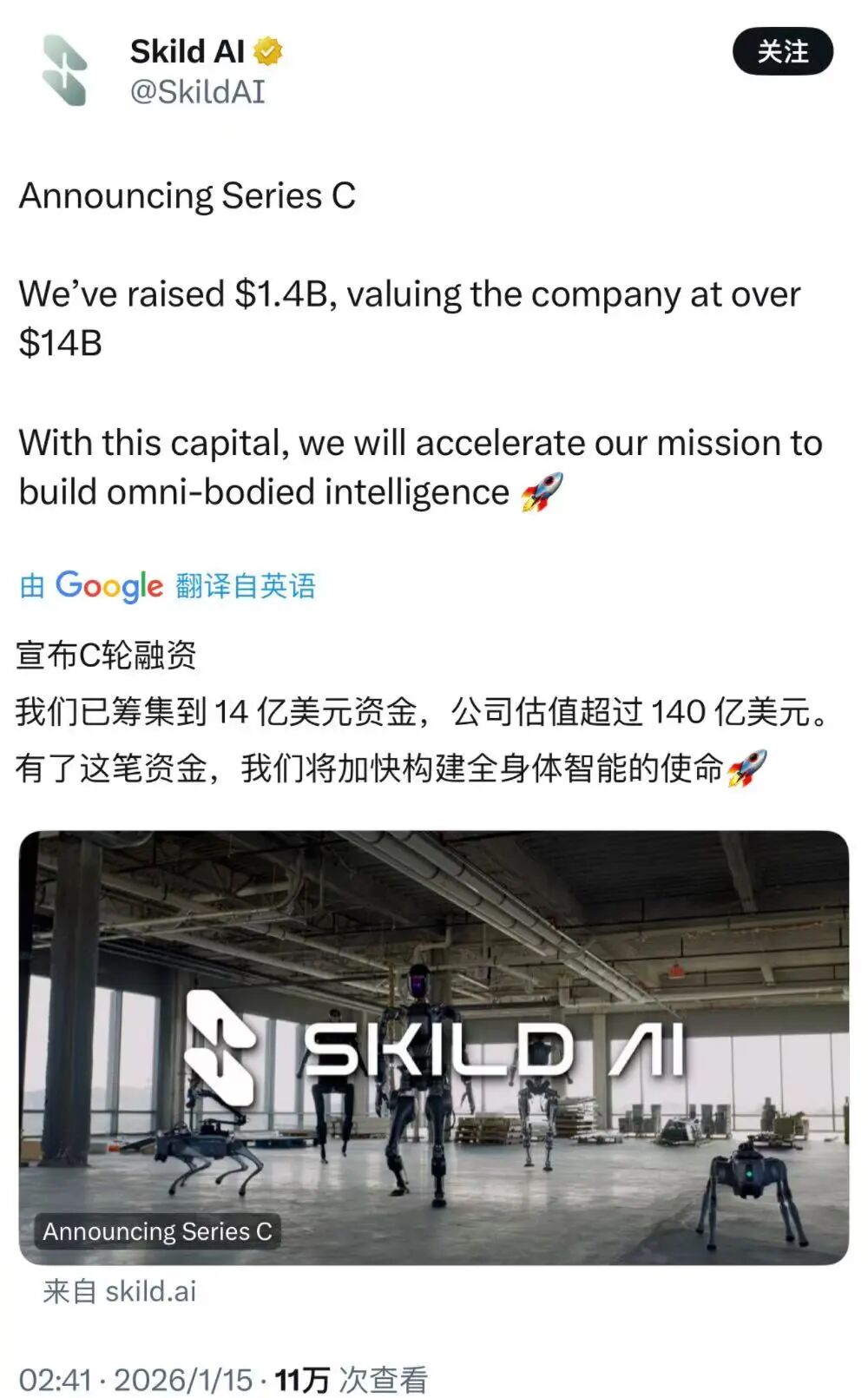
Core Viewpoint - Skild AI, a US robotics startup, has completed a C round financing of approximately $1.4 billion, raising its valuation to over $14 billion, which is three times its valuation from seven months ago [2][5]. Group 1: Financing and Valuation - The recent financing round was led by SoftBank, with participation from Nvidia, Macquarie, 1789 Capital, Bezos Expeditions, and companies like Samsung and LG [5]. - Since its establishment in May 2023, Skild AI has raised a total of about $2 billion, aiming to create a "general robotic brain" that enables robots to learn tasks through video observation and practice [5][11]. Group 2: Founders and Vision - Skild AI was co-founded by Deepak Pathak and Abhinav Gupta, who previously worked together at Meta's robotics lab and later became professors at Carnegie Mellon University [6]. - The founders recognized a bottleneck in robotics research regarding the practical application of video demonstrations, which lack stable and replicable system capabilities [8]. Group 3: Technology and Applications - Skild AI aims to develop a "general robotic brain" that operates on standard GPUs without the need for custom chips, enabling cross-platform and cross-task execution capabilities [9]. - The Skild Brain system is trained using large-scale human videos and simulated practices, optimizing control strategies through feedback loops [9]. - The technology has been adapted for various robotic forms, including quadrupedal platforms, robotic arms, and humanoid robots, capable of performing tasks in complex environments like homes, warehouses, hospitals, and construction sites [9][10]. Group 4: Market Potential and Partnerships - By 2025, Skild AI aims to serve over eight clients, with revenue projected to rise from zero to several million dollars [11]. - LG CNS has announced a partnership with Skild AI to develop humanoid robot solutions, and the software will be used for automation at Nvidia's GPU factory [13]. - The company sees significant potential for robots to fill over a million job vacancies in the US, particularly in dangerous, repetitive, or undesirable positions [11][13]. Group 5: Industry Trends and Challenges - The high valuation and oversubscription of Skild AI's financing reflect a shift in investment strategies among tech giants, moving away from heavy asset acquisitions to early-stage investments in promising startups [13]. - The robotics sector faces common challenges, especially in deploying humanoid robots for consumer use, with issues related to endurance, mobility, and safety still being critical hurdles [14]. - The competition for developing general-purpose robotic systems is intensifying, with a collective push towards scalable implementations in the industry [15][16].


今年最快千亿独角兽诞生
3 6 Ke· 2026-01-15 03:05
Core Insights - Skild AI, a US robotics startup, has completed a C round financing of approximately $1.4 billion, raising its valuation to over $14 billion, which is three times its valuation from seven months ago [1][3] Financing and Investment - The financing round was led by SoftBank, with participation from Nvidia, Macquarie, 1789 Capital, Bezos Expeditions, and companies like Samsung, LG, and Salesforce [3] - Since its establishment in May 2023, Skild AI has raised a total of around $2 billion [3] Company Vision and Technology - Skild AI aims to create a "general robotic brain" that allows robots to learn tasks through video observation and practical experience, similar to human learning [3][4] - The founders, Deepak Pathak and Abhinav Gupta, previously worked at Meta's robotics lab and are focused on overcoming the limitations of current robotic systems [4][6] - The Skild Brain system utilizes large-scale human video and simulation training to optimize control strategies, integrating internal sensory data with external visual signals for robust task execution [6] Market Potential and Applications - Skild Brain is adaptable to various robotic forms, including quadrupeds, robotic arms, and humanoid robots, and can operate in complex environments such as homes, warehouses, hospitals, and construction sites [7] - By 2025, Skild AI aims to serve over eight clients, with revenue projected to grow from zero to several tens of millions of dollars [10] Industry Trends and Competitive Landscape - The high valuation and significant funding for Skild AI reflect a shift in investment strategies among tech giants, moving towards early-stage investments rather than heavy asset acquisitions [11] - Competitors in the robotics AI space, such as Physical Intelligence, are also experiencing rapid growth, indicating a competitive landscape with similar challenges [12] Conclusion - The race for developing a general robotic brain is intensifying, with major tech companies accelerating their investments in the robotics sector, signaling a collective push towards scalable deployment of robotic systems [13]
一口气融资40亿,最强机器人大脑诞生,谁能跑通终局?
创业邦· 2025-12-01 04:09
Core Insights - The article discusses the rise of Physical Intelligence (PI), a startup in the field of embodied intelligence, which has achieved a valuation of approximately 56 billion yuan (around 8 billion USD) after raising 600 million USD in its latest funding round [2] - PI's approach emphasizes a "software-first" strategy, aiming to create a universal robotic brain that can control various robot bodies without being hardware-dependent [5][6] - The competition in the global "universal robotic brain" arena is intensifying, with both international players like PI and domestic innovators like Qianjue Technology emerging rapidly [9] Funding and Valuation - PI's latest funding round was led by CapitalG, with participation from existing investors such as Lux Capital, Thrive Capital, and Jeff Bezos, as well as new investors like Index Ventures and T. Rowe Price [2] - The company's valuation surged from 2 billion USD to 5.6 billion USD in a short period, making it the highest-valued player in the universal robotic brain sector [2] - The funding history of PI includes a seed round of 70 million USD in March 2024 and an angel round of 400 million USD in November 2024 [11] Team and Expertise - PI has assembled a high-profile team, including CEO Karol Hausman from Google DeepMind and co-founder Sergey Levine, a leading academic in reinforcement learning [4] - The team comprises top talents from institutions like Google, Tesla, and Stanford, creating a strong research and development matrix that integrates academia and industry [4] Technological Advancements - PI aims to overcome the technical bottleneck of creating truly universal robots that can adapt to diverse scenarios and make autonomous decisions [5] - The newly released robotic foundation model π*0.6 significantly enhances the robot's generalization ability in complex tasks, showcasing impressive performance in real-world applications [6][8] - The model's capabilities include making espresso, folding clothes, and assembling industrial boxes with a success rate exceeding 90% [8] Competitive Landscape - The competition between PI and Skild AI highlights two distinct approaches: PI focuses on real-world training, while Skild AI emphasizes large-scale simulation environments [17][18] - Skild AI has also seen rapid valuation growth, reaching approximately 45 billion yuan (around 6.3 billion USD) within a year [13] - Both companies are vying to establish themselves as leaders in the robotic brain sector, with differing strategies for commercialization and technological development [21][34] Domestic Innovations - Qianjue Technology, similar to PI, is focused on developing a universal robotic brain and has formed partnerships with various hardware manufacturers [22] - The company aims to create a clear commercialization path by initially targeting household robots and gradually expanding into service and industrial applications [22] - The competition among domestic players like Qianjue Technology and international firms like PI reflects a broader trend in the robotics industry towards developing versatile and capable robotic systems [24]
