遗嘱

Search documents
普通人如何规划“老有所安”
第一财经· 2026-01-01 10:07
Core Viewpoint - The year 2025 marks the "awakening year" for wealth inheritance in China, highlighting the urgency for both high-net-worth individuals and ordinary families to address inheritance issues and risks [2][3]. Group 1: Wealth Inheritance Challenges - The overlapping challenges of global geopolitical impacts, industrial and technological transitions, and generational wealth transfer create uncertainties in inheritance and business succession [3]. - Many Chinese entrepreneurs are unaware or only partially aware of the importance of succession planning, often neglecting critical aspects like wills, trusts, and insurance [3][4]. - The legacy of ownership disputes in private enterprises, stemming from historical ties with state-owned enterprises, complicates the inheritance landscape [4]. Group 2: Structural Issues in Inheritance - The simplistic and rough equity structures established in the 1980s, often involving family members, lead to governance failures and increased risks during transitions [4][5]. - Complex marital histories of entrepreneurs pose significant risks to wealth and equity distribution, as modern legal principles advocate for equal inheritance rights among all children [5]. Group 3: Current Wealth Landscape - China is experiencing a peak in private wealth accumulation, with nearly 4,000 private companies listed among approximately 5,500 A-share companies, and households holding over 300 trillion yuan in real estate and 160 trillion yuan in savings [6]. - The transition from "individual heroism" to "institutionalism" and from "family control" to "social contribution" is essential for sustainable wealth management and societal stability [6]. Group 4: Importance of Trusts and Legal Frameworks - The development of family trusts and professional family offices is becoming increasingly vital for wealth transfer, with significant regulatory advancements in recent years [8]. - The establishment of a robust legal framework for wealth inheritance, including trusts and wills, is necessary to mitigate risks and ensure orderly transfers [9].


“法律诊室”里老人们写下106份“幸福留言”
Liao Ning Ri Bao· 2025-12-29 01:02
Core Insights - The increasing number of elderly individuals seeking to draft wills reflects a growing awareness of wealth inheritance planning, particularly in economically developed regions like Beijing, Shanghai, and Guangdong [2] - The establishment of community-based "legal clinics" has made it easier for residents to seek legal advice regarding wills, helping to overcome emotional and cultural barriers associated with discussing death and inheritance [3] Group 1: Legal Consultation Trends - On December 24, a legal clinic led by Zhao Jianfeng provided consultations to six residents, with three inquiries specifically related to wills, indicating a rising interest among the elderly in will creation [1] - The legal clinic has facilitated the drafting of 106 wills for elderly residents since its inception in January 2024, which Zhao Jianfeng refers to as "happy messages" to their families [3] Group 2: Legal Framework and Public Awareness - The Civil Code has introduced new forms of legal wills, including printed and video wills, which enhance the flexibility and accessibility of will creation for individuals [2] - Despite the increasing legal awareness, many elderly individuals still face emotional barriers when it comes to discussing wills, often preferring to frame their inquiries as being for "a friend" to avoid discomfort [3]
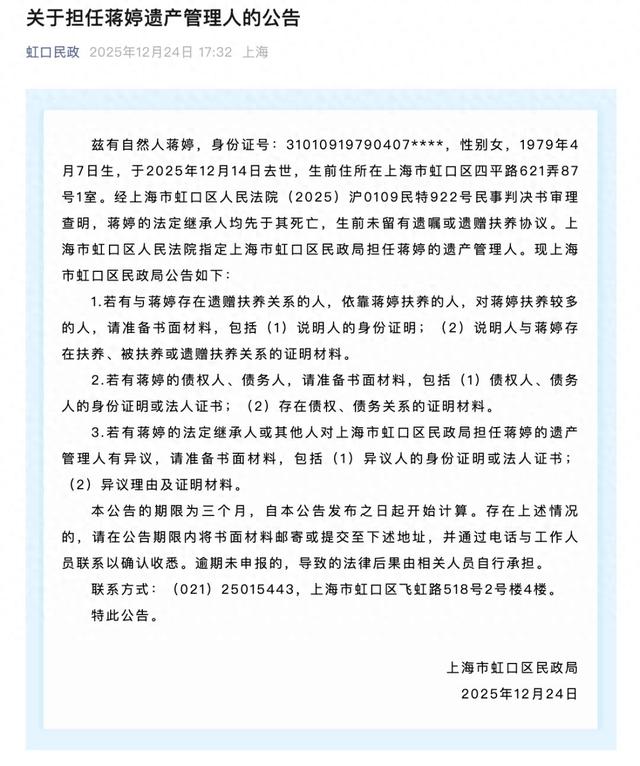
上海市虹口区法院指定区民政局担任蒋婷遗产管理人
Xin Lang Cai Jing· 2025-12-24 16:48
Core Viewpoint - The case of Ms. Jiang, who passed away without a will or legal heirs, highlights the importance of estate management and the need for clear regulations regarding guardianship and inheritance in society [1][7]. Group 1: Estate Management - The Shanghai Hongkou District Civil Affairs Bureau has been appointed as the estate manager for Ms. Jiang, as her legal heirs had predeceased her and she left no will or inheritance agreement [2][8]. - The announcement specifies that individuals who had a caregiving relationship with Ms. Jiang or are her creditors or debtors must submit written materials to the Civil Affairs Bureau within three months [3][4]. Group 2: Funeral Arrangements - Ms. Jiang's distant cousin and friends wish to use her estate for a memorial service and burial, but they have faced procedural obstacles [7]. - The local community committee is coordinating with Ms. Jiang's former employer and relatives to arrange a farewell ceremony, expected to take place by the end of December [8].
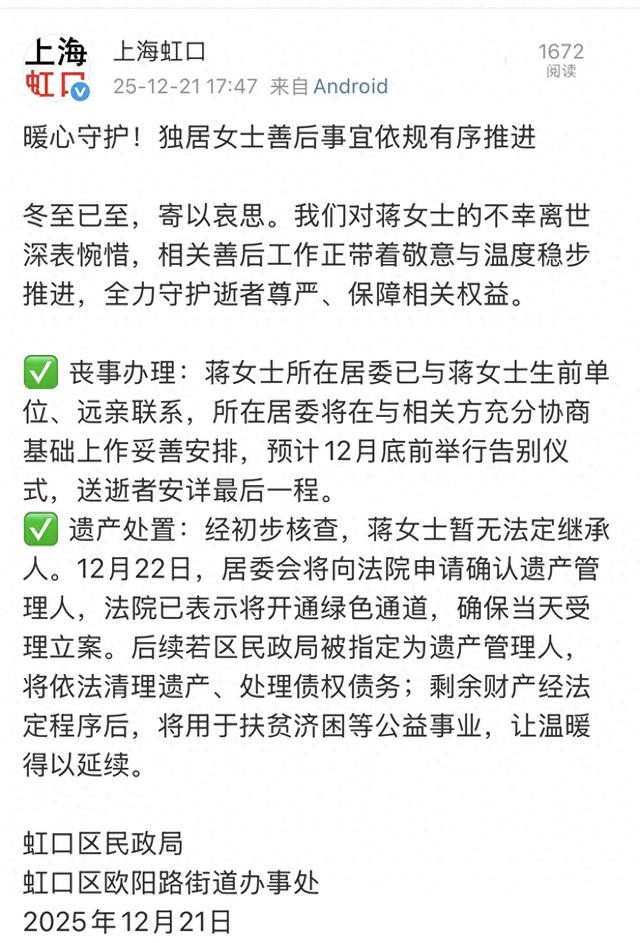
46岁上海独居女子突离世 最新进展:将办告别式
Xin Lang Cai Jing· 2025-12-21 14:32
Core Viewpoint - The unfortunate passing of a 46-year-old single woman in Shanghai has raised significant societal concerns regarding the handling of her estate, including property, savings, and funeral arrangements, due to the absence of designated guardians or heirs [1] Group 1: Estate Management Issues - The deceased had no children, was unmarried, and her parents had passed away, leading to complications in determining legal heirs [1] - The lack of a designated guardian has prompted discussions on the importance of legal frameworks such as guardianship and wills [1] Group 2: Government Response - The Shanghai Hongkou district's official Weibo account announced that the relevant departments are working systematically to address the aftermath of the situation [1] - Authorities are committed to handling all matters in accordance with the law, ensuring the dignity of the deceased is maintained and that legal rights are protected [1]
独身,未婚,无子女,得了病,有点小焦虑丨叶檀回信
Xin Lang Cai Jing· 2025-12-20 11:53
Core Viewpoint - The article emphasizes the importance of preparing legal documents such as wills and advance directives for individuals, especially those living alone without immediate family, to ensure their wishes are respected and their assets are managed appropriately in case of incapacitation or death [6][7][14]. Group 1: Importance of Legal Preparations - Individuals, particularly those who are single and without children, should establish a clear plan for their assets and medical decisions to avoid complications during emergencies [7][14]. - The case of a woman who passed away unexpectedly highlights the consequences of not having designated guardians or clear instructions for asset distribution, leading to her estate being managed by the state [11][14]. Group 2: Role of Designated Guardians - Designating a trusted individual as a guardian is crucial for making medical decisions and managing financial matters when one is unable to do so [15][20]. - The legal framework allows individuals to appoint guardians who can act on their behalf in medical and financial situations, ensuring their preferences are honored [15][17]. Group 3: Advance Directives and Wills - Advance directives can specify medical treatment preferences, while wills ensure that assets are distributed according to one's wishes [17][19]. - It is recommended to keep important documents, such as wills and advance directives, accessible to designated guardians to facilitate their execution when needed [20][21].

养老“三件套”:遗嘱、生前预嘱和意定监护如何操作
第一财经· 2025-12-20 07:28
Core Viewpoint - The article emphasizes the increasing need for designated guardianship (意定监护) in the context of an aging population, rising singlehood, and the phenomenon of "lonely deaths," highlighting the importance of legal arrangements for elder care and asset distribution [1][5][7]. Group 1: Need for Designated Guardianship - The number of elderly individuals requiring designated guardianship is rising due to factors such as aging, singlehood, and children living abroad, leading to a potential increase in cases of individuals lacking guardianship [7][19]. - Cases of elderly individuals, such as a 90-year-old woman and a 70-year-old woman, illustrate the practical need for designated guardianship to manage healthcare and asset distribution [5][6]. - Statistics indicate that by 2024, China's population aged 60 and above will reach 310 million, accounting for 22% of the total population, with significant numbers of elderly living alone [6][7]. Group 2: The "Three Essentials" for Elderly Care - Experts recommend that individuals establish a legal framework consisting of designated guardianship, wills, and advance medical directives to ensure their wishes are respected in healthcare and asset management [9][10]. - Designated guardians can be family members or trusted individuals, and the legal documentation should be notarized to ensure its validity [9][12]. - Advance medical directives allow individuals to specify their preferences for medical treatment in critical situations, thereby guiding their designated guardians in making healthcare decisions [10][11]. Group 3: Cost and Accessibility of Designated Guardianship - The cost of basic designated guardianship services is relatively low, typically around 500 yuan per month, with higher fees for specialized needs [15][16]. - Concerns about financial exploitation by guardians are addressed, emphasizing that designated guardianship organizations do not typically manage large sums of money, and legal frameworks exist to protect individuals' assets [15][16]. - Public awareness of designated guardianship remains low, and there is a need for increased education and professional organizations to support this service [19][21]. Group 4: Challenges and Future Directions - The implementation of designated guardianship faces challenges, including societal stigma and a lack of public knowledge about the concept [19][21]. - The Shanghai government is actively working to establish a formal mechanism for designated guardianship to better protect the rights of the elderly [21][22]. - Future efforts will focus on enhancing legal protections and increasing the availability of designated guardianship services to meet the needs of an aging population [21].
老有所依|意定监护如何收费?养老“三件套”吸引无伴侣无子女者关注
Di Yi Cai Jing· 2025-12-20 06:33
Core Insights - The increasing aging population and changing family structures have made designated guardianship, wills, and advance directives essential for ensuring a secure old age [1][9][19] Group 1: Designated Guardianship - Designated guardianship is becoming increasingly necessary due to the rise in elderly individuals without children or close relatives, leading to potential issues in care and inheritance [4][6] - Cases of elderly individuals, such as a 90-year-old woman without children, highlight the need for designated guardianship to manage healthcare and inheritance matters [4][5] - The number of inquiries regarding designated guardianship has surged, particularly following high-profile cases of "lonely deaths" [1][5] Group 2: Legal Framework and Recommendations - Experts recommend that individuals create legal documents for designated guardianship, wills, and advance directives to ensure their wishes are respected in healthcare and inheritance matters [9][10] - The designated guardian can be a trusted individual or organization, and the process should be formalized through notarization to ensure legal validity [10][11] - Establishing advance directives allows individuals to specify their medical treatment preferences in case of incapacitation, thus alleviating potential conflicts for guardians [10][18] Group 3: Financial Aspects and Public Perception - The cost of basic designated guardianship services is relatively low, typically around a few hundred yuan per month, which makes it accessible for many elderly individuals [14][15] - There is a general skepticism among the elderly regarding the involvement of designated guardianship organizations in financial matters, leading to hesitance in establishing such arrangements [14][15] - Public awareness of designated guardianship remains low, and there is a need for increased education and outreach to encourage more individuals to consider these legal arrangements [18][19] Group 4: Challenges and Future Directions - The implementation of designated guardianship faces challenges, including a lack of public understanding and the limited number of professional organizations offering these services [18][19] - The Shanghai government is actively working to establish a more robust framework for designated guardianship to protect the rights of the elderly, with plans for further development in the coming years [19]

彷徨的中年人开始立遗嘱,需要注意什么?
第一财经· 2025-12-19 11:47
Core Viewpoint - The case of a 46-year-old single woman, Ms. Jiang, who passed away without heirs, has sparked widespread social concern regarding the handling of her estate, highlighting the need for clearer policies on inheritance for individuals without immediate family [2]. Group 1: Legal and Social Implications - Ms. Jiang's case is the first publicly handled estate case in China involving a single deceased person without heirs, which may influence future policy development [2]. - There is a growing trend among middle-aged individuals to seek legal advice on wills and guardianship, indicating a shift in awareness regarding personal estate planning [2][3]. - The concept of "intended guardianship" is applicable to all adults, not just the elderly, suggesting a need for broader public education on this legal provision [2]. Group 2: Will and Estate Planning - The process of drafting a will is straightforward, and individuals as young as their 30s are considering it to ensure their assets are passed on to their children or designated guardians [3]. - It is essential for single individuals, especially those without close relatives, to establish intended guardianship to ensure their wishes are respected in case of incapacitation [3][4]. - A well-structured will should include specific details about asset distribution, including burial arrangements, to facilitate the process for executors and avoid disputes [4]. Group 3: Challenges in Estate Execution - The refusal of authorities to allow Ms. Jiang's distant relative to use her estate for burial expenses highlights the lack of clear standards for what constitutes reasonable expenses in estate management [4][5]. - Establishing a designated executor or estate manager in a will can help clarify the use of assets and resolve potential disputes regarding expenses [5].

“孤独死”者的遗产归谁
第一财经· 2025-12-17 04:41
Core Viewpoint - The article discusses the increasing prevalence of "lonely deaths" in society, particularly among individuals without spouses or children, and emphasizes the importance of establishing legal frameworks such as wills, advance directives, and designated guardianship to manage their affairs posthumously [3][4][9]. Group 1: The Issue of "Lonely Deaths" - The case of a 46-year-old woman, who passed away without heirs, highlights the complexities surrounding the inheritance of assets for individuals without direct relatives [3]. - As societal trends shift towards late marriage, childlessness, and an aging population, the number of individuals facing "lonely deaths" is expected to rise, raising questions about who will manage their affairs [3][4]. Group 2: Legal Frameworks for Inheritance - Many individuals in China do not establish wills or advance directives, leading to complicated inheritance issues for those who die without direct heirs [4]. - According to the Civil Code, the first order of heirs includes spouses, children, and parents, while distant relatives like cousins typically have no inheritance rights [4]. Group 3: Importance of Advance Directives and Guardianship - The concept of designated guardianship allows individuals to choose trusted persons to manage their affairs if they lose the capacity to do so themselves, which is particularly relevant for the growing number of older adults without immediate family [5][6]. - There is a lack of awareness and understanding of designated guardianship among the public, with over 60% of respondents unaware of the system [6]. Group 4: Government Initiatives - The Shanghai government is working on implementing a designated guardianship system, which will provide guidelines and support for older adults to establish such arrangements [8]. - The proposed system aims to create a consultation service and establish a framework for the appointment of guardians, ensuring that older adults can make informed decisions about their care and assets [8].

独身女子“孤独死”后遗产难买墓地?意定监护与遗嘱很必要|乐言商业
Di Yi Cai Jing· 2025-12-17 04:11
Core Viewpoint - The phenomenon of "lonely death" is becoming increasingly common due to trends such as late marriage, childlessness, and aging, raising concerns about inheritance and posthumous arrangements [1][2][7] Group 1: Inheritance Issues - The case of Ms. Jiang, who died without direct heirs, highlights the complexities of inheritance for "lonely death" cases, where distant relatives may face challenges in claiming the estate [1][2] - According to the Civil Code, the first-order heirs include spouses, children, and parents, while distant relatives like cousins do not have inheritance rights, complicating matters for those without immediate family [2][5] Group 2: Importance of Wills and Advance Directives - Many individuals in China avoid discussing death, leading to a lack of wills or advance directives, which complicates inheritance for those without direct heirs [2][5] - Establishing wills or advance directives is deemed necessary, especially for those without spouses or children, to protect their interests and reduce disputes after death [2][5] Group 3: Designated Guardianship - The concept of designated guardianship allows individuals to appoint trusted persons to manage their affairs if they lose capacity, which is crucial for the growing number of childless elderly [4][5] - There is a lack of awareness and trust in designated guardianship, with over 60% of respondents unaware of the system, indicating a need for education and legal frameworks to support it [5][6] Group 4: Government Initiatives - The Shanghai government is promoting the implementation of a designated guardianship system, providing guidelines and support for establishing such arrangements [6] - The initiative aims to create a consultation service mechanism and standardize the process for appointing guardians, effective from January 1, 2026 [6]