量化股多策略

Search documents
量化股多的“变形式”
Xin Lang Cai Jing· 2026-02-27 10:37
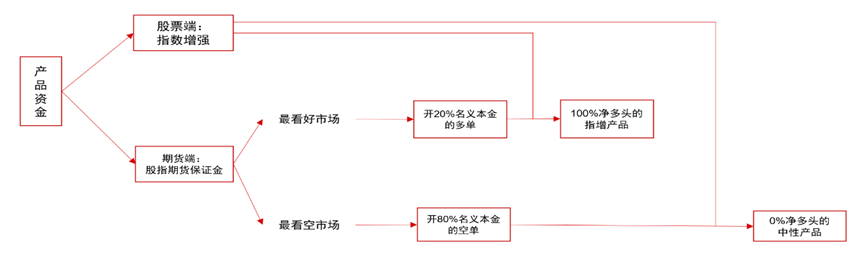
Core Viewpoint - The article discusses two popular quantitative long strategies that provide stronger risk mitigation capabilities in the face of potential market downturns, particularly in light of concerns about a repeat of the small-cap stock crisis seen in early 2024 [1][11]. Group 1: Timing Strategies - The first strategy is the "timing selection strategy," which allows for flexible position adjustments based on market outlook. When the model is bullish, it increases positions; when bearish, it reduces them [2][12]. - There are three approaches to implement this strategy: - The first approach involves timing only in the stock index futures market, maintaining a constant stock position while adjusting futures positions. For example, 80% of funds are invested in a quantitative long strategy, with 20% used as margin for futures. If bullish, an additional 20% long futures position is opened, raising overall exposure to 100%. If bearish, an 80% short futures position is taken to hedge against stock long risks, achieving near-zero exposure [2][12]. - The second approach focuses solely on stock selection, using a bottom-up method to dynamically adjust stock positions based on high-frequency predictions of individual stock movements. The model scans the market every 15 minutes, increasing positions when high-probability opportunities are identified and significantly reducing or even liquidating positions when opportunities are scarce [4][14]. - The third approach combines both stock and futures timing, increasing stock positions and adding long futures when bullish, while reducing stock and opening short futures when bearish [6][16]. Group 2: Options Protection Strategy - The second strategy is the "quantitative long strategy with options protection," which acts like a "critical illness insurance" for the portfolio. For instance, when establishing a position, a put option with a strike price at 90% of the current index is purchased. If the market drops more than 10%, the option becomes valuable, providing a hedge. If the market rises steadily, the protection can be adjusted at new high points. This strategy does not predict market direction but maintains a downside buffer, with the cost being the continuous payment of option premiums [7][17]. Group 3: Strategy Evaluation - The effectiveness of these strategies can be evaluated during critical market events, such as the small-cap flash crash in early 2024, the bull market initiation in September 2024, the tariff war in April 2025, and the style switch at the end of November 2025. Ultimately, there is no "best" strategy, only the "most suitable" strategy framework. For managers seeking absolute returns, the key lies in making executable decisions or quickly correcting mistakes during genuine crises or opportunities [9][18].

什么样的策略,选产品会更省心?
雪球· 2026-02-07 04:10
Core Viewpoint - The article discusses the concept of "hardcore strategies" in private equity investment, emphasizing the importance of selecting strategies that are less dependent on individual managers and more reliant on stable market conditions [8][10]. Group 1: Strategy Selection - Investors often face challenges in selecting from thousands of products, making it crucial to find strategies that simplify the selection process [4][6]. - A proposed solution is to identify strategies with low variance in management and higher success rates, termed "hardcore strategies" [7][8]. Group 2: Characteristics of Hardcore Strategies - Hardcore strategies are defined by two main characteristics: reliance on stable market environments and reduced dependence on individual capabilities [9]. - A truly effective strategy is rooted in long-term market principles that remain unchanged, ensuring its continued effectiveness [9]. Group 3: Examples of Hardcore Strategies - **Quantitative Long-Only Strategy**: This strategy utilizes mathematical models to identify mispriced opportunities in the market, significantly reducing reliance on individual fund managers [12][13]. - Quantitative strategies have shown substantial returns, with examples indicating gains of 40% to 50% during favorable market conditions, outperforming subjective long strategies [13][14]. - The A-share market, characterized by a high percentage of retail investors, provides ample mispricing opportunities for quantitative strategies [16][17]. - **Macro Hedge Strategy**: This strategy focuses on creating a multi-asset portfolio that is less affected by economic cycles, ensuring profitability regardless of market conditions [18]. - The most robust form of macro hedge strategy is the allocation-based approach, which avoids reliance on precise economic predictions and instead builds a resilient portfolio [19][20]. Group 4: Non-Hardcore Strategies - Market-neutral strategies, while often perceived as stable, have significant weaknesses due to their dependence on both quantitative models and the volatile costs of hedging [21][22]. - The performance of market-neutral strategies can be fragile, as they rely solely on excess returns, which can be severely impacted by market fluctuations and hedging costs [25].