量子信息集群等

Search documents
火石创造| 31省份“十五五”抢滩新兴产业和未来产业
Sou Hu Cai Jing· 2026-02-04 20:23
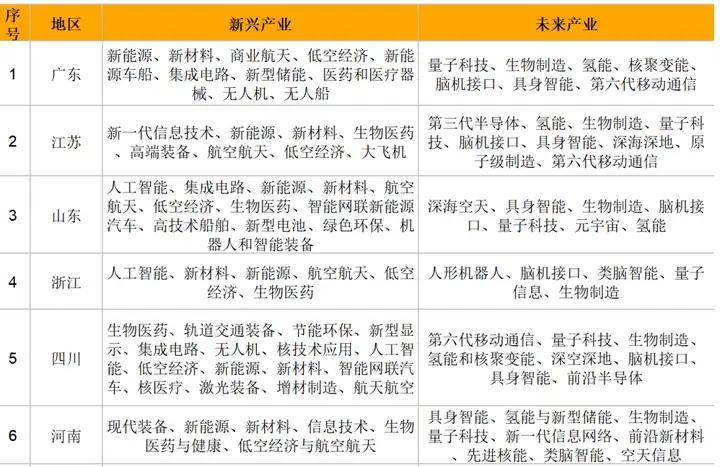
Core Insights - The "14th Five-Year Plan" marks the beginning of a new round of industrial transformation in China, with a clear focus on emerging and future industries across various provinces [1][10] - A comprehensive industrial map has emerged, showcasing strategic competition and collaboration among coastal economic provinces and emerging inland regions [1] Emerging Industries - Low-altitude economy is prioritized by over 28 provinces, making it a nearly universal focus, followed by new materials and new energy, each mentioned by 25 provinces [2] - Biomedicine is highlighted as the most covered future industry, appearing in the plans of 26 provinces, with embodied intelligence and hydrogen energy following closely with 20 and 19 provinces respectively [4] Regional Characteristics - Major economic provinces like Guangdong, Jiangsu, Shandong, and Zhejiang exhibit a comprehensive approach to industrial layout, focusing on both current and future industries [6][7] - Central and western provinces leverage their unique resources to carve out specialized paths, with Sichuan emphasizing nuclear technology and aerospace, while Hubei focuses on optoelectronic information [8] Future Industry Clusters - Six disruptive future industry clusters have been identified: - Intelligent integration cluster focusing on AI and embodied intelligence, with key regions including Zhejiang and Beijing [9] - Quantum information cluster led by Anhui and Beijing, focusing on quantum computing and communication [9] - Future energy cluster targeting hydrogen and nuclear fusion energy, with active participation from Inner Mongolia and Sichuan [9] - Aerospace and deep-sea cluster promoting commercial aerospace and low-altitude economy, with contributions from coastal and inland provinces [9] - Life sciences cluster redefining health and manufacturing, with strengths in Shanghai and Guangdong [9] - Advanced materials cluster providing foundational support for future industries, with significant efforts from Jiangsu and Zhejiang [9] Conclusion - The "14th Five-Year Plan" not only outlines an economic map but also serves as a strategic guide for China to seize opportunities in the global technological revolution and industrial transformation [10]