金融资产收益率回升

Search documents
中国金融业-2026年展望:逐步回归正循环
2026-01-20 03:19
Summary of the Conference Call on China's Financial Industry Outlook for 2026 Industry Overview - The report focuses on the **Chinese financial industry** and its outlook for 2026, predicting a gradual return to a positive cycle after hitting a low in 2025 [1][8]. Key Points and Arguments 1. **Economic Recovery**: - The Chinese financial industry is expected to enter a positive cycle characterized by a gradual recovery in new loans and financial asset yields, stable credit costs, and active capital markets [1][8]. - Nominal GDP growth is projected to stabilize and improve compared to 2025, providing a favorable environment for financial stocks [1][8]. 2. **Policy Support**: - Policy support is shifting from credit to fiscal measures, which will help reduce long-term credit risks [1][8]. - The reduction in policy intervention regarding loan growth and pricing is anticipated, leading to a more favorable lending environment [1][8]. 3. **Financial Asset Yields**: - Financial asset yields are expected to gradually recover in the second half of 2026, driven by a slowdown in loan supply and a renewed focus on risk pricing [2][10]. - The banking sector's net interest margin is expected to bottom out in the first half of 2026 and rebound later due to delayed deposit repricing [12][13]. 4. **Insurance Sector Growth**: - The insurance sector is expected to benefit from improved investment spreads and strong growth in premium income, with double-digit growth anticipated [2][14]. - Ping An is highlighted as a preferred stock due to its advantages in structural growth and product innovation [2][17]. 5. **Banking Sector Performance**: - Ningbo Bank is noted for its strong revenue and profit growth, while Minsheng Bank shows potential for recovery [2][18]. - Overall, bank profits are expected to recover, supported by stable credit costs and improved fee income from active capital markets [2][14]. 6. **Credit Risk Management**: - The report indicates that credit risks in retail, small and micro enterprises, and industrial loans are being effectively managed, with new risk accumulation slowing significantly [15][16]. - The banking system is expected to continue digesting high-risk financial assets, with non-performing loans projected to decrease [15][16]. 7. **Market Opportunities**: - The report identifies several investment opportunities in the financial sector, particularly in insurance, banking, and brokerage firms [17][19]. - The anticipated recovery in A-share and Hong Kong stock markets, along with increased IPO activity, is expected to benefit brokers and exchanges [19][20]. Other Important Considerations - **Risks**: - A significant decline in loan or financial asset yields could adversely affect credit availability and the financial system's ability to absorb risks [23]. - The report emphasizes the importance of maintaining reasonable loan rates to support market-driven capacity clearing in the industrial sector [23]. - **Catalysts for Growth**: - Key catalysts for the banking sector include stable or slightly lower loan market rates and strong performance in 2025, which could support credit demand [21][22]. - **Investment Recommendations**: - The report provides a list of top investment ideas, including specific banks and insurance companies, highlighting their competitive advantages and growth potential [20]. This summary encapsulates the key insights and projections for the Chinese financial industry as discussed in the conference call, providing a comprehensive overview of expected trends, opportunities, and risks for 2026.
中国金融股为何上升?大摩:低风险但有增长,保险业将成领头羊
Hua Er Jie Jian Wen· 2025-08-28 07:51
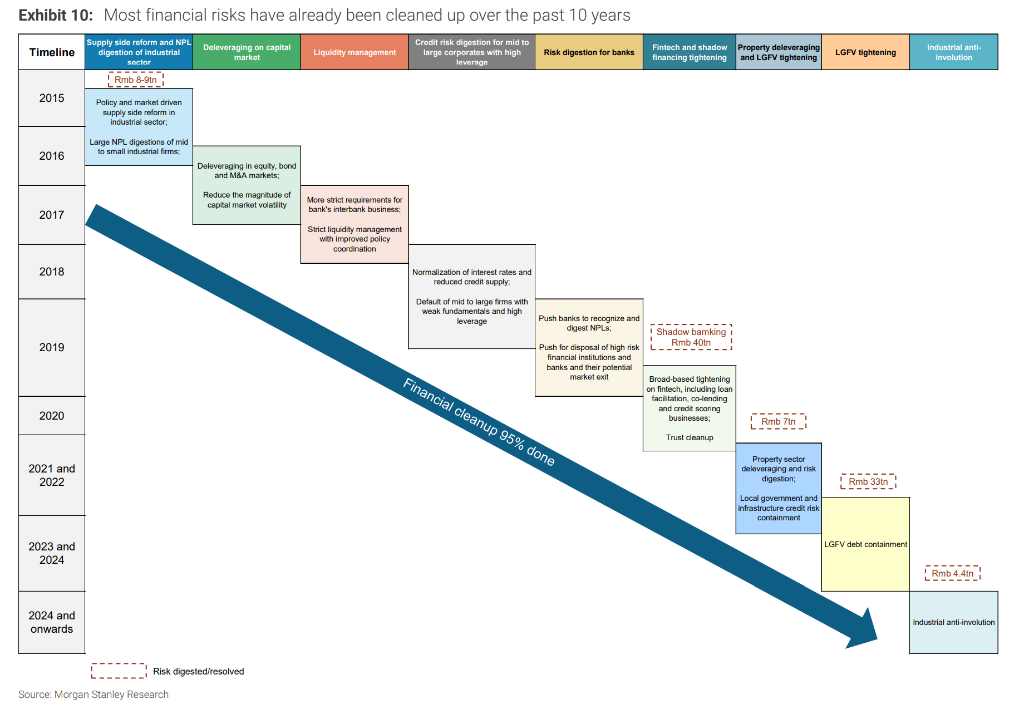
Core Viewpoint - Morgan Stanley believes that China's financial industry is entering a relatively healthy operating cycle, with the insurance sector expected to be the next to return to double-digit price-to-earnings ratios after brokerage firms, leading the financial stocks [1]. Financial Risk Reduction - High-risk financial assets have significantly decreased from 62 trillion RMB (30.2% of total financial assets) in 2017 to 21 trillion RMB (4.9%) in 2025, as a result of ten years of financial cleanup [2]. - It is anticipated that by the end of 2027, high-risk financial assets will further decline to approximately 15 trillion RMB, accounting for about 3% of total financial assets [4]. Profitability and Growth Expectations - The financial industry is expected to experience a rebound in income and profit growth due to stabilized asset yields and reduced risk premiums, with overall profit growth projected to return to a sustainable level of 6-7% [7]. - In an optimistic scenario, financial institutions could see loan and asset yields rise by 50-70 basis points over the next 3-4 years, supporting revenue growth of 7-8% and double-digit profit growth [7]. Insurance Sector Outlook - The insurance industry is particularly favored, with expectations of a return to double-digit price-to-earnings ratios, supported by strong insurance sales and stable balance sheet growth [11]. - If financial asset yields show recovery in the coming years, the valuation rebound for insurance companies may occur faster than currently anticipated [13]. Banking Sector Opportunities - Overall bank income and profit growth may return to 4-6% annually, with some mid-sized banks potentially achieving double-digit profit growth [14]. - The regulatory environment for brokerages has improved, leading to a revaluation back to double-digit price-to-earnings ratios, which is expected to drive the next round of stock price increases [14]. Market Dynamics - The average daily trading volume (ADT) in the A-share market is projected to exceed 2 trillion RMB, driven by changes in the regulatory environment, higher potential ADT, and improved corporate earnings expectations [16].