铀矿

Search documents
美股散户势力崛起:2025年资金破纪录,华尔街机构正被迫“随散户起舞”
智通财经网· 2025-12-23 13:33
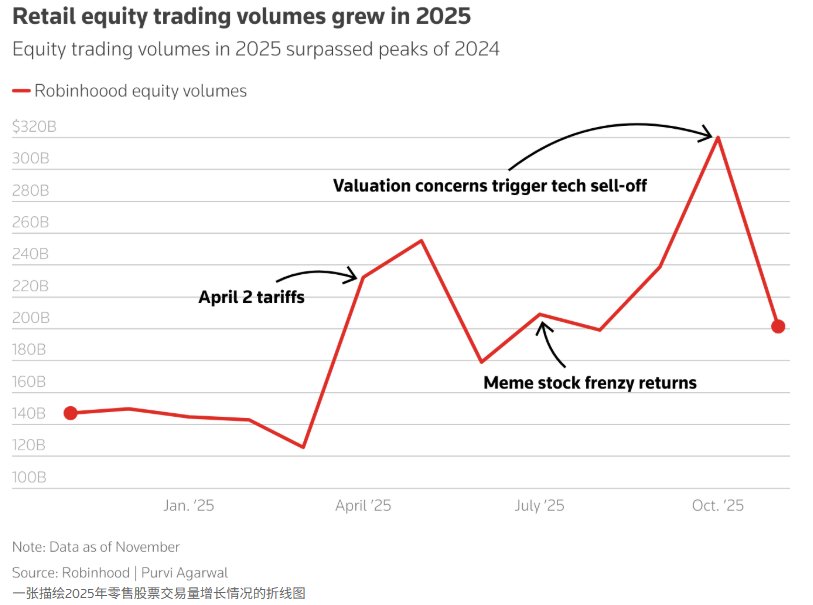
Core Viewpoint - Retail investor inflows into the US stock market are expected to reach a record high in 2025, driven by interest rate cut expectations, making individual investors a significant force behind the potential market rebound that may continue into next year [1]. Group 1: Retail Investor Activity - Retail investors have contributed $302 billion to the US stock market in 2025, a 53% increase from $197 billion in the same period last year, and 14% higher than the record $270 billion during the retail trading frenzy in 2021 [1]. - Retail trading accounted for approximately 20%-25% of total trading activity this year, peaking at around 35% in April [1]. - Retail investors have been actively buying quality stocks during market sell-offs, notably after the global market crash in April triggered by tariff policies, which helped push the S&P 500 index to new highs, with the index up about 16% this year [1]. Group 2: Popular Stocks and Trends - AI concept stocks like Nvidia and Palantir have become favorites among retail investors, with Palantir's value more than doubling as retail investors bought the dip when institutional investors exited due to valuation concerns [5]. - Tesla's stock reached a historical high on December 17, marking its first peak since the end of 2024, indicating strong retail interest [5]. - Retail investors are increasingly favoring ETFs that track stock indices, cryptocurrencies, and commodities, with significant interest in leveraged ETFs [7]. Group 3: Market Dynamics and Future Outlook - Analysts expect potential interest rate cuts by the Federal Reserve to continue boosting the market, sustaining retail investor momentum into 2026 [8]. - Nasdaq plans to apply to the SEC for 24-hour stock trading, which analysts believe will further accelerate retail growth [11]. - Despite the current dominance of AI stocks, analysts predict that retail investment may not exceed 2025's record levels in the coming year due to a potential shift towards more diversified portfolios [11].