银行改革化险

Search documents
2025年,293家银行退出江湖
3 6 Ke· 2025-10-11 02:46
Core Viewpoint - The Chinese banking industry is undergoing significant reform, with a notable trend of mergers and dissolutions among small and medium-sized banks, particularly village and rural commercial banks, as part of a broader effort to enhance efficiency and risk management in the sector [1][2][15]. Group 1: Mergers and Dissolutions - As of September 30, 2025, a total of 293 independent legal banks have exited the market, including 166 that were dissolved and 127 that were merged [1][12]. - The majority of the banks that have disappeared are village banks and rural commercial banks, indicating a shift in the banking landscape towards larger, more stable institutions [1][15]. - Recent examples include the merger of Ningxia Bank with Ningxia Helan Hui Commercial Village Bank, which will result in the latter being dissolved and its operations continued under Ningxia Bank [4][6]. Group 2: Industry Challenges and Responses - Small financial institutions have historically filled gaps in financial services but face challenges such as limited management capabilities and weak risk resistance [2][20]. - The ongoing digital transformation and competition from larger banks necessitate a restructuring through mergers to improve quality while reducing quantity [2][15]. - The central government has emphasized the need for comprehensive financial regulation and risk management, making the reform of small and medium-sized banks a priority [15][20]. Group 3: Future Outlook - The number of banking institutions in China is projected to decrease from over 4,000 to around 3,000 in the next 3-5 years, with a continued focus on consolidating smaller banks [18][21]. - The restructuring of village banks into branches of larger banks is expected to enhance service capabilities and risk management, leading to a gradual reduction in the number of village banks [21][22]. - The overall trend suggests that while mergers may lead to short-term challenges, they are likely to result in a more stable and efficient banking sector in the long run [22][23].

超4000万股股权明日开拍!武汉农商行业绩承压,新管理层如何破局?
Sou Hu Cai Jing· 2025-08-22 07:20
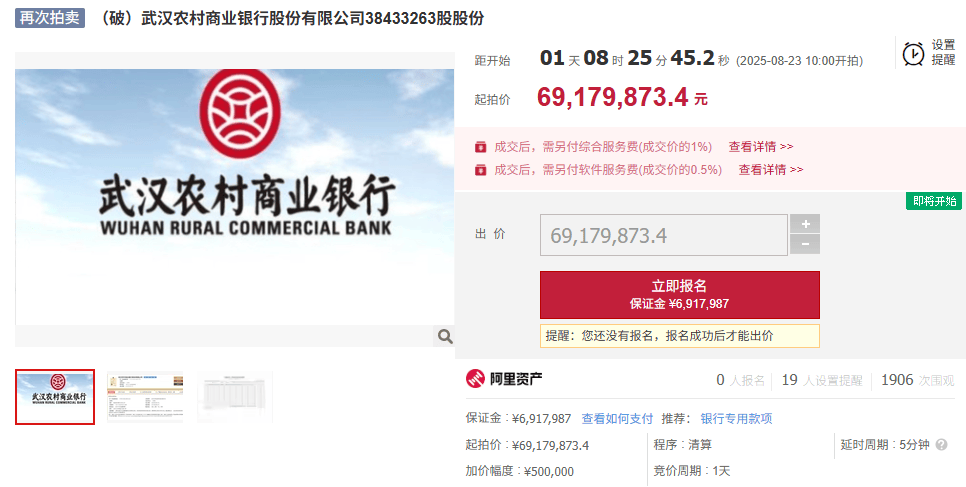
Core Viewpoint - The auction of shares from Wuhan Rural Commercial Bank reflects the challenges faced by the bank, including declining performance and internal governance issues, despite a general bullish sentiment in the banking sector [1][6][10]. Group 1: Share Auction Details - Wuhan Rural Commercial Bank has approximately 38.43 million shares up for auction, with a starting price of 69.18 million yuan, translating to 1.79 yuan per share, which is significantly below its net asset value of 5.04 yuan per share [6][7]. - The auction process includes multiple smaller auctions, with shares being offered in quantities ranging from 100,000 to 2.5 million, aimed at improving liquidity and increasing the chances of successful sales [3][6]. - Despite the low starting prices, there has been a lack of bidders, indicating a lack of interest and confidence in the bank's shares [6][8]. Group 2: Financial Performance - Wuhan Rural Commercial Bank reported a revenue of 7.84 billion yuan in 2024, a decline of 3.8% year-on-year, marking the second consecutive year of negative growth [7]. - The bank's net profit for 2024 fell sharply by 36.7% to 880 million yuan, highlighting significant deterioration in profitability [7]. - The bank's non-performing loan ratio reached 2.96% by the end of 2024, above the industry average, indicating increasing asset quality issues [7][8]. Group 3: Governance and Management Changes - The bank has faced significant governance issues, with two consecutive chairpersons being dismissed for misconduct, raising concerns about internal controls and market confidence [8][10]. - In April 2024, a new chairperson, Zhou Yuping, took over, bringing a fresh perspective and experience from various financial institutions, which may help in stabilizing the bank [10][11]. - The influence of Wuhan Financial Holding Group has increased, with the group becoming a major shareholder, which may lead to more concentrated governance and potential improvements in management practices [11][12]. Group 4: Strategic Restructuring - The bank is undergoing a strategic restructuring, including the divestment of underperforming village banks to improve overall financial health and focus on core operations [12][13]. - The decision to sell off stakes in loss-making village banks is part of a broader effort to enhance profitability and reduce operational risks [12][13]. - The ongoing auction of shares and restructuring efforts reflect the bank's attempts to navigate its financial difficulties and regain investor confidence [13].
广州农商行增资近30亿,近年利润“滑坡”,拟收编5家村行
Nan Fang Du Shi Bao· 2025-08-21 08:27
Core Viewpoint - Guangzhou Rural Commercial Bank has increased its registered capital from approximately 11.45 billion yuan to about 14.41 billion yuan, marking an increase of 2.96 billion yuan, or approximately 26% [2][4]. Capital Changes - The bank's registered capital change was officially recorded on August 6, 2025, reflecting a significant capital increase after three and a half years [3]. - This recent capital increase is close to the total of 3.3 billion yuan raised in previous rounds in January 2018 and January 2022 [4]. Financial Performance - As of the end of Q1 2025, the bank's core Tier 1 capital adequacy ratio was 9.54%, a decrease of 0.36 percentage points from the end of the previous year, indicating weakened risk resistance [2][5]. - The bank's revenue and net profit have declined for two consecutive years, with net profit at 2.416 billion yuan, down 69.5% compared to 2019 [7]. - In Q1 2025, revenue and net profit continued to decline year-on-year by 12.6% and 17.2%, respectively [7]. Market Position and Challenges - Guangzhou Rural Commercial Bank's stock price has dropped 70% from its peak of 6 HKD per share since its listing in June 2017, indicating poor returns for investors [4]. - The bank's credit impairment losses reached 7.769 billion yuan in 2024, accounting for 49.07% of its revenue, highlighting significant financial strain [7]. Strategic Initiatives - The bank has initiated a series of reforms since 2022, including the "Asset Quality Year" campaign and the "Three Hundred Billion Project" aimed at focusing on small and medium-sized asset businesses [7][8]. - The bank is also undergoing restructuring of its rural banks, having publicly announced plans to merge five rural banks in Guangdong province [8]. Future Outlook - The recent capital increase of nearly 3 billion yuan is seen as a crucial support for both the bank's internal reforms and the restructuring of its rural banks [8]. - The bank's chairman has committed to enhancing profitability and market expansion over the next two years, aiming for significant improvements in operational efficiency [8].