
银行板块配置

Search documents
机构:政策工具维持银行间流动性均衡,关注银行配置窗口
Sou Hu Cai Jing· 2026-02-24 07:21
Group 1 - The China Securities Bank Index (399986) decreased by 0.25% as of 15:00, with mixed performance among constituent stocks, where China Merchants Bank led with a rise of 0.59% and Chongqing Bank fell by 1.57% [1] - The People's Bank of China announced a 7-day reverse repurchase operation of 526 billion yuan at a fixed rate of 1.4%, resulting in a net withdrawal of 926.4 billion yuan from the market due to 1,452.4 billion yuan of reverse repos maturing [1] - Analysts from Guangfa Securities expect the central bank to continue flexible and efficient open market operations to maintain overall liquidity balance in the banking sector, especially with important meetings scheduled for early March [1] Group 2 - China Galaxy believes that the current fiscal policy is proactive and the monetary policy continues to support stable interest margins, which is beneficial for bank performance and valuation recovery, making the banking sector an attractive investment opportunity [1] - The Bank ETF Huaxia (515020) tracks the China Securities Bank Index (399986) and has the lowest comprehensive fee rate among ETFs, with its linked funds A class (008298), C class (008299), and D class (024642) [1]
中信证券:银行业经营质效保持平稳态势 板块配置具备较高性价比
智通财经网· 2026-02-09 00:55
Core Viewpoint - The banking sector is maintaining stable operational efficiency, with expectations for improved revenue and profit growth by 2026, supported by stable interest margins and asset quality [1] Group 1: Banking Sector Performance - Recent reports from 11 banks indicate a steady performance in the banking sector, with expectations for a strong start in Q1 2026 [1] - The sector is projected to see revenue and profit growth rates recover, with forecasts of 3.3% for revenue and 2.8% for net profit growth in 2026 [5] Group 2: VAT Policy Analysis - The implementation of the new VAT law in 2024 does not affect the existing tax rates for the banking sector, maintaining a 6% rate for general financial services and a 3% rate for specific services [2][3] - The comprehensive VAT rate for the banking sector is estimated to be 5.88% of operating income based on the education fee surcharge calculations [3] Group 3: Market Conditions - The peak of capital outflows has passed, with a significant reduction in net outflows from related ETFs, indicating a more favorable environment for bank stock investments [5] - The weighted price-to-book ratio for banks is currently at 0.67x, which is at the 44th percentile of the past five years, suggesting a good value configuration for the sector [5]

中国银河证券:银行板块配置窗口开启 维持行业推荐评级
智通财经网· 2026-01-30 07:47
Core Viewpoint - The report from China Galaxy Securities indicates that since Q3 2025, the preference for the banking sector has remained relatively low, with recent passive fund outflows causing disturbances in the banking sector's funding environment. It is expected that the redemption outflow space will narrow, opening a low-valuation configuration window for banks [1]. Group 1: Market Trends - The market style has shifted, with active funds continuing to underweight the banking sector, maintaining a low preference level. As of Q4 2025, the total market value of active funds' holdings in banks was 30.545 billion yuan, accounting for 1.88%, a slight increase of 0.07 percentage points quarter-on-quarter, yet still at a near five-year low. The underweight ratio expanded to 8.88%, up 0.5 percentage points [1]. - Since Q3 2025, there has been a notable rotation in market sectors, with active funds favoring sectors such as non-ferrous metals, communications, and non-bank financials, which saw increases in holdings of 2.07 percentage points, 1.89 percentage points, and 1.03 percentage points respectively. In contrast, the banking sector experienced a decline of 7.68% [1]. Group 2: Fund Flows and Impact - The recent adjustment in the banking sector is primarily attributed to passive fund outflows, with net outflows from stock ETFs reaching 757.99 billion yuan in January 2026. The estimated net outflow from the banking sector due to these redemptions is approximately 83.14 billion yuan [2]. - The largest four CSI 300 ETFs have seen their market shares drop below the top ten holders' shares from the first half of 2025, with an average reduction of about 43%. Although selling pressure remains, the narrowing of redemption outflow space is expected to lessen its impact on the banking sector [2]. Group 3: Long-term Investment Outlook - The influence of long-term funds on the pricing of the banking sector is becoming more pronounced, with the impact of both active and passive public funds diminishing. Long-term funds, such as insurance capital, are expected to stabilize and potentially elevate the valuation of the banking sector, creating opportunities for rebound [3]. - The average dividend yield for A-share banks is currently 4.62%, maintaining its attractiveness for long-term investors. The expectation of steady credit growth and improved liability cost optimization is likely to support a narrowing of interest margin declines, enhancing the outlook for the banking sector [3]. - Historically, the proportion of northbound funds in the banking sector tends to increase in Q1 compared to Q4 of the previous year, with an average increase of 1.07 percentage points over the past five years, excluding 2023. Certain joint-stock banks are expected to benefit more from this increased foreign allocation [3].

中国银河证券:银行板块配置窗口开启 从资金流向看银行定价逻辑
Zhi Tong Cai Jing· 2026-01-30 04:36
Core Viewpoint - The banking sector is currently experiencing low levels of investment interest, with passive fund outflows causing disturbances in the funding landscape. However, a low valuation window for banks is opening up, driven by high dividends and low valuations appealing to long-term investors like insurance funds [1][2]. Group 1: Market Trends - Since Q3 2025, the preference for the banking sector among active funds has remained low, with a total market value of active fund holdings in banks at 30.545 billion yuan, accounting for 1.88% of total holdings, which is near a five-year low [1]. - The low allocation ratio for banks has expanded to 8.88%, indicating a shift in market style with significant rotation among sectors, particularly favoring non-bank financials, metals, and communications [1]. - The banking sector has underperformed, with a decline of 7.68% compared to other sectors, which have seen substantial gains, such as metals rising by 28.89% [1]. Group 2: Fund Flows and Impacts - Recent adjustments in the banking sector are primarily attributed to passive fund outflows, with net outflows from stock ETFs reaching 757.99 billion yuan, leading to an estimated net outflow of approximately 83.14 billion yuan from the banking sector [2]. - The largest four ETFs have seen a significant reduction in market share, with the average holding by the top ten holders decreasing by about 43% compared to the first half of 2025 [2]. - Although selling pressure remains, the space for further outflows is expected to contract, which may reduce the negative impact on the banking sector [2]. Group 3: Long-term Investment Outlook - The influence of long-term funds on the pricing of the banking sector is increasing, as the impact of both active and passive public funds diminishes [3]. - In a low-interest-rate environment, the stable dividends and high dividend yield of banks are attractive to long-term investors, with the average dividend yield for A-share banks currently at 4.62% [3]. - The outlook for credit growth is positive, supported by favorable fiscal and monetary policies, which may enhance the recovery of bank valuations [3]. Group 4: Investment Recommendations - The report recommends specific banks for investment, including Industrial and Commercial Bank of China (601398), Agricultural Bank of China (601288), Postal Savings Bank of China (601658), China Merchants Bank (600036), Jiangsu Bank (600919), and Ningbo Bank (002142) [4].
银行板块配置窗口开启:从资金流向看银行定价逻辑
Zhong Guo Yin He Zheng Quan· 2026-01-30 00:24
Investment Rating - The report maintains a "Recommended" rating for the banking sector, indicating a favorable outlook for investment opportunities in this industry [40]. Core Insights - The banking sector is currently experiencing a configuration window for investment, driven by a shift in market style and a low preference for active funds towards banking stocks. The active fund holdings in the banking sector are at a five-year low, with a total market value of 30.545 billion yuan, accounting for only 1.88% of total holdings, and a low allocation ratio of 8.88% [5][15]. - Recent market performance shows that from the beginning of 2026 until January 28, the Shanghai and Shenzhen 300 Index increased by 1.9%, while the banking sector declined by 7.68%, underperforming compared to other industries [5][15]. - The report highlights that passive fund outflows have significantly impacted the banking sector, with an estimated net outflow of approximately 831.4 billion yuan attributed to ETF redemptions in January 2026. However, it is expected that the outflow pressure will diminish, leading to a stabilization of the banking sector's valuation [15][28]. - Long-term funds are increasingly influencing the pricing of banking stocks, with a notable interest from foreign capital. The average dividend yield for A-share banks is currently 4.62%, making them attractive to long-term investors, especially in a low-interest-rate environment [28][40]. Summary by Sections Section 1: Market Dynamics - The report notes a significant shift in market dynamics, with active funds showing a continued low preference for banking stocks, while funds are flowing into sectors like non-bank financials and materials [5][15]. - The banking sector's performance has been weak compared to other sectors, indicating a potential opportunity for reallocation as valuations are low [5][15]. Section 2: Fund Flows and Impact - The report details that the net outflow from stock ETFs reached 757.99 billion yuan in January 2026, with a significant portion affecting the banking sector due to its weight in the indices [15][28]. - The concentration of holdings in major ETFs, with top holders averaging around 90% ownership, suggests that any changes in these funds will have a pronounced effect on the banking sector [15][28]. Section 3: Long-term Investment Outlook - The report emphasizes the potential for a rebound in the banking sector as long-term funds, particularly insurance capital, are expected to stabilize valuations and enhance investment returns [28][40]. - Recommendations for specific banks include Industrial and Commercial Bank of China, Agricultural Bank of China, Postal Savings Bank of China, China Merchants Bank, Jiangsu Bank, and Ningbo Bank, reflecting a focus on high dividend yields and low valuations [40].






中国银河证券:短期扰动不改业绩回升趋势 继续看好银行板块配置价值
智通财经网· 2025-11-12 08:14
Core Viewpoint - The banking sector's performance in Q3 is temporarily affected by non-interest income disturbances, but steady growth in scale continues to support overall performance, with a stable trend in interest margins and improving net interest income [1] Group 1: Revenue and Profitability - In Q1-Q3 2025, listed banks' revenue grew by 0.9% year-on-year, with pre-provision profit increasing by 0.62% and net profit attributable to shareholders rising by 1.46%, showing a recovery from earlier declines [1] - The annualized weighted average ROE stands at 10.61%, down by 0.6 percentage points year-on-year, indicating a mixed performance across the sector [1] Group 2: Asset Quality and Provisioning - As of the end of September, the non-performing loan ratio for listed banks is 1.15%, unchanged from the first half of the year, with stable asset quality expected for corporate loans and manageable risks in retail [4] - The provision coverage ratio is at 283.17%, down by 4.11 percentage points from the first half, with an increased release of provisions contributing to net profit growth [4] Group 3: Interest Income and Cost of Liabilities - In Q1-Q3 2025, net interest income for listed banks decreased by 0.62% year-on-year, but the decline has narrowed compared to the first half of the year, indicating a stabilization in interest margins [2] - The sample banks' net interest margin is at 1.55%, down by 1 basis point from the first half, with improvements in deposit costs and active adjustments in liability structures supporting this trend [2] Group 4: Non-Interest Income - Non-interest income growth for listed banks has slowed to 4.98% year-on-year, with middle-income sources improving by 4.6%, primarily benefiting from a recovering capital market [3] - Investment income has increased by 20.59% year-on-year, despite fluctuations in other non-interest income due to bond market volatility [3] Group 5: Recommendations - The report recommends investment in specific banks including Industrial and Commercial Bank of China, Agricultural Bank of China, Postal Savings Bank of China, Jiangsu Bank, Hangzhou Bank, and China Merchants Bank [5]
广发证券:当前银行板块具备配置吸引力
Mei Ri Jing Ji Xin Wen· 2025-10-22 02:47
Group 1 - The banking sector has shown strong performance amidst a general market pullback, with the CITIC primary bank index rising by 5.0% from October 13 to 17, 2025, outperforming the Wind All A index significantly [1] - All categories of banks, including state-owned banks, joint-stock banks, city commercial banks, and rural commercial banks, achieved positive returns, with rural commercial banks leading with a 7.12% increase, indicating a temporary market preference for the banking sector [1] - The banking sector has returned to a value range after previous adjustments, and with increasing demand for year-end allocations, it may be in a bottoming phase, presenting certain investment appeal [1] Group 2 - The banking sector performed well today, with bank ETF funds slightly increasing, and over the past five trading days, they attracted a net inflow of over 260 million yuan, with a net inflow rate of 30.60% [1]

终于反弹!百亿银行ETF(512800)涨逾1%,机构:增量资金持续,银行回调大概率接近尾声
Xin Lang Ji Jin· 2025-07-30 06:01
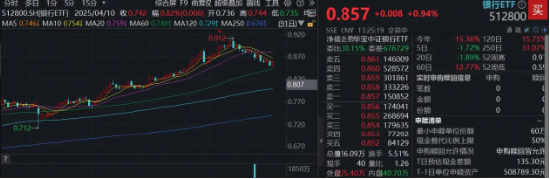
Core Viewpoint - The banking sector is experiencing a rebound, with significant activity in the bank ETF (512800), which has seen a price increase and high trading volume, indicating renewed investor interest [1][4]. Group 1: Market Performance - The bank ETF (512800) opened higher and fluctuated upwards, reaching a peak increase of over 1% before settling at a 0.94% gain, with a trading volume close to 800 million yuan [1]. - Approximately half of the bank stocks rose by over 1%, with notable gains from Qingnong Commercial Bank and Ping An Bank, both exceeding 2% [1][3]. Group 2: Sector Analysis - The banking sector has shown volatility since reaching a peak on July 11, with a recent pullback attributed to a shift in trading funds seeking excess returns [3]. - Analysts suggest that the recent correction in the banking sector may be nearing its end, as absolute return funds, particularly from the insurance sector, are still facing significant asset shortages [3]. Group 3: Investment Opportunities - According to Galaxy Securities, banks, as major components of broad market indices, benefit from ETF quality improvements and expansion, with ongoing accumulation of positive fundamental factors suggesting potential performance turning points [4]. - Huachuang Securities noted an increase in public fund allocation to banks in Q2, indicating a significant under-allocation that could lead to further capital inflows into the sector [4]. - The bank ETF (512800) tracks the CSI Bank Index and includes 42 listed banks, making it an efficient investment tool for tracking the overall banking sector performance, with a fund size exceeding 14.1 billion yuan and an average daily trading volume of 558 million yuan [4].





银行周报(0526-0601):全国农信社改革再下一城
Tai Ping Yang Zheng Quan· 2025-06-03 04:15
Investment Rating - The industry investment rating is "Positive," indicating an expected overall return exceeding 5% above the CSI 300 index in the next six months [41]. Core Viewpoints - The report highlights that the banking sector remains attractive as a dividend asset under a moderately loose monetary policy environment. It suggests focusing on companies benefiting from incremental policy improvements and those with strong fundamentals and regional advantages [6][39]. Summary by Sections Market Review - The Shanghai Composite Index and CSI 300 Index experienced slight declines of -0.03% and -1.08%, respectively, while the Shenwan Banking Index rose by 0.04%, outperforming the CSI 300 by 1.12 percentage points [4][10]. - Among the major banking sectors, state-owned banks, joint-stock banks, city commercial banks, and rural commercial banks had varying performances, with the rural commercial banks showing a positive change of 0.41% [12][13]. Data Tracking - As of May 30, 2025, the banking sector's PB-LF valuation stands at 0.67 times, placing it in the 74.50 percentile over the past five years. The median dividend yield for individual stocks is 4.40%, exceeding the 10-year government bond yield by 2.73 percentage points [5][23]. - The total social financing stock reached 424 trillion yuan, reflecting a year-on-year increase of 8.70%. The loan and deposit balances of Chinese banks were 258.36 trillion yuan and 293.94 trillion yuan, respectively, with year-on-year growth rates of 7.73% and 7.99% [5][39]. Industry Dynamics - The report notes the establishment of the Inner Mongolia Rural Commercial Bank, marking the completion of rural financial institution reforms in ten provinces. This bank has a registered capital of 58 billion yuan and represents a significant milestone in local financial reform [40]. - The National Development and Reform Commission announced a reduction in credit report inquiry fees, which is expected to save users approximately 1.1 billion yuan annually [39][40]. Recommended Companies and Ratings - The report recommends the following companies with respective ratings: - CITIC Bank: "Increase" - China Merchants Bank: "Buy" - Chongqing Bank: "Increase" - Yunnan Rural Commercial Bank: "Buy" [3][40].

