银行理财降费潮

Search documents
【银行理财】银行理财大事记:理财市场降费潮又起,中小银行代销路谋新——2026年1月银行理财市场月报
华宝财富魔方· 2026-02-11 09:40
Key Points - The article discusses the recent developments in the banking wealth management sector, highlighting a new wave of fee reductions and regulatory changes aimed at lowering investor costs and promoting long-term investment [3][4]. - The total scale of wealth management products in January 2026 was reported at 31.57 trillion yuan, showing a slight month-on-month decrease of 0.10% but a year-on-year increase of 5.75% [10]. - The average yield of wealth management products has dropped below 2% for the first time, indicating a challenging environment for returns [4][11]. Regulatory and Industry Dynamics - The new public fund sales regulations were officially implemented, allowing for a relaxation of redemption fees and an extended transition period, which is expected to benefit the market by reducing potential redemption pressures [3][4]. - A "fee reduction wave" has emerged in the banking wealth management industry, with many institutions lowering management and service fees to enhance product attractiveness [3][4]. - The wealth management market is projected to grow to 33.29 trillion yuan by 2025, with a structural shift towards fixed-income products and an increase in allocations to public funds and bank deposits [4][11]. Market Trends - The market for cash management products has been contracting, while fixed-income products, particularly those with minimum holding periods and daily opening types, have been expanding steadily [10][11]. - The average annualized yield for cash management products was recorded at 1.28%, reflecting a decrease of 7.45 basis points, while pure fixed-income products saw an increase in yield to 2.67% [4][10]. - The issuance of new wealth management products in January showed a seasonal increase, with a continued dominance of fixed-income and closed-end products [4][11]. Innovation and Product Development - Several institutions, including Bank of Communications Wealth Management and Ping An Wealth Management, have successfully launched new systems for direct registration of wealth management products, enhancing compliance and operational efficiency [7][8]. - New product strategies, such as the "micro-wave fixed income+" approach, have been introduced to balance liquidity and stability, reflecting the industry's response to evolving market demands [7][9]. - Wealth management companies are increasingly participating in IPOs, particularly in the technology sector, to capture growth opportunities and align with policy directions [7][9].


存款都去哪儿了?银行理财开启“揽客之战”
Jin Rong Shi Bao· 2025-07-11 13:26
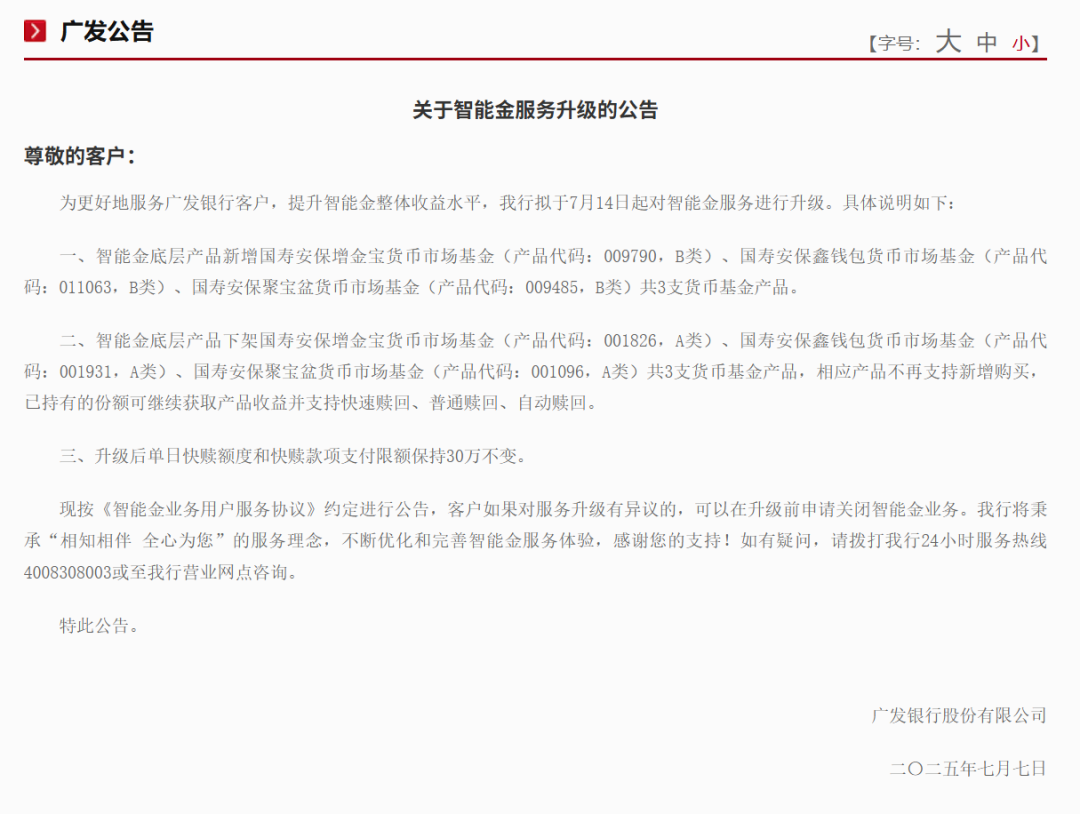
Group 1 - The decline in deposit interest rates has led to a competitive "customer acquisition battle" among banks, with wealth management products becoming a popular alternative for investors [1] - As of the end of June, the scale of the bank wealth management market has returned to over 30 trillion yuan, with cash management products being a key focus for banks [1][2] - The average annualized yield for cash management wealth management products remains above 1%, making them attractive compared to the current deposit interest rate of 0.05% [1] Group 2 - Guangfa Bank announced an upgrade to its cash management product "Smart Gold" starting July 14, which will involve the removal of three money market fund products and the addition of three new ones [2][5] - Other banks are also optimizing their cash management products, with adjustments to sales channels and single account holding limits [5][8] - For example, the single account holding limit for "Zhaoying Daily Gold" products has been significantly increased, indicating a trend towards accommodating larger investments [5][7] Group 3 - Several banks, including Zhaoyin Wealth Management and Guangfa Wealth Management, have initiated a "fee reduction wave" to attract customers, with management fees being lowered to as low as 0% [8][9] - Guangfa Bank has issued over 40 announcements regarding fee reductions for various wealth management products, with reductions of up to 25 basis points [9] - The current fee reduction strategy is seen as a short-term measure to attract clients and respond to interest rate cuts, while also indicating a shift towards service optimization in the industry [9][10]