现金管理类理财产品

Search documents
2025年银行理财规模普增,低利率环境下结构调整加速
第一财经· 2026-03-12 15:36
Core Viewpoint - The overall operational pattern of the banking wealth management industry is gradually emerging, with many banks' wealth management subsidiaries reporting positive growth in their 2025 operating data despite downward pressure on bond yields and a trend of "deposit disintermediation" [2][3]. Group 1: Industry Growth - Thirteen wealth management companies have reported their 2025 performance, showing that the industry scale has generally achieved positive growth, with a total management scale reaching 33.29 trillion yuan, an increase of 3.34 trillion yuan year-on-year, representing a growth of 11.15% [5][6]. - Leading the industry, Xingyin Wealth Management has a product scale exceeding 2.43 trillion yuan, followed by Puyin Wealth Management at 1.47 trillion yuan. Several city commercial banks also showed steady growth, with Su Yin Wealth Management and Hang Yin Wealth Management at 826.2 billion yuan and 607.6 billion yuan, respectively [5]. - Nine wealth management companies achieved double-digit growth, with foreign joint venture companies showing particularly strong growth, such as Far East Agricultural Bank Wealth Management, which increased from 48.7 billion yuan to 89.3 billion yuan, a growth of over 80% [5]. Group 2: Product Structure Changes - Despite the continuous expansion of wealth management scale, the structure of products is changing due to declining asset yields. Fixed-income products still dominate but the proportion of mixed products is gradually increasing, with mixed products reaching a scale of 870 billion yuan, accounting for 2.61% of the total [10]. - For instance, Xingyin Wealth Management's fixed-income product scale is 2.26 trillion yuan, accounting for 98.19%, while its mixed product scale has nearly doubled to 34.9 billion yuan, now accounting for 1.52% [10]. - The "fixed income plus" strategy has become a major focus for wealth management companies, with products typically based on stable assets like bonds, supplemented by a small allocation to equity or commodity assets to enhance returns [12]. Group 3: Future Trends - The trend of increasing wealth management scale is expected to continue into 2026, with estimates suggesting an increase of 1.5 trillion to 2.3 trillion yuan in the scale of wealth management products [6][7]. - The competition for funds is intensifying, with insurance products potentially diverting some funds, although the overall impact is expected to be limited [8]. - In the current low-interest-rate environment, wealth management products may further evolve towards multi-asset and multi-strategy configurations to enhance yield flexibility [19].


2月理财月报:总量止跌回升,混合类产品增长放缓
GUOTAI HAITONG SECURITIES· 2026-03-04 00:25
Investment Rating - The report assigns an "Overweight" rating for the industry, indicating a potential increase of over 15% relative to the CSI 300 index [2][18]. Core Insights - As of the end of February 2026, the total scale of bank wealth management products reached 31.66 trillion yuan, reflecting a year-on-year growth of 5.6% and a slight month-on-month increase of 0.3%, ending a two-month trend of net outflows [4][11]. - The mixed product category continues to show positive growth, although the monthly increase is less than half of January's figures, totaling only 10.8 billion yuan [7]. - In February, 2,015 new wealth management products were launched, with an initial fundraising scale of 299.5 billion yuan, which is less than half of January's due to the impact of the long holiday [7][8]. Summary by Sections Wealth Management Scale - The total scale of bank wealth management products is 31.66 trillion yuan, with a year-on-year growth of 5.6% and a month-on-month increase of 0.3%. The net inflow for the month was 94.8 billion yuan, ending the previous two months of net outflows [4][11][7]. Product Structure - Cash management and fixed-income products have rebounded, with net increases of 7.7 billion yuan and 77 billion yuan, respectively. Mixed products maintained positive growth but saw a significant decrease in monthly increments, totaling only 10.8 billion yuan [7]. - In February, 2,015 new wealth management products were issued, with a total initial fundraising of 299.5 billion yuan. The breakdown includes 32 cash management products, 1,941 fixed-income products, 36 mixed products, and 6 equity products [7][8]. Average Yield - The weighted average yield of bank wealth management products in February was 2.8%, a decrease of 6 basis points from January. Cash management and pure fixed-income products saw further declines in average yields, while equity products experienced an increase in yield to 11.84% [9][7].
2月理财月报:总量止跌回升,混合类产品增长放缓-20260303
GUOTAI HAITONG SECURITIES· 2026-03-03 14:29
Investment Rating - The report assigns an "Overweight" rating for the industry, indicating a potential increase of over 15% relative to the CSI 300 index [2][18]. Core Insights - As of the end of February 2026, the total scale of bank wealth management products reached 31.66 trillion yuan, reflecting a year-on-year growth of 5.6% and a slight month-on-month increase of 0.3%, ending a two-month trend of net outflows [4][11]. - The mixed product category continues to show positive growth, although the monthly increase is less than half of January's figures, amounting to only 10.8 billion yuan [7]. - In February, 2,015 new wealth management products were launched, with an initial fundraising scale of 299.5 billion yuan, which is less than half of January's due to the impact of the long holiday [7][8]. Summary by Sections Wealth Management Scale - The total scale of bank wealth management products is 31.66 trillion yuan, with a year-on-year growth of 5.6% and a month-on-month increase of 0.3%. The net inflow for the month was 94.8 billion yuan, marking the end of the previous two months' net outflow [4][11][7]. Product Structure - Cash management and fixed-income products have rebounded, with net increases of 7.7 billion yuan and 77 billion yuan respectively. The mixed product category maintained positive growth but saw a significant drop in monthly increments [7]. - In February, 2,015 new products were issued, with cash management, fixed-income, mixed, and equity products being 32, 1,941, 36, and 6 respectively [7]. Average Yield - The weighted average yield of bank wealth management products in February was 2.8%, a decrease of 6 basis points from January. Cash management and pure fixed-income products saw further declines in yields [9][7].
专访连平:天量定期存款将到期,如何为实体经济“添薪”蓄力
Nan Fang Du Shi Bao· 2026-02-24 02:07
Core Insights - The 2026 Guangdong Province High-Quality Development Conference focused on the collaborative development of manufacturing and service industries, emphasizing the role of financial innovation in promoting industrial integration [2] - A significant amount of time deposits, estimated between 72 trillion to 90 trillion yuan, will mature in 2026, raising questions about how these funds will be redirected to support industrial integration and technological innovation [5][6] - The release of these funds presents a historic opportunity for banks to adopt differentiated strategies to retain customers and lower funding costs, thereby directing more resources towards high-quality development sectors [2][5] Financial Landscape - The total amount of maturing time deposits in 2026 is projected to be between 72 trillion and 90 trillion yuan, with approximately 49 trillion to 61 trillion yuan from households and 23 trillion to 29 trillion yuan from enterprises [6][7] - The growth rate of time deposits in China has exceeded 10% annually over the past three years, with a total balance of 179.6 trillion yuan as of the end of 2025 [6] Factors Influencing Deposit Behavior - The preference for long-term time deposits has been driven by low-risk tolerance among investors, particularly among older demographics seeking to preserve capital [7][8] - The COVID-19 pandemic and subsequent economic uncertainties have led to an increase in precautionary savings, with many individuals opting for time deposits as a safe asset [8][9] - Regulatory changes in asset management and a downturn in the real estate market have also contributed to the shift towards time deposits [9][10] Potential Fund Allocation Post-Maturity - Upon maturity, a portion of these funds is expected to remain within the banking system, while some may flow into private banking products, bonds, and equity markets, depending on market conditions [10][11] - The likelihood of a large-scale migration of deposits to capital markets is low due to the conservative risk profile of depositors, but some funds may seek higher returns in stable investment vehicles [11][12] Economic Implications - The movement of these funds into capital markets could enhance liquidity, stimulate market activity, and support direct financing for enterprises, particularly benefiting small and medium-sized enterprises [14] - A portion of the released funds may also enter the consumer market, potentially boosting demand in sectors like retail and tourism [14] Banking Sector Impact - The upcoming maturity of time deposits is expected to improve bank performance in the short term by reducing funding costs, but may also lead to long-term challenges as banks face pressure on asset yields [19][20] - Large state-owned banks are better positioned to retain maturing deposits due to their extensive customer base and resources, while smaller banks may struggle to compete [20][21] Strategies for Customer Retention - Different types of banks are adopting varied strategies to retain customers amid the maturing deposit wave, with state-owned banks focusing on comprehensive service offerings and smaller banks emphasizing local engagement and innovative products [21][23] - The competition is shifting from interest rate-based retention to a focus on overall service quality and customer experience [23]

居民少增、非银多增延续 存款结构变化如何影响银行负债格局
Di Yi Cai Jing· 2026-02-24 01:05
Core Viewpoint - In January, there was a significant increase in RMB deposits, with a notable trend of a decrease in household deposits and an increase in non-bank deposits, reflecting a shift in wealth from traditional savings to asset management products [1][10]. Group 1: Deposit Trends - In January, RMB deposits increased by 3.8 trillion yuan year-on-year, with household deposits increasing by 2.1 trillion yuan, which is a decrease of 3.4 trillion yuan compared to the previous year [1][10]. - Non-bank deposits saw an increase of 1.5 trillion yuan, which is a year-on-year increase of 2.6 trillion yuan, driven by a low base effect from the previous year and a bullish equity market at the beginning of the year [2][11]. - The total increase in RMB deposits for January was 8.09 trillion yuan, with non-bank financial institution deposits increasing by 1.45 trillion yuan, marking a significant rise compared to previous years [11]. Group 2: Factors Influencing Non-Bank Deposits - The increase in non-bank deposits is attributed to multiple factors, including a low base from the previous year and an active stock market that attracted household funds [2][11]. - Research indicates that the implementation of new interbank deposit rate regulations in December 2024 led to a significant reduction in non-bank deposits in January 2025, contributing to the low base effect observed [2][11]. - The average daily trading volume in the stock market increased by 58% in January, further encouraging the shift of household deposits to non-bank deposits [2][12]. Group 3: Wealth Migration and Asset Management - The trend of "deposit migration" reflects a broader shift in asset allocation from traditional bank deposits to asset management products, driven by differences in yield [3][13]. - The growth of asset management products, which reached a balance of 56.3 trillion yuan by the end of 2025, indicates a 9.7% year-on-year increase, outpacing the growth of household and enterprise deposits [4][14]. - This migration does not imply a net outflow of funds from the banking system, as funds often return to banks through various channels [4][14]. Group 4: Impact on Banking Sector - The rapid growth of non-bank deposits is altering the liability structure of banks, with non-bank deposits growing at a rate of 22.8%, significantly higher than other deposit types [7][17]. - Non-bank deposits are characterized by higher volatility and uncertainty, which increases the liquidity management challenges for banks [7][17]. - The cost implications of non-bank deposits are mixed; while they may be cheaper than traditional deposits, banks may need to offer additional services to retain customers, potentially increasing overall costs [8][18].
居民少增、非银多增延续,存款结构变化如何影响银行负债格局
Di Yi Cai Jing· 2026-02-23 12:35
Group 1 - The core viewpoint of the articles highlights a significant increase in RMB deposits in January, with a notable trend of decreasing household deposits and increasing non-bank deposits [2][3] - In January, RMB deposits increased by 3.8 trillion yuan year-on-year, with non-bank deposits contributing 1.5 trillion yuan to this growth, while household deposits only added 2.1 trillion yuan, reflecting a decrease of 3.4 trillion yuan compared to the previous year [2][3] - The shift in deposit structure indicates a trend of wealth migration from traditional deposits to asset management products, raising concerns about the liquidity status of the banking system [2][5] Group 2 - Non-bank deposits have shown a continuous increase, with January figures indicating a rise of 2.56 trillion yuan compared to the same month in the previous year, driven by a low base effect and an active stock market [3][5] - The rapid growth of non-bank deposits is altering the liability structure of banks, with non-bank financial institution deposits increasing by 22.8% year-on-year, compared to 9.7% for household deposits [9] - The volatility and uncertainty associated with non-bank deposits pose higher liquidity management challenges for banks, as these deposits are more susceptible to market fluctuations [9][10] Group 3 - The migration of deposits does not necessarily equate to a significant influx of funds into the equity market, as the term "deposit migration" primarily refers to a reallocation of assets rather than a systemic liquidity shift [6][7] - Analysts suggest that the cost implications of non-bank deposits for banks are twofold, potentially lowering direct costs but increasing the need for banks to offer additional services to retain customers [10] - The ongoing trend of household deposits flowing into asset management products and equity markets is expected to continue, potentially widening the liability gap for banks in 2026 [10]
中银理财总裁崔海涛:以专业践初心,以匠心守财富
Zhong Guo Ji Jin Bao· 2026-02-16 13:54
Core Viewpoint - The company emphasizes its commitment to wealth management and investment opportunities in the context of a stable macroeconomic environment and evolving capital markets, highlighting the importance of strategic asset allocation and long-term investment perspectives [1][2]. Economic Outlook - The macroeconomic environment is expected to improve, with China's economic foundation being strong, resilient, and full of potential. The country has established the largest and most comprehensive industrial system globally, which will maintain its supply chain advantages [1]. - Policies aimed at boosting new consumption and investment are anticipated to further unlock economic potential, reinforcing the positive economic momentum [1]. Investment Recommendations - The company suggests four key investment strategies: 1. Maintain a steady investment approach with a balanced asset allocation of "stable + growth" assets, including cash management and fixed-income products for wealth stability, while also considering "fixed income +" and mixed products for growth opportunities [1]. 2. Adopt a long-term investment perspective to mitigate the impact of short-term market fluctuations, particularly for equity-linked products that can benefit from industrial upgrades over time [2]. 3. Tailor investment strategies to individual risk profiles and life stages, recommending cash management and fixed-income products for conservative investors, while encouraging more aggressive asset allocations for those with higher risk tolerance [2]. 4. Leverage professional insights and services to navigate complex market conditions, ensuring customized and expert financial management to seize investment opportunities and mitigate risks [2]. Leadership Profile - Cui Haitao, the current president and executive director of the company, holds a master's degree in finance from the Graduate School of the People's Bank of China and has held various significant positions within the banking sector [3].
银行存款“流失”?央行最新回应
Di Yi Cai Jing Zi Xun· 2026-02-11 15:11
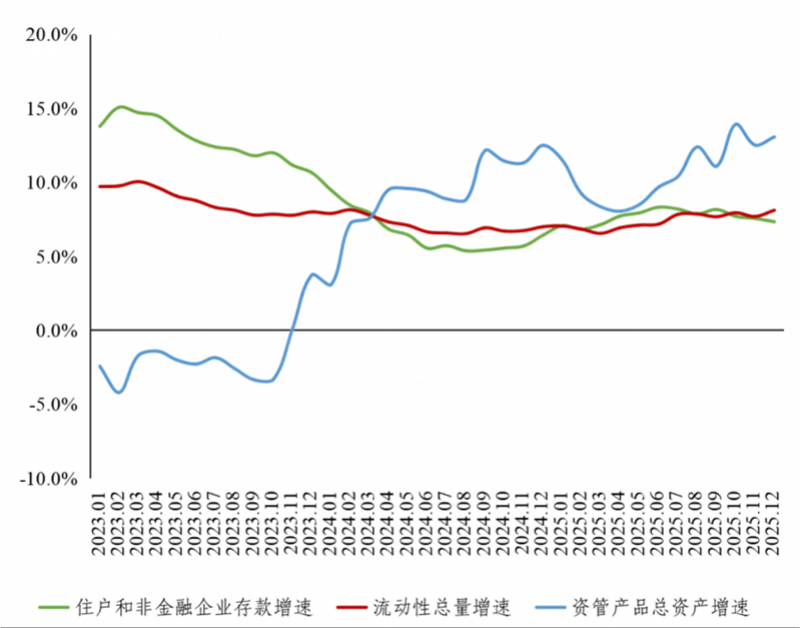
Core Viewpoint - The article discusses the high-level decline in the growth rate of household deposits in China by the third quarter of 2025, highlighting a shift in asset allocation towards wealth management and asset management products, which is a response to the declining interest rates and a more diversified financial market [2][3]. Group 1: Asset Management Products Growth - The scale of asset management products has been growing rapidly, with a total asset balance of 120 trillion yuan by the end of 2025, reflecting a year-on-year increase of 13.1% [3][4]. - The growth in asset management products is attributed to the marketization of interest rates, where investors are weighing returns against risks, leading to a shift from bank deposits to these products [3][4]. - By the end of 2025, over 80% of asset management products were allocated to fixed-income assets, with significant investments in interbank deposits and certificates of deposit [4]. Group 2: Changes in Deposit Structure - The report indicates that the rapid growth of asset management products has altered the structure of bank deposits, with a recent decline in the proportion of household and corporate deposits and an increase in interbank deposits [5][6]. - Even though some deposits are shifting towards wealth management and asset management products, a significant portion is still directed towards interbank deposits and certificates of deposit, which ultimately returns to the banking system [5][6]. Group 3: Liquidity Assessment - The overall liquidity in the financial system can be assessed by aggregating bank deposits and asset management products while excluding interbank transactions, showing a stable growth trend in liquidity over recent years [6][7]. - The central bank has effectively met the liquidity needs of the banking system through various tools, with a net injection of 6 trillion yuan in open market operations in 2025 [6][7]. - The current social financing environment remains relatively loose, supporting the real economy while allowing for a more diversified observation of asset and liability structures [7].
央行回应居民存款“搬家”
Sou Hu Cai Jing· 2026-02-11 12:38
Core Insights - The discussion around the "50 trillion deposits maturing" has sparked widespread debate among residents regarding the reallocation of deposits [1] - The People's Bank of China (PBOC) released a report addressing the trends in the flow of these massive deposits [1] Group 1: Deposit Trends - In a low-interest-rate environment, there is a notable shift between asset management products and bank deposits, with the growth rates of these two categories showing an inverse relationship [2] - Since 2024, the one-year fixed deposit rate has decreased by 0.5 percentage points, while cash management products have maintained higher yields compared to bank deposits [2] Group 2: Asset Management Growth - By the end of 2025, the total assets in asset management reached 120 trillion yuan, marking a year-on-year increase of 13.1%, with an additional 13.8 trillion yuan added throughout the year [4] - The funds sourced from households and enterprises for asset management products reached 56.3 trillion yuan, reflecting a 9.7% year-on-year growth, which is 2.4 percentage points higher than the growth rate of household and enterprise deposits [4] Group 3: Fund Allocation - Over 80% of asset management products are directed towards fixed-income assets, with significant allocations to interbank deposits and certificates of deposit, totaling 28.7 trillion yuan by the end of 2025, which is an 18.9% increase [6] - The shift of deposits to asset management products does not imply a departure from the banking system, as most funds eventually return to banks, altering the structure of bank deposits rather than reducing overall deposits [6] Group 4: Diversification of Investments - Besides deposit-like assets, bonds, stocks, and non-standardized debt are also significant investment targets for asset management products, indicating a trend towards diversified asset allocation [6]
存款搬家!理财公司上调单户持仓上限 降费率揽客
Guo Ji Jin Rong Bao· 2026-02-11 06:34
Core Viewpoint - Cash management financial products have become a focal point for banks' wealth management institutions to attract customers, driven by declining deposit rates and the need to enhance customer experience and market share [1][4]. Group 1: Market Dynamics - Since June, several banks, including China Merchants Bank Wealth Management, Everbright Wealth Management, and Huaxia Wealth Management, have initiated promotional activities such as fee rate discounts and increased individual customer holding limits for cash management products [1][3]. - The downward trend in deposit rates has accelerated the migration of household savings to the wealth management market, making cash management products a critical area for competition among wealth management firms [4]. Group 2: Product Adjustments - China Merchants Bank Wealth Management launched two cash management products on June 19, with a total fundraising scale of approximately 4.575 million and 5.4692 million yuan, respectively, and reduced the annual management fee from 0.3% to 0.01% [3]. - Other banks, such as Huaxia Wealth Management and Everbright Wealth Management, have also implemented fee rate reductions and expanded sales quotas for their cash management products to enhance customer service and reduce investment costs [3]. Group 3: Future Outlook - The bank wealth management market is expected to develop with a "steady yet changing" characteristic, with an increasing emphasis on the allocation value of equity assets as a significant avenue for enhancing returns [1][7]. - Analysts suggest that as deposit rates decline, household savings will likely flow into cash management and short-term debt products, while the stock market's slow growth may limit the effectiveness of deposit migration [7].