银行经营困境

Search documents
北京商报解析廊坊银行选聘"救场" 欲加速摆脱业绩泥淖
Zhong Guo Jing Ji Wang· 2026-02-13 08:00
Core Viewpoint - Langfang Bank is actively seeking to improve its management and operational performance by publicly recruiting five senior executives, including two vice presidents, a board secretary, a chief compliance officer, and a chief risk officer, in response to ongoing operational challenges [1] Financial Performance - The bank has experienced a continuous decline in operating revenue from 2020 to 2024, with figures of 5.249 billion, 5.137 billion, 4.963 billion, 4.563 billion, and 3.613 billion respectively [1] - The net profit attributable to shareholders has also decreased significantly during the same period, with values of 1.418 billion, 0.803 billion, 0.569 billion, and 0.243 billion [1] Asset Quality - As of the end of 2024, the non-performing loan ratio increased by 0.41 percentage points to 2.44% compared to the previous year [1] - The provision coverage ratio saw a significant decline from 153.19% at the end of the previous year to 104.29% [1]
新帅上任、增资获批,双喜临门的山西银行旧愁难消
Bei Jing Shang Bao· 2026-02-10 14:47
Group 1 - The core message of the news is that Shanxi Bank has received approval for a capital increase and a new president, but it faces significant operational challenges, including weak profitability and asset quality issues [1][2][4] - Shanxi Bank's registered capital has increased from 25.894 billion to 27.309 billion yuan, primarily due to a 1.42 billion yuan capital injection from the Shanxi Provincial Finance Department, making it the third-largest shareholder [2][3] - The new president, Xing Yi, has a strong background in the central banking system, which is expected to enhance the bank's governance and operational stability [3][4] Group 2 - Despite positive developments, Shanxi Bank's stock auction faced challenges, with a recent auction of 416 million shares failing to attract any bids, highlighting ongoing issues with shareholder confidence [4][5] - The bank's financial performance has been under pressure, with a capital adequacy ratio declining from 13.05% at the end of 2022 to 10.51% in mid-2025, and net profit dropping by 93.86% year-on-year [8][9] - Analysts suggest that the bank should focus on improving asset quality, optimizing governance, and diversifying its business model to reduce reliance on traditional lending [9][10]

换帅难挽颓势!东莞农商行:从珠三角样本到风险样本
市值风云· 2025-10-17 10:10
Core Viewpoint - Dongguan Rural Commercial Bank is facing unprecedented challenges, with declining profitability and deteriorating asset quality, reflecting both macroeconomic pressures and internal shortcomings in business transformation and risk management [3][21]. Financial Performance - The bank's revenue growth has sharply declined from 26.3% in 2019 to 2.1% in 2022, and has turned negative since the new chairman took office, with revenue decreasing by 12.5% in 2023 and 13.6% in 2024 [6][7]. - For the first half of 2025, the bank reported revenue of 5.5 billion yuan, a 14% decrease year-on-year, and net profit of 2.6 billion yuan, down 22% [7][8]. Interest Income and Net Interest Margin - The bank's net interest income fell by 13.2% to 9.17 billion yuan in 2024, continuing to decline by 10% to 4.24 billion yuan in the first half of 2025 [10]. - The net interest margin decreased from 2.24% in 2020 to 1.35% in 2024, and further to 1.22% in the first half of 2025, placing it among the lowest in comparison to peers [10][13]. Non-Interest Income - Although non-interest income grew in 2024, it was primarily driven by bond trading gains, while fee and commission income dropped by 35.9% [13]. - In the first half of 2025, fee and commission income continued to decline by 16.8%, indicating a structural issue in the bank's income sources [13]. Asset Quality - The bank's non-performing loan (NPL) ratio has increased for four consecutive years, rising from 0.82% in 2020 to 1.84% in 2024, and further to 1.87% in the first half of 2025 [14]. - The balance of non-performing loans surged from 2.87 billion yuan at the end of 2022 to 6.978 billion yuan by the end of 2024, reflecting a significant increase in credit risk [15]. Loan Structure and Regional Concentration - The bank's loan structure has shown an imbalance, with corporate loans increasing to 59% of total loans by the end of 2024, while retail loans remained stagnant [18]. - A significant 82% of the bank's loans are concentrated in the Dongguan region, making it vulnerable to local economic fluctuations [20]. Future Outlook - The bank is expected to continue facing operational pressures due to an unstable economic recovery and a low interest rate environment, necessitating a balance between risk management and business development [21].


成本涨17.2%,净利跌16.77%,浙江德清农商银行上半年经营陷困局
Jin Rong Jie· 2025-08-15 06:54
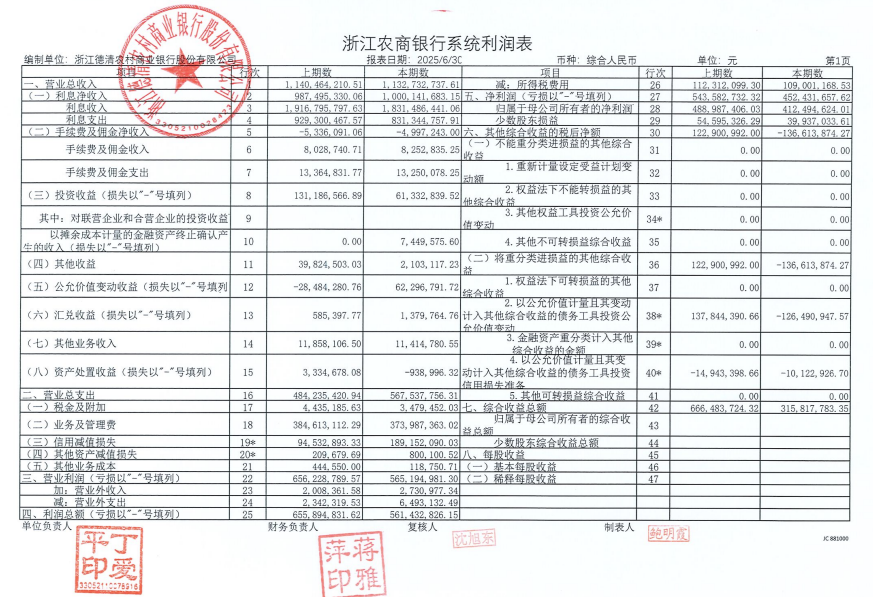
Core Insights - Zhejiang Deqing Rural Commercial Bank has reported mixed financial results for the first half of 2025, with total assets reaching 100.49 billion yuan and total liabilities at 92.54 billion yuan, indicating a stable capital adequacy ratio that meets regulatory requirements [1][3] Financial Performance - As of June 30, 2025, the bank's total assets were 1004.86 billion yuan, liabilities were 925.38 billion yuan, and total equity was 79.48 billion yuan [1] - The capital adequacy ratio stood at 14.38%, with a tier-one capital ratio of 11.47% and a core tier-one capital ratio of 11.37% [1] - Total operating income for the bank was 1.13 billion yuan, a slight decrease of 0.07 billion yuan or 0.61% compared to the same period in 2024 [1] - Net interest income increased to 1.00 billion yuan, up 0.13 billion yuan or 1.32% year-on-year, serving as a key revenue driver [1] - Investment income, however, plummeted by 53.39% to 0.61 billion yuan, down from 1.31 billion yuan, significantly impacting overall revenue [1] Expense and Profitability - Total operating expenses rose to 568 million yuan, an increase of 84 million yuan or 17.20% year-on-year [2] - Net profit for the period was 452 million yuan, a decrease of 92 million yuan or 16.77% compared to the previous year [2] - The net profit attributable to the parent company was 412 million yuan, down 77 million yuan or 15.64% year-on-year, indicating a decline in profitability [2] Company Structure - Deqing Rural Commercial Bank was established in 2008 with a registered capital of 121.3 million yuan, featuring a mixed ownership structure of natural persons and legal entities [3] - In May 2025, the bank's registered capital increased from 1.155 billion yuan to 1.213 billion yuan [3]
广州银行,不配上市?
Sou Hu Cai Jing· 2025-05-21 00:49
Core Viewpoint - Guangzhou Bank has faced multiple challenges in its journey towards IPO, including a significant drop in net profit and high executive turnover, which reflect deeper operational and governance issues [3][4][5]. Financial Performance - In 2024, Guangzhou Bank reported a revenue decline of 13.86% to 13.785 billion yuan and a net profit drop of 66.47% to 1.012 billion yuan [3][5]. - The bank's net profit has decreased for four consecutive years, from 4.101 billion yuan in 2021 to 1.012 billion yuan in 2024, with an average annual decline exceeding 30% [5][32]. - Interest income fell below 10 billion yuan for the first time, decreasing by 18.03% year-on-year [6]. Revenue Structure and Quality - Net interest income accounted for over 70% of total income, but it dropped to 9.667 billion yuan in 2024, a decrease of 21.26 billion yuan [6][9]. - The bank's non-performing loan (NPL) ratio was 1.84% in 2024, higher than the industry average of 1.50% [6][33]. - Real estate loans totaled 60.4 billion yuan, representing 13% of total loans, with a personal housing loan NPL ratio of 2.07% [6][33]. Regulatory and Compliance Issues - In 2023, the bank faced regulatory penalties totaling 44.8 million yuan, with ongoing compliance issues highlighted by multiple fines in 2024 [7][34]. - The bank has been under scrutiny for internal control deficiencies, with significant litigation risks amounting to 9.758 billion yuan in unresolved lawsuits [35]. Governance and Management Challenges - Frequent changes in leadership have led to strategic inconsistency, with the bank experiencing its fourth chairman in recent years [16][30]. - The governance structure is complicated by a high number of unconfirmed shareholders, which complicates compliance and decision-making processes [31]. Strategic Outlook - To overcome its challenges, the bank needs to focus on regional strengths, enhance risk management, and explore new capital sources [22][25][37]. - The introduction of strategic investors and a focus on digital transformation are essential for future growth and stability [26][28][37].