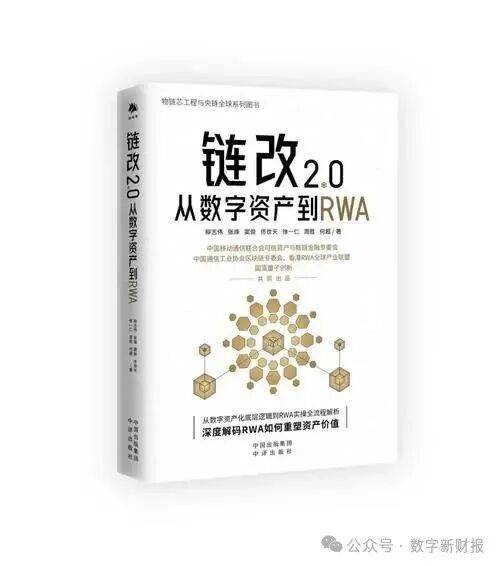
链改2.0

Search documents
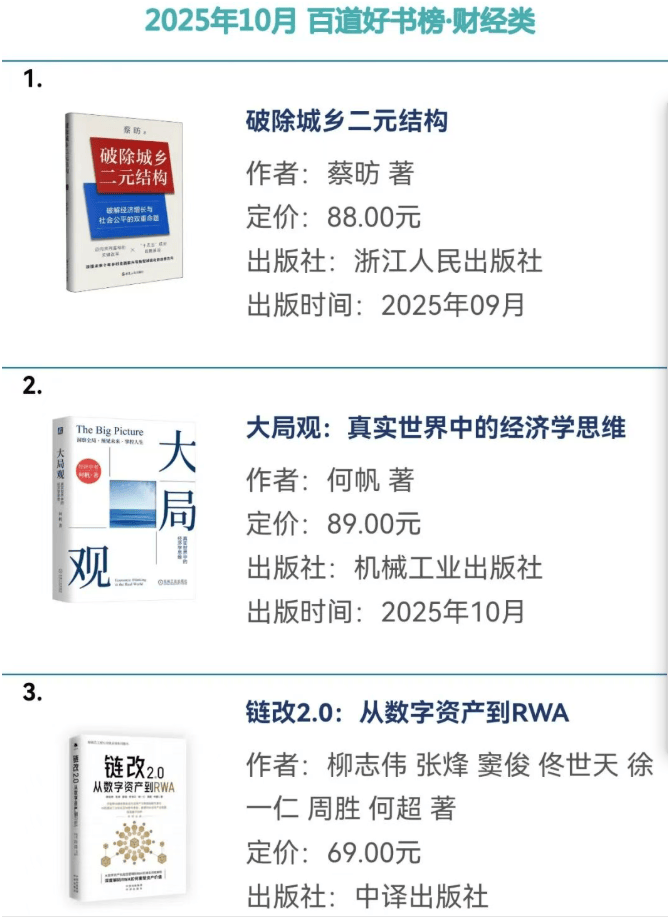
《链改2.0:从数字资产到RWA》荣登2025年10月百道好书榜财经类第三名
Sou Hu Cai Jing· 2025-11-03 11:48
(央链直播 北京讯)近日,聚焦区块链、数字资产与RWA(现实世界资产)融合的专业著作《链改 2.0:从数字资产到 RWA》凭借对"链改2.0时代"核心逻 辑的深度拆解与实践路径的清晰梳理,成功入选 2025年10月百道好书榜财经类第三名,成为当下数字经济与金融创新领域的热门读物。 图书 全球系列图书 中国移动通信联合会可信资产与数链金融专委会 中国通信工业协会区块链专委会、香港RWA全球产业联盟 本"RWA全生态战略布局。 中国出版集团 中译出版社 中国出版集L 中详出版社 - 共同出品 《链改 2.0:从数字资产到 RWA》由柳志伟、张烽、窦俊、佟世天、徐一仁、周胜、何超七位行业专家联合撰写,汇聚了区块链技术应用、金融资产数字 化、产业协同等领域的前沿实践经验。该书由中国出版集团旗下中译出版社2025年10月正式出版。作为"物链芯工程与央链全球系列图书"之一,由三大权威 机构——中国移动通信联合会可信资产与数链金融专委会、中国通信工业协会区块链专委会、香港 RWA 全球产业联盟,联合国富量子创新共同出品,本书 从学术高度与产业实践双重维度保障了内容的专业性与落地性。 全书以从数字资产到 RWA为核心主线,系 ...

彭荣携《链改2.0——从数字资产到 RWA》献策可信资产与数链金融破局
Sou Hu Cai Jing· 2025-10-31 18:39
Core Insights - The event "1024 Blockchain China Day" focuses on the theme of "Chain Reform 2.0" to empower credible assets and digital chain financial innovation, with participation from 16 domestic and international venues [1] - The discussion highlights the core contradiction in the industry of "policy heat, industry cold," emphasizing the lack of standards as a barrier for enterprises to invest and experiment [3][5] - The book "Chain Reform 2.0 - From Digital Assets to RWA" serves as both a summary of the discussions and a practical guide for enterprises to engage in chain reform [9] Industry Challenges - Enterprises face significant challenges due to the absence of unified data standards, leading to failed investments and operational difficulties [3] - Investment concerns arise from the lack of reliable data evaluation models, causing potential investors to withdraw from significant opportunities [3] - Cross-border compliance issues create a paralyzing environment for companies, as regulatory differences hinder their ability to operate internationally [3] Proposed Solutions - A four-dimensional framework proposed in the book includes technical credibility, ecological collaboration, value circulation, and cross-border adaptation, aimed at addressing industry challenges [5] - Localized examples from Guangzhou's blockchain practices provide inspiration for implementing the proposed framework, showcasing successful integration of data and regulatory processes [7] - The company plans to offer practical tools for small and medium-sized enterprises in Guangzhou, facilitating their entry into blockchain applications [9] Future Initiatives - The company is initiating two key projects: developing a toolkit for blockchain implementation in the photovoltaic and intellectual property sectors, and organizing a salon focused on industrial equipment and cross-border asset circulation [9] - The goal is to position Guangzhou as a benchmark city for the practical application of Chain Reform 2.0, leveraging local industry strengths and policy support [9]

《链改2.0:从数字资产到RWA》十大观点
Sou Hu Cai Jing· 2025-10-23 01:37
Core Insights - The book "Chain Reform 2.0 - From Digital Assets to RWA" focuses on the compliant development path of tokenizing real-world assets (RWA) and emphasizes the need for value stability, legal clarity, and verifiable off-chain data [1][3] - RWA serves as a crucial bridge for the integration of digital and real assets, enhancing asset liquidity and reducing transaction costs through blockchain technology [3][4] - The development of RWA is supported by Chain Reform 2.0, which integrates smart contracts, decentralized applications, and artificial intelligence to create a robust digital asset infrastructure [4][5] RWA as a Key Component - RWA is positioned as a foundational element for asset value in the Web 3.0 era, allowing real assets to be tokenized and integrated into decentralized networks, thus enhancing the utility and trust in decentralized finance (DeFi) applications [5][6] - Data is identified as a core production factor and value carrier within the RWA ecosystem, enabling real-time data collection and analysis throughout the asset lifecycle [6][7] Innovation and Challenges - The dual challenges of innovation and risk are shaping the development of RWA, with regulatory frameworks like Hong Kong's sandbox approach facilitating compliance while addressing governance issues [6][8] - RWA promotes the intelligent upgrade of industries and the innovation of business models, enabling small and medium enterprises to convert receivables into on-chain assets for quicker funding [8][9] Collaborative Ecosystem - The RWA ecosystem relies on collaboration among various stakeholders, including asset owners, technology providers, financial institutions, and regulators, necessitating deep integration of technologies like blockchain and IoT [9][10] - RWA is seen as a vital tool for inclusive finance and global asset allocation, significantly improving transaction efficiency in areas like cross-border payments and securitization [8][11] Future Outlook - Despite the current small market size of RWA, projected growth indicates a rapid increase, with expectations to surpass $50 billion by 2025, driven by enhanced asset liquidity and transparency [11] - RWA is anticipated to play a pivotal role in the digital economy, particularly in sectors like green finance and the metaverse, as technology matures and regulatory frameworks evolve [11]