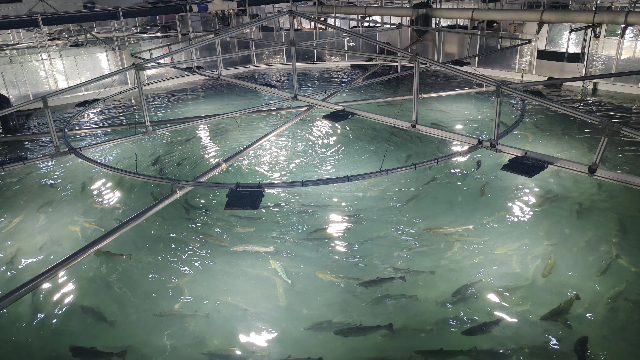
陆基养殖

Search documents
东海“游”出大西洋鲑,中国本土如何养殖三文鱼?|欧洲企业在中国
Di Yi Cai Jing· 2025-12-26 10:10
Core Viewpoint - The cultivation of Atlantic salmon using water from the East China Sea has become a reality, with the first batch expected to be available in 2024, marking a significant development in the aquaculture industry in China [1][3]. Industry Overview - The demand for salmon in China is rapidly increasing, with imports from Norway showing a substantial growth of 112.1% year-on-year, making China the sixth largest export market for Norwegian salmon [3]. - The trend of salmon consumption has expanded from first and second-tier cities to third and fourth-tier cities, indicating a broadening market base [3]. Company Development - Nordic Aquafarms (Ningbo) Co., Ltd. has established a land-based salmon farming project in Ningbo, which is the first of its kind in Asia, with an initial production capacity of 4,000 tons per year [5]. - The company plans to expand its production capacity to 20,000 tons annually by the completion of its third phase by the end of 2026 or early 2027, aiming to meet over 10% of the domestic market's incremental demand [5]. Technology and Methodology - The company utilizes Recirculating Aquaculture Systems (RAS) to maintain optimal water quality and temperature, simulating the natural habitat of Atlantic salmon [4]. - The salmon eggs are sourced from Iceland to ensure biosecurity, as they have not been exposed to the wild, reducing the risk of disease [3][4]. Financial and Strategic Moves - Nordic Aquafarms has transitioned from a wholly-owned Norwegian enterprise to a Sino-Norwegian joint venture, receiving significant local investment and loans to support its growth [5]. - The partnership with local capital is expected to enhance the company's operational capabilities and bring it closer to Chinese consumers [5]. Future Outlook - The collaboration between Norwegian companies and local partners in China reflects a shift towards more efficient, green, and sustainable aquaculture practices [6].