
集体防御

Search documents
为什么欧洲拼命帮乌克兰?原因很简单,一旦乌克兰停火,接下来很有可能轮到他们倒霉了
Sou Hu Cai Jing· 2025-12-21 03:33
Core Viewpoint - European countries are significantly increasing their support for Ukraine, driven by fear rather than a sense of justice, as they perceive a direct threat from Russia [1] Group 1: Historical Context - The expansion of NATO from 16 to over 30 member countries since the end of the Cold War has been perceived as a direct threat by Russia, particularly with Ukraine's potential NATO membership [3] - The 2014 Crimea incident marked a turning point, leading to a complete breakdown in relations between Russia and Europe, which had previously underestimated the conflict's implications [3] Group 2: Current Concerns - European leaders fear that a sudden ceasefire could solidify Russian gains in Ukraine, leading to a permanent military presence near Eastern Europe, which would undermine regional security [5] - The economic implications of a ceasefire are dire, as Europe has invested heavily in new energy infrastructure to reduce reliance on Russian gas, making it unlikely to revert to previous energy sources [7] Group 3: Financial Implications - The World Bank estimates that Ukraine will require at least $486 billion for reconstruction over the next decade, a figure that is expected to rise as the conflict continues [7] - If a ceasefire occurs with Russia in a favorable position, Europe would likely bear the financial burden of Ukraine's reconstruction and face a potential influx of refugees, exacerbating existing social and political tensions [9] Group 4: Trust and Future Actions - The breakdown of trust between Europe and Russia makes negotiations impossible, with both sides viewing each other as adversaries, leading to a situation where Europe must continue to support Ukraine militarily [11] - The ongoing conflict has transformed into a struggle for European nations to secure their own safety, with financial support for Ukraine seen as a necessary investment in their own security [13]

中欧班列再遇波兰“卡脖子”,如何解决欧洲国家出尔反尔的问题?
Sou Hu Cai Jing· 2025-11-02 11:08
Core Viewpoint - Poland has postponed the opening of its border crossing with Belarus from early November to mid-November to support Lithuania, indicating a coordinated approach among Eastern EU member states towards Belarus [1][3]. Group 1: Geopolitical Implications - The postponement reflects a growing "coordinated blockade" mechanism among Eastern EU countries, with Lithuania having closed all land borders for a month, and Poland following suit, showcasing a collective strategy against Belarus [3]. - The situation illustrates the "NATO-ization" of regional security issues, as Poland and Lithuania align their border policies with NATO's collective defense principles, potentially leading to calls for increased NATO or EU military presence [3][4]. - The border closure has significant economic implications, with warnings from the Polish Transport Association about the risk of logistics companies going bankrupt with each additional day of closure, highlighting the prioritization of political signaling over economic stability [4]. Group 2: Strategic Recommendations for China - China should incorporate uncertainty into long-term planning by diversifying transport routes and reducing reliance on the Poland-Lithuania route from approximately 70% to below 50% to mitigate political risks [4][5]. - Contractual terms should be redesigned to include detailed clauses on political border closures, ensuring compensation for pre-paid fees and interest on delays, backed by agreements among relevant parties [5]. - Financial hedging tools, such as "land border insurance," should be introduced to cover losses from border closures, with a premium based on cargo value, enhancing financial interlocks with Polish and Lithuanian financial institutions [6]. - Establishing a mechanism for intergovernmental communication is crucial, requiring regular updates on border policies and immediate explanations for any changes, with potential repercussions for non-compliance [9].
默茨断言“和平已无”!俄“灰色战争”搅乱欧洲,普京野心藏不住
Sou Hu Cai Jing· 2025-10-04 06:41
Core Viewpoint - Recent security incidents in Europe, including drone incursions and cyberattacks, indicate a rising threat from Russia, which is engaging in "gray warfare" to undermine NATO and European security [1][2][4] Group 1: Security Incidents - Multiple countries in Europe have experienced security breaches, such as drones flying over Poland and MiG jets entering Estonian airspace, leading to increased tensions in the region [1] - Cyberattacks and disruptions at airports have further complicated the security landscape, highlighting vulnerabilities in European infrastructure [1][5] Group 2: Russian Strategy - Russia's strategy aims to weaken NATO's internal unity by sowing distrust among European nations regarding U.S. security commitments [2] - The "gray warfare" tactics are designed to raise the cost of support for Ukraine among European nations, particularly targeting those most supportive of Ukraine [3][4] Group 3: NATO's Response - Experts suggest that NATO and European allies must reveal the truth behind "gray warfare" and respond decisively to provocations to maintain deterrence [4][5] - Enhancing resilience in critical infrastructure and establishing rapid response teams for cyber threats are essential steps for Europe [5] Group 4: Political Implications - The actions of Russia are seen as attempts to exploit divisions within Western democracies, potentially bolstering populist and nationalist movements [4] - The fluctuating stance of U.S. leadership, particularly under President Trump, complicates the situation and raises concerns about NATO's cohesion [6]

北约通过历史性防务开支计划,特朗普收获重大胜利
智通财经网· 2025-06-25 13:21
Group 1 - NATO leaders agreed to increase defense spending to 5% of GDP to address security challenges from geopolitical conflicts, marking a significant political victory for Donald Trump [1] - The declaration emphasizes a strong commitment to collective defense, aiming to protect 1 billion citizens and uphold freedom and democracy [1] - The new spending target is a response to deep security threats, particularly from Russia and ongoing terrorism, with NATO Secretary General Mark Rutte suggesting Russia could be capable of attacking the alliance within five years [1] Group 2 - The declaration confirmed NATO's support for Ukraine but removed the previous statement that "Ukraine's future belongs to NATO," indicating reluctance from the Trump administration to provide more military aid [2] - The new spending target is broken down into 3.5% for core defense and 1.5% for infrastructure and cybersecurity investments, potentially leading to trillions in defense spending by 2035 [4] - The trajectory of spending will be reassessed in 2029, with direct contributions to Ukraine's defense counting towards military spending [6]
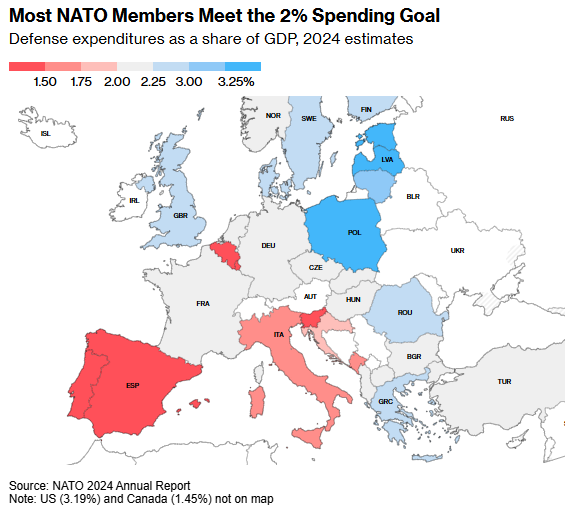
北约秘书长吕特:北约协议将引领集体防御实现“飞跃式”发展。
news flash· 2025-06-25 12:39
Group 1 - The core viewpoint is that NATO Secretary General Jens Stoltenberg emphasizes that the NATO agreement will lead to a "quantum leap" in collective defense capabilities [1] Group 2 - The statement indicates a significant enhancement in NATO's defense strategy, suggesting a transformative approach to collective security [1] - The focus on collective defense highlights NATO's commitment to adapting to new security challenges in the current geopolitical landscape [1] - The term "quantum leap" suggests a substantial and rapid improvement in NATO's operational effectiveness and readiness [1]
北约重申对集体防御的承诺,指出俄罗斯构成的长期威胁,重申承诺向乌克兰提供援助。
news flash· 2025-06-25 12:17
Group 1 - NATO reaffirms its commitment to collective defense, highlighting the long-term threat posed by Russia [1] - NATO reiterates its commitment to providing assistance to Ukraine [1]
北约盟国就国防开支占GDP 5%的新目标达成一致,重申对集体防御的承诺。
news flash· 2025-06-25 12:15
Group 1 - NATO allies have reached an agreement on a new target for defense spending to be 5% of GDP, reinforcing their commitment to collective defense [1] - The decision reflects a strategic shift in defense policy among member countries in response to evolving global security threats [1] - This new target aims to enhance military readiness and capabilities across the alliance, ensuring a unified approach to defense [1]
波兰总统杜达:北约第五条款很明确,意味着集体防御,关于它没有任何争议。
news flash· 2025-06-25 07:54
Core Viewpoint - The statement from Polish President Duda emphasizes the clarity of NATO's Article 5, which signifies collective defense and leaves no room for dispute [1] Group 1 - NATO's Article 5 is clearly defined as a commitment to collective defense among member states [1]