雨雪冰冻

Search documents
两股较强冷空气来“过年” 局地将现雨雪冰冻或霜冻
Xin Lang Cai Jing· 2026-01-31 01:56
Group 1 - The core viewpoint of the article is the prediction of significant cold air and precipitation events in Guangxi during February 2026, particularly affecting the Spring Festival period [1] - The climate forecast indicates three main periods of temperature drop and precipitation in February: February 6-10 with light rain in southern Guangxi and moderate rain in northern Guangxi; February 14-18 with light to moderate rain and localized heavy rain; February 24-26 with similar conditions [1] - During the cold air events, northern Guangxi may experience rain, snow, ice, or frost [1] Group 2 - The spring climate trend forecast for Guangxi from February to April 2026 predicts that the number of days with average daily temperatures ≤12°C for more than three consecutive days will be 5-10 days in southern Guangxi, 10-15 days in central Guangxi, and 15-20 days in northern Guangxi, which is close to the historical average [2] - The end of the low-temperature and rainy weather period (average daily temperature ≤12°C for more than three consecutive days) is expected to occur in early March for southern Guangxi, mid-March for central Guangxi, and late March for northern Guangxi, aligning with historical patterns [2] - The likelihood of experiencing low-temperature weather (average daily temperature ≤8°C for more than three consecutive days) is low for most areas except northern Guangxi, where it may occur in early March [2]
第1现场|寒潮北下影响南方地区,湘黔桂赣有雨雪冰冻
Xin Lang Cai Jing· 2026-01-20 04:32
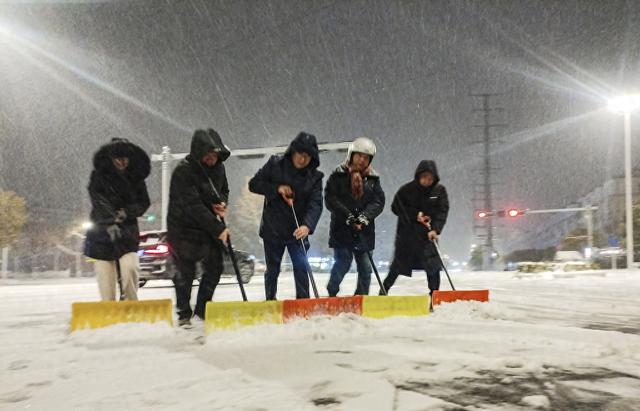
Core Viewpoint - The article discusses the impact of a cold wave affecting southern China, coinciding with the solar term "Great Cold," leading to significant snowfall and freezing conditions in various provinces [1][12]. Weather Warnings - The Central Meteorological Observatory issued blue warnings for cold waves, yellow warnings for freezing, and blue warnings for strong winds on January 20 [1]. - The cold wave is expected to bring moderate to heavy snow in parts of southeastern Hubei, northern and central Hunan, northwestern Jiangxi, and eastern Guizhou [3]. Temperature Changes - From January 20 to 21, temperatures in regions such as western Jianghuai, eastern and southern Jiangnan, southeastern Southwest China, and South China are forecasted to drop by 4°C to 6°C, with some areas experiencing drops of up to 10°C [15]. Snow Removal Efforts - Various regions, including Jiangsu and Anhui, have mobilized workers to clear snow from roads and public areas to ensure safe travel for citizens [5][10][19]. Public Safety Measures - In Wuhan, schools have laid down anti-slip mats at entrances to ensure student safety during the cold and snowy weather [12]. - Experts have warned about the potential secondary risks from the cold wave, including road icing, damage to power and communication facilities, and agricultural frost damage [18]. Future Weather Outlook - By the end of the week, most of the country is expected to return to a state with little rain or snow, with temperatures in southern regions, particularly Jiangnan, rising above 15°C [20].

寒潮暴雪来袭 最低温-10℃以下
Da Zhong Ri Bao· 2026-01-18 01:19
Group 1 - The province is experiencing a cold wave, with temperatures expected to drop below -10°C, and significant snowfall and ice are forecasted from the night of January 17 to the night of January 19 [2][3] - The average cumulative precipitation across the province is expected to be between 6 to 12 millimeters, with snow depth ranging from 3 to 8 centimeters, and potentially exceeding 10 centimeters in some areas [2] - The temperature is projected to decrease by 10 to 12°C, with some regions experiencing drops of over 14°C, leading to prolonged low temperatures from January 20 to 24 [2] Group 2 - The provincial disaster reduction office held a video conference to assess the situation and coordinate response efforts, emphasizing the need for enhanced monitoring, information sharing, and preemptive measures [3] - Key areas of focus include schools, medical and elderly care institutions, tourist sites, and construction projects, with a strong emphasis on preventing secondary disasters [3] - Specific measures include snow removal, traffic control, and agricultural guidance to mitigate the impacts of the severe weather [3]
山东将迎2026年第一场大范围寒潮 低温持续一周
Xin Hua Wang· 2026-01-17 02:19
Group 1 - A significant cold wave is affecting Shandong, with temperatures expected to drop by 10-12°C, and in some areas, exceeding 14°C [3][4] - The cold weather will persist for an extended period, with temperatures below -12°C expected from January 21 to 25 [4] - The weather conditions are predicted to lead to substantial snowfall, with accumulations of 3 to 8 centimeters, and in some areas, exceeding 12 centimeters [2][4] Group 2 - The cold wave is accompanied by strong winds, with gusts reaching 7-8 levels in the Bohai Sea and 9-10 levels in certain areas [4] - The rain and snow are expected to improve soil moisture levels and reduce forest fire risks, but will negatively impact transportation, urban operations, and agricultural facilities [4] - The prolonged low temperatures will significantly affect energy supply, public health, and agricultural production [4]
寒潮暴雪将至!山东五预警齐发
Xin Lang Cai Jing· 2026-01-16 18:01
Group 1 - The core weather event affecting Shandong province includes a strong cold air mass leading to a significant drop in temperatures, with forecasts indicating a temperature decrease of 10℃ to 12℃, and in some areas exceeding 14℃ [1][2] - A series of weather warnings have been issued, including a blue snow warning, orange road icing warning, yellow cold wave warning, and yellow low-temperature warning, indicating severe weather conditions expected from January 17 to January 19 [1][2] - The expected minimum temperatures for various regions include -16℃ to -14℃ in the northwest and central mountainous areas, with coastal regions experiencing lows of -8℃ to -6℃, and other areas ranging from -10℃ to -8℃ [1] Group 2 - The precipitation forecast indicates an average accumulation of 8mm to 15mm, with snow depth reaching 3cm to 8cm, and potentially exceeding 12cm in some areas, which may significantly impact transportation due to road icing [2] - The weather conditions are expected to improve soil moisture and reduce forest fire risks, but the prolonged low temperatures and snow accumulation could adversely affect transportation, urban operations, and agricultural facilities [2] - The north winds are anticipated to negatively impact maritime transportation and coastal aquaculture, necessitating enhanced preventive measures [2]
我国将有寒潮和雨雪冰冻过程
Ren Min Ri Bao· 2026-01-16 03:20
Group 1 - The core viewpoint of the articles highlights a significant weather event in China, with a large-scale rain and snow weather process expected from January 17 to 21, affecting various regions including Xinjiang, the northwest, and central and eastern areas [1][2] - The Central Meteorological Observatory predicts a drop in temperatures across the northwest and central regions, with strong winds expected in the Yangtze River basin and northward areas, and rain and snow weather in the eastern northwest, North China, and Jiangnan regions [1] - The forecast indicates that the minimum temperature line will move southward to areas from Guizhou to southern Jiangnan by the morning of January 21, with significant snowfall expected in several provinces [1] Group 2 - The current cold wave process is characterized by a larger range of rain and snow compared to previous cold waves, with early rain-to-snow transitions and prolonged snowfall durations in northern regions [2] - The Ministry of Agriculture and Rural Affairs and the China Meteorological Administration have issued frost damage risk warnings for winter wheat and rapeseed, advising farmers to take preventive measures against frost damage [2]
我国将有寒潮和雨雪冰冻过程 两部门联合发布冬小麦、油菜冻害风险预警
Ren Min Ri Bao· 2026-01-15 22:11
Group 1 - The core viewpoint of the articles highlights a significant cold wave and extensive rain and snow weather process expected in China from January 17 to 21, with various regions experiencing temperature drops and precipitation [1][2] - The Central Meteorological Observatory predicts that the cold wave will impact different regions sequentially, starting from Xinjiang and Inner Mongolia, moving to the central and eastern parts of the country, and finally affecting southern areas like Guizhou and South China [1] - The forecast indicates that areas in the southeast of Northwest China, southern North China, Huanghuai, Jianghan, western Jianghuai, and northern Jiangnan will experience moderate to heavy snow or rain-snow mix, with some regions potentially facing blizzards [1][2] Group 2 - The characteristics of this cold wave process include a larger range of rain and snow compared to previous cold waves, with early transitions from rain to snow in the central and eastern regions [2] - The Ministry of Agriculture and Rural Affairs and the China Meteorological Administration have issued frost damage risk warnings for winter wheat and rapeseed, advising farmers to take preventive measures against frost damage [2]
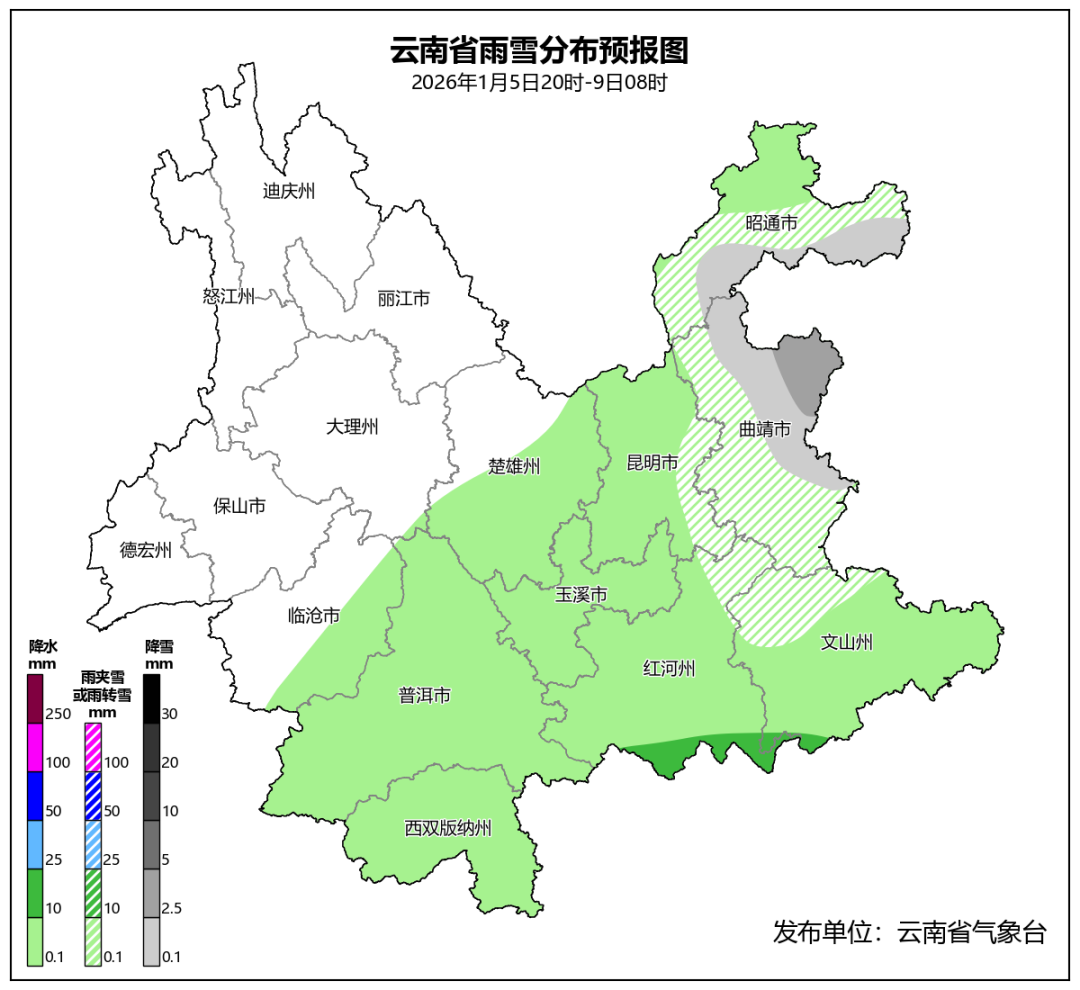
最高降温超10℃!昆明告别蓝天,这些地方可能下雪
Xin Lang Cai Jing· 2026-01-04 21:06
Core Viewpoint - The weather forecast indicates a significant drop in temperatures across central and eastern Yunnan Province from the night of January 5 to January 8, with maximum temperatures expected to decrease by 6 to 8 degrees Celsius, and in some areas, by more than 10 degrees Celsius [1]. Weather Forecast Summary - From January 5 night, the eastern and southern parts of Zhaotong and northern Qujing are expected to experience minimum temperatures between -2 to 0 degrees Celsius, with high-altitude areas seeing light to moderate snow and localized heavy snow [5]. - On January 6, maximum temperatures in central and western Qujing, Kunming, eastern Yuxi, and northern Wenshan are forecasted to drop by 6 to 8 degrees Celsius, with some areas experiencing drops exceeding 10 degrees Celsius [6]. - On January 7, high-altitude regions in Zhaotong, Qujing, and Kunming are expected to see light snow or rain mixed with snow, while other areas will have scattered light rain [7]. - On January 8, high-altitude areas in northern Qujing are forecasted to have mixed rain and snow, with other regions experiencing cloudy weather with localized light rain [8]. Recommendations - It is advised to take precautions against rain, snow, and freezing conditions in high-altitude areas of Zhaotong, Qujing, and Kunming, which may adversely affect transportation, power facilities, and residents' daily lives [10]. - The significant drop in temperatures in central and eastern Yunnan necessitates protective measures for temperature-sensitive agricultural crops [10]. - Due to the recent fluctuations in temperatures, the public is encouraged to dress appropriately and ensure safety in electricity and fire usage [10].