非标产品

Search documents
2025年非标产品观察:非标产品发行放缓,资产风险收敛但持续存在
Lian He Zi Xin· 2026-02-27 09:46
1. Report Industry Investment Rating No relevant content is provided in the report. 2. Core View of the Report In 2025, China's non - standard market entered a stage of deep transformation and structural adjustment under continuous regulatory guidance. The regulatory framework of the trust industry was systematically reconstructed, and the financing platform business in the financial leasing industry was classified as an "exit - class" business. The scale of the non - standard market is expected to continue to shrink, and non - standard asset risks will still exist in the short term. Although the short - term risks of urban investment enterprises are generally controllable under the support of debt - resolution policies, risks in regions with heavy debt pressure such as Shandong and Guizhou still need attention [1]. 3. Summary by Relevant Catalogs Policy Review - The regulatory framework of China's trust industry was systematically reconstructed and continuously deepened in 2025, aiming to make the trust industry return to its origin. The State Financial Regulatory Administration positioned the financing platform business as an "exit - class" business for the first time, and non - compliant financial leasing business of ineligible leased items faced replacement pressure [4]. - A series of policies such as "Document 35", "Document 134", and "Document 226" were introduced to promote the orderly contraction of non - standard debt of urban investment enterprises and transform the stock assets to a more reasonable cost [8]. Market Review (1) Debt Investment Plans - In 2025, the number, scale, and issuance payment scale of debt investment plan registrations continued to decline. The registration scale in Zhejiang, Anhui, Shandong, Jiangsu, Hubei, and Guangdong ranked among the top. The total scale of stock debt investment plans in Hubei, Zhejiang, Shandong, Sichuan, and Jiangsu accounted for 41.21%, and the regional concentration increased [9]. - The top two investment fields were transportation and park infrastructure, with the registration scale accounting for 49.24% and 21.21% respectively in 2025. The average investment period in 2025 was 7.6 years, longer than that in 2024, and the average registration yield decreased by 0.47 percentage points to 3.66% per year [9]. (2) Trust Plans - As of the end of June 2025, the scale of outstanding capital trust assets continued to grow to 24.43 trillion yuan. The proportion of funds invested in the securities market became the largest, while the proportion invested in basic industries, industrial and commercial enterprises, and the real estate industry decreased. Traditional non - standard financing business was further compressed [19]. - In the context of the three - category classification, trust companies were gradually transforming from traditional non - standard financing business to the origin business of asset management, asset services, public welfare and charity [19]. (3) Financial Leasing - In 2025, the value of leasing and financing property in the whole industry decreased by 7.77% year - on - year to 3.19 trillion yuan. The value in Jiangsu, Shandong, Hebei, Sichuan, and Shanghai decreased significantly. The main investment regions were Jiangsu, Zhejiang, Shandong, Guangdong, Sichuan, Hebei, and Anhui, accounting for more than 56% [27]. - The value of leasing and financing property of urban investment companies and their subsidiaries accounted for about 29% of the whole industry, and continued to shrink under the influence of regulatory policies and debt - resolution measures [32]. Non - standard Risk Events - In 2025, the number of non - standard risk events decreased significantly, with trust plans becoming the main type of risk products, accounting for more than 65%. Financial leasing still faced the pressure of renewal due to subsequent policy tightening [34]. - Urban investment enterprises were an important part of the underlying assets of non - standard products. Risk events mainly occurred in regions with high debt pressure such as Guizhou, Shandong, and Shaanxi, and district - and county - level urban investment enterprises accounted for a relatively high proportion [34]. Future Outlook - Under the guidance of regulatory policies, the non - standard market is undergoing profound transformation. Trust companies are gradually transforming to the origin business, and some financial leasing business faces replacement pressure [41]. - Considering the substitution effect of bank loans and bonds, the issuance and implementation of non - standard products will still be difficult in the future. Although the risks of non - standard assets of urban investment enterprises are generally controllable in the short term, risks in high - debt - pressure regions still need continuous attention [41].
3·15晚会再次剑指!危险的“它”,被公然售卖!
Zhong Guo Jing Ji Wang· 2025-03-15 22:46
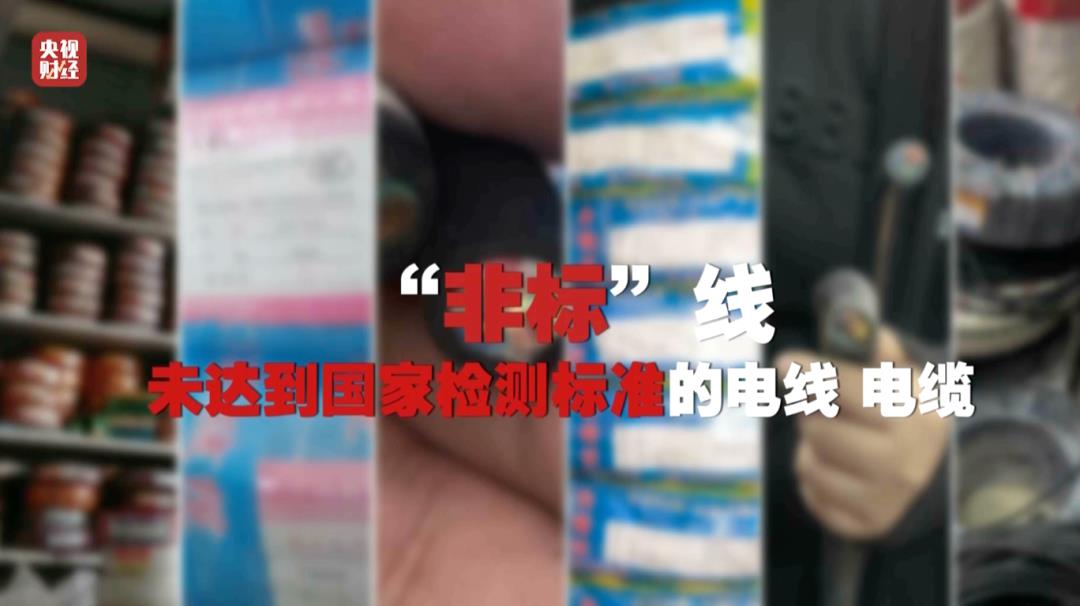
Core Insights - The article highlights the prevalence of substandard electrical wires in the South China hardware market, where many vendors sell "non-standard" cables that do not meet national safety standards, posing significant risks to safety and infrastructure [1][2][5]. Group 1: Market Overview - The Kede International Hardware Market in Nanning is one of the largest hardware markets in South China, where many vendors offer electrical cables at prices significantly lower than the market average, primarily selling "non-standard" wires [1]. - Vendors openly promote the advantages of non-standard wires, claiming that they are difficult to distinguish from standard wires with the naked eye [1][2]. Group 2: Safety Concerns - According to the Ministry of Emergency Management, over 50% of major fire incidents in China are caused by electrical cables, with more than 100 significant accidents reported in the last decade, resulting in the destruction of over 320,000 meters of cables and financial losses exceeding 10 billion yuan [2]. - Recent incidents, including a fire in a residential building that resulted in 26 fatalities, underscore the dangers associated with substandard electrical wiring [3][4]. Group 3: Production and Distribution - The Jinmingyang Electric Wire and Cable Company, located in Anshun, claims to produce non-compliant wires according to customer specifications, indicating a willingness to compromise safety for profit [5]. - The company, along with others like Runxiong Cable Group, provides counterfeit certification and quality reports for their non-standard products, facilitating their sale in the market [5][6]. - A detailed internal pricing structure reveals significant price differences between standard and non-standard cables, with discounts of up to 20% on non-compliant products [6]. Group 4: Regulatory Issues - Electrical wires and cables are classified as mandatory certification products under Chinese law, prohibiting the sale of non-certified products [4]. - To evade regulatory scrutiny, manufacturers store non-standard cables in undisclosed locations, ensuring they are not easily detected by authorities [6][7].