电线电缆制造业

Search documents
“四项第一”!商业航天独角兽要IPO了,估值超150亿!
IPO日报· 2025-10-30 00:32
Core Viewpoint - The article discusses the recent IPO counseling filings of seven companies, highlighting their business focus, financial performance, and challenges faced in the IPO process. Group 1: Company Profiles - Jinlong New Materials specializes in military tents and camping supplies, with a production capacity of 10 million sets of binding materials and 100,000 tents annually [4][5] - Saikesaisi, a high-tech enterprise in the field of biomedical materials, has faced multiple IPO application failures and regulatory warnings due to internal control issues [9][10] - Guodian Cable focuses on the research, production, and sales of electric cables, reporting increasing revenue but declining profits [15] - Oushangyuan is an organic acid equipment supplier aiming for an IPO on the ChiNext board, with a focus on technology design and equipment supply [18][19] - Xinghe Power, a commercial aerospace company, has achieved significant milestones in satellite launches and is valued at over 150 billion RMB [25][26] - Bangsheng Technology, a big data software developer, has previously attempted to list on the Sci-Tech Innovation Board but withdrew its application [30][31] - Kangbaijia Pharmaceutical operates over 2,000 stores, primarily in Fujian, and has recently expanded through acquisitions [35] Group 2: Financial Performance - Jinlong New Materials has a registered capital of 100.9 million RMB and is controlled by its founder, holding 68.31% of the shares [4][5] - Saikesaisi's revenue from 2021 to 2023 was 437 million, 436 million, and 379 million RMB, with net profits showing a slight increase followed by a decline [10] - Guodian Cable's projected revenues for 2023 and 2024 are 1.548 billion and 2.055 billion RMB, respectively, with net profits of 94.05 million and 77.92 million RMB, indicating a situation of increasing revenue but decreasing profit [15] - Bangsheng Technology reported revenues of 101 million, 196 million, and 270 million RMB from 2020 to 2022, with net losses each year [31] Group 3: IPO Challenges - Saikesaisi has faced regulatory scrutiny and warnings from the Shenzhen Stock Exchange, leading to the withdrawal of its IPO application in 2025 [9][10] - Guodian Cable's financial performance raises concerns about its ability to attract investors due to the increase in revenue without corresponding profit growth [15] - Bangsheng Technology's previous attempt to list on the Sci-Tech Innovation Board was unsuccessful, leading to a renewed effort for an IPO [30][31]

一根高原线缆的创新之路
Ren Min Ri Bao· 2025-08-25 22:40
Core Insights - The company, Ounait Cable Group, has developed specialized cables tailored for high-altitude regions, achieving a market share of 40% in this niche [1][3] - The company has successfully reduced the failure rate of its cables due to rodent damage from 90% to below 15% by incorporating a repellent solvent into the cable sheath [2] - Ounait has filed over 130 patents and has transitioned from a small enterprise to a national high-tech enterprise, focusing on high-quality development and innovation [3] Group 1 - Ounait Cable Group produces cables designed for high-altitude environments, featuring UV resistance, cold tolerance, and corrosion resistance, with a lifespan of over 15 years [1] - The company faced challenges with its initial products being damaged by local wildlife and environmental conditions, prompting a collaboration with Qinghai University to develop solutions [1][2] - The company is currently constructing a project to produce 100,000 tons of green high-purity aluminum rods, aiming to replace copper with aluminum in cable production [3] Group 2 - Ounait has established partnerships with five central enterprises, facilitated by government-organized supply-demand matching events [2] - The company is actively involved in the formulation of technical standards for photovoltaic cables in high-altitude regions, indicating its commitment to industry leadership [3] - The company’s innovative approach has led to the development of a plant oil-based plasticizer to enhance the flexibility of cables in extreme cold [2]
3·15晚会再次剑指!危险的“它”,被公然售卖!
Zhong Guo Jing Ji Wang· 2025-03-15 22:46
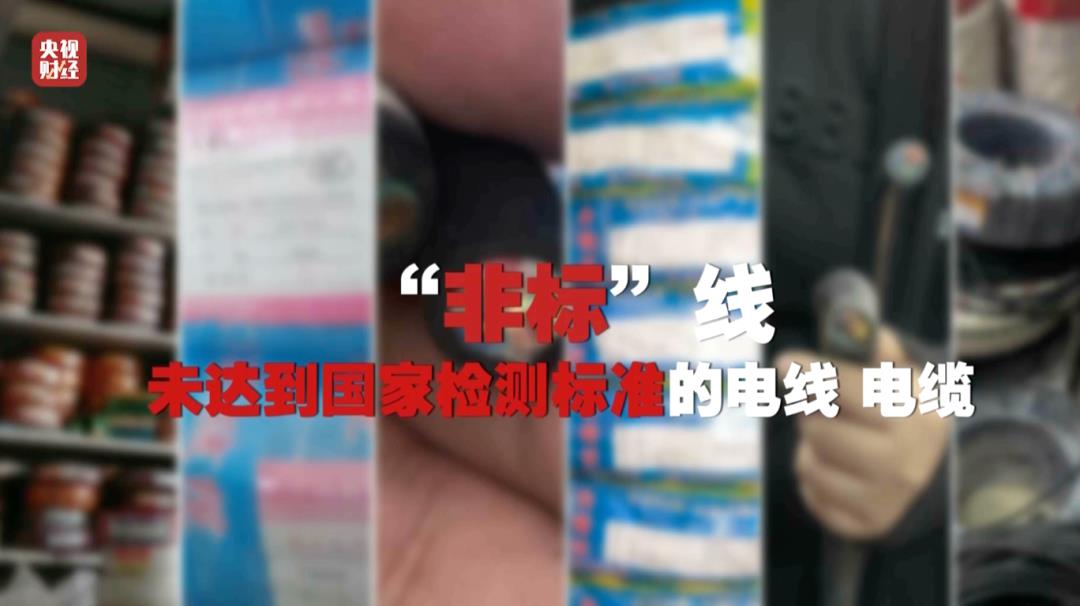
Core Insights - The article highlights the prevalence of substandard electrical wires in the South China hardware market, where many vendors sell "non-standard" cables that do not meet national safety standards, posing significant risks to safety and infrastructure [1][2][5]. Group 1: Market Overview - The Kede International Hardware Market in Nanning is one of the largest hardware markets in South China, where many vendors offer electrical cables at prices significantly lower than the market average, primarily selling "non-standard" wires [1]. - Vendors openly promote the advantages of non-standard wires, claiming that they are difficult to distinguish from standard wires with the naked eye [1][2]. Group 2: Safety Concerns - According to the Ministry of Emergency Management, over 50% of major fire incidents in China are caused by electrical cables, with more than 100 significant accidents reported in the last decade, resulting in the destruction of over 320,000 meters of cables and financial losses exceeding 10 billion yuan [2]. - Recent incidents, including a fire in a residential building that resulted in 26 fatalities, underscore the dangers associated with substandard electrical wiring [3][4]. Group 3: Production and Distribution - The Jinmingyang Electric Wire and Cable Company, located in Anshun, claims to produce non-compliant wires according to customer specifications, indicating a willingness to compromise safety for profit [5]. - The company, along with others like Runxiong Cable Group, provides counterfeit certification and quality reports for their non-standard products, facilitating their sale in the market [5][6]. - A detailed internal pricing structure reveals significant price differences between standard and non-standard cables, with discounts of up to 20% on non-compliant products [6]. Group 4: Regulatory Issues - Electrical wires and cables are classified as mandatory certification products under Chinese law, prohibiting the sale of non-certified products [4]. - To evade regulatory scrutiny, manufacturers store non-standard cables in undisclosed locations, ensuring they are not easily detected by authorities [6][7].