颠覆性碳中和技术

Search documents
邱慈观专栏 | 颠覆性碳中和技术创新:利用公共资本撬动市场化资本
Xin Lang Cai Jing· 2025-12-29 05:26
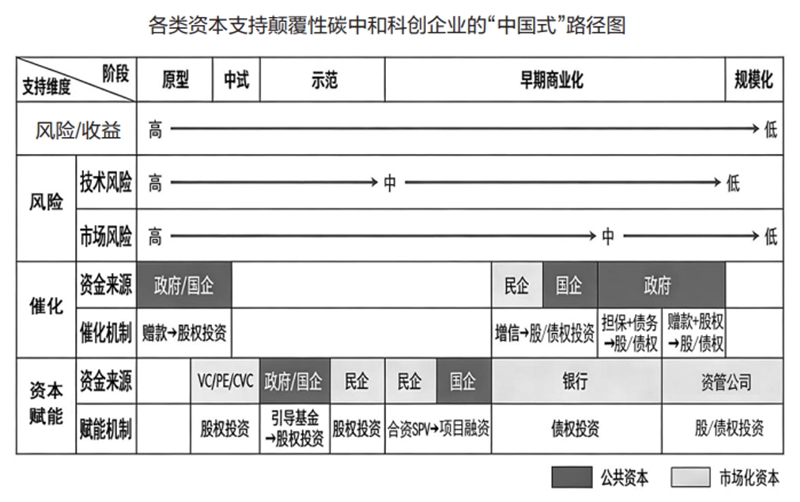
Core Viewpoint - The article emphasizes the necessity of developing disruptive carbon-neutral technologies to achieve significant reductions in carbon emissions in high-carbon industries such as electricity, steel, cement, and aluminum smelting, which currently rely on traditional processes that do not meet carbon neutrality standards [1][2]. Group 1: Disruptive Carbon-Neutral Technologies - Approximately half of carbon-neutral technologies have not yet reached commercial scale, particularly in "hard tech" and "deep tech," which are crucial for significant carbon emission reductions [2]. - Disruptive technologies related to "hard tech" include efficient photovoltaic cells, green hydrogen, and new energy storage systems, while "deep tech" encompasses electrochemical ironmaking, silicon-magnesium cement, and inert anode aluminum smelting [2]. - These technologies face market investment challenges due to high capital intensity and long investment cycles, often requiring decades to scale from prototypes to commercial viability [2][3]. Group 2: Public Capital to Leverage Market Capital - Public capital is essential for supporting the development of disruptive carbon-neutral technologies, as it can alleviate some financial constraints, but its scale is limited [4]. - The main challenge for market capital is obtaining risk-adjusted returns, which can be addressed by using public capital to reduce field risks and attract diverse investors [4]. - Public capital can catalyze market capital by improving the risk-return profile through donations, guarantees, and other financial structures, thereby accelerating the development of tech startups [5][4]. Group 3: Case Studies of Public Capital Leveraging Market Capital - Boston Metal and Sublime Systems are examples where public capital provided grants for prototype validation and technology scaling, successfully attracting market investments for further development [8][11]. - Elysis and Zhongchu Guoneng are cases where public capital was used to co-invest with market capital during the demonstration and early commercialization stages, effectively filling funding gaps [11][12]. - The article outlines various international and domestic cases where public capital has successfully attracted market capital, demonstrating effective mechanisms for leveraging investments in disruptive carbon-neutral technologies [10][12]. Group 4: Future Outlook - To further promote the innovation and development of disruptive carbon-neutral technologies, public capital should focus on supporting tech startups, establishing clear financing policies, and exploring financing mechanisms suitable for carbon-neutral tech [13][14]. - The transition from merely providing funds to achieving tangible outcomes for enterprises is crucial for unlocking economic potential and achieving climate goals [14].

颠覆性碳中和技术创新:利用公共资本撬动市场化资本
Jin Rong Shi Bao· 2025-12-15 05:17
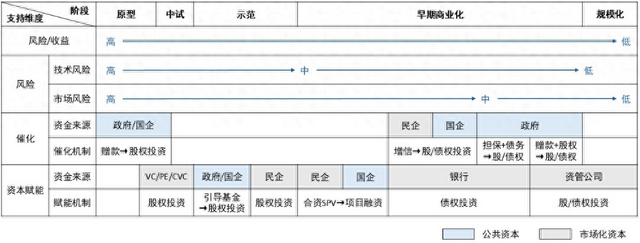
Core Viewpoint - The necessity of developing disruptive carbon-neutral technologies is emphasized as high-carbon industries in China, such as electricity, steel, cement, and aluminum smelting, have not yet achieved carbon neutrality through traditional methods, highlighting the need for significant investment and innovative approaches to reduce carbon emissions to near-zero levels [1][2]. Summary by Sections Disruptive Carbon Neutral Technology Investment - Approximately half of carbon-neutral technologies have not reached commercial scale, particularly in "hard tech" and "deep tech," which rely heavily on foundational scientific research [2]. - High-carbon industries face significant market investment challenges due to the high capital intensity and long investment cycles required for scaling up carbon-neutral technologies [2][3]. Public Capital to Leverage Market Capital - Public capital is essential for supporting the development of disruptive carbon-neutral technologies due to their dual positive externalities of technological spillover and carbon reduction [4]. - The key to attracting market capital lies in reducing perceived risks through public funding, which can help address both technological and market risks faced by investors [4][5]. Catalytic Mechanisms - Public capital can intervene in the early stages of technology development by providing catalytic funding to improve the risk-reward profile for investors, thus attracting more market capital [5]. - In early commercialization, public capital can enhance the investment appeal by offering guarantees and hybrid funding structures to mitigate the low returns associated with carbon-neutral technologies [5][6]. Capital Empowerment - Public capital can collaborate with market capital in the demonstration and early commercialization phases to fill funding gaps and empower the scaling of innovative technologies [6]. - Establishing venture capital funds focused on carbon-neutral technologies can signal to the market and attract additional investments [6]. Case Studies - Several international and domestic cases illustrate how public capital has successfully attracted market capital in the field of disruptive carbon-neutral technologies, with specific mechanisms and support structures detailed [7][9]. - Examples include Boston Metal and Sublime Systems, which received public grants to validate and scale their technologies, leading to successful market capital participation [10]. - Elysis and Zhongchu Guoneng are highlighted as cases where public capital effectively partnered with market capital to accelerate technology development [11]. Future Outlook - To further promote the innovation of disruptive carbon-neutral technologies, public capital should focus on incubating tech companies, establishing supportive financing policies, and exploring financing mechanisms that align with China's unique context [13][14][15].