风电产业升级

Search documents
德力佳传动科技(江苏)股份有限公司关于项目投资暨签订合作协议的公告
Shang Hai Zheng Quan Bao· 2026-01-25 19:08
Investment Overview - The company plans to invest in a 10 MW wind turbine gearbox R&D and manufacturing project with a total investment of 5 billion yuan, including an initial investment of 2 billion yuan for infrastructure, initial equipment, and part of the working capital [2][9] - The project aims to meet the growing demand for wind turbine gearboxes and enhance the company's production capacity and market competitiveness in the wind energy sector [9][54] Project Details - The project will be developed in collaboration with Wuxi Wanshanhu Industrial Development Co., Ltd. and the Yangjian Town People's Government, with a planned land area of approximately 350 acres [9][20] - The construction period is set for 60 months, with implementation progressing in phases based on market conditions and capacity demand [3][31] Approval and Governance - The project has been approved by the company's board of directors and will require further approval from the shareholders' meeting [10][55] - The company will seek authorization from the shareholders' meeting to allow management to handle project-related matters, including signing contracts and conducting bidding [10][55] Market Positioning and Feasibility - The project targets the high-power wind turbine gearbox market (10 MW and above), aligning with industry trends towards larger and offshore wind energy solutions [14][17] - The company has a solid technical foundation and stable customer relationships, which will support the successful implementation of the new capacity [17][30] Financial Implications - The investment is expected to positively impact the company's financial status and operational results, with increased fixed assets and construction projects leading to improved revenue and profitability [30] - The project will enhance the company's supply capacity and market responsiveness, allowing it to capture growth opportunities and expand market share [30]
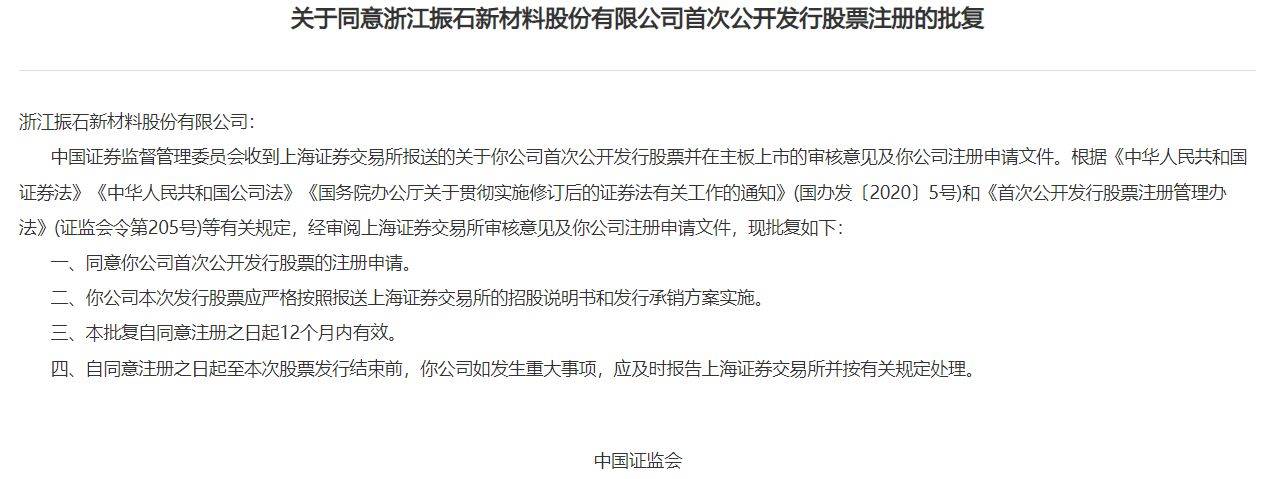
沪市主板企业振石股份IPO获注册
Sou Hu Cai Jing· 2025-12-09 14:07
Core Viewpoint - The China wind power fiber fabric industry is at a critical juncture, transitioning from a "large" to a "strong" phase, necessitating leading companies to focus on technological advancements and global strategies to maintain their competitive edge [7] Company Overview - Zhejiang Zhenstone New Materials Co., Ltd. is a national high-tech enterprise primarily engaged in the research, production, and sales of fiber-reinforced materials in the clean energy sector, with over 70% of its revenue derived from wind power fiber fabrics [4][5] - The company has become a global leader in wind blade material manufacturing, holding over 35% of the global market share for wind power glass fiber fabrics in 2024, and is recognized for its innovative solutions across various clean energy applications [4][5] Market Dynamics - The global wind power installation capacity is continuously increasing, with a clear trend towards larger blades, which can weigh nearly 20 tons and require about 60% glass fiber, driving demand for wind power fabrics [5] - The Chinese market demand for wind power fabrics is projected to reach 810,000 tons by 2025, indicating a robust market environment despite seasonal fluctuations [5] Industry Challenges - The industry faces significant challenges, including ongoing technological upgrade pressures and the risk of material substitution, particularly from carbon fiber, which is gaining market share in wind blade applications [6] - The international trade environment poses additional challenges, with anti-dumping and countervailing duties affecting the competitiveness of Chinese glass fiber products in overseas markets [6] - There is a potential risk of structural oversupply in low-end segments, as new entrants target high-performance fiber markets, necessitating strategic foresight from leading companies to avoid price wars and market saturation [6] Future Directions - Leading companies must not only maintain their current market positions but also strive for advancements in high-modulus and ultra-high-modulus products, while exploring new materials like carbon fiber [7] - A strategic shift towards localized production overseas is essential to mitigate trade risks and transition from merely exporting products to establishing technology standards and brand recognition globally [7]