食品安全法规

Search documents
南方科技大学×宁波东方理工大学最新Science论文:揭开海鲜带来的意外健康风险
生物世界· 2025-12-20 03:21
Core Viewpoint - The article highlights the health risks associated with per- and polyfluoroalkyl substances (PFAS), particularly through marine fish consumption, emphasizing the need for regulatory measures and international trade standards to mitigate exposure risks [2][10]. Group 1: PFAS Overview - PFAS are synthetic chemicals known for their stability due to carbon-fluorine bonds, making them persistent in the environment and difficult to degrade [5]. - These substances are linked to various health issues, including thyroid disease, immune system suppression, and cancer [5]. Group 2: Research Findings - The study analyzed data from 212 marine fish species to estimate the daily intake of C8-PFAS, revealing a median exposure of 0.023 nanograms per kilogram per day, with higher levels in North America, Oceania, and Europe [2]. - The research indicates that fish consumption is a significant source of PFAS exposure, with intake from fish being three times that from grains and 14.5 times that from meat [5]. Group 3: Geographic and Economic Disparities - Exposure levels vary globally, with North America, Oceania, and Europe showing the highest levels of C8-PFAS, while Asia and Oceania have higher pollution concentrations in fish [9]. - High-income countries have a median daily intake of C8-PFAS at 0.068 nanograms per kilogram per day, over five times higher than that of other countries, highlighting a correlation between economic status and PFAS exposure [9]. Group 4: Trade Dynamics - European countries play a crucial role in the global fish trade, significantly affecting exposure pathways, with imports contributing to over 76% of PFAS exposure in some regions [10]. - The study found that in Italy, only 11.71% of imported marine fish contributed to 35.82% of PFAS exposure, indicating the complex dynamics of local versus imported fish [10]. Group 5: Regulatory Implications - Following the implementation of the Stockholm Convention in 2009, the risk index for PFOS decreased by 72.3%, while the risk for PFOA dropped by 40.44%, demonstrating the effectiveness of regulations [10]. - However, unregulated long-chain PFAS pose increasing risks, necessitating urgent regulatory attention [10]. Group 6: Policy Recommendations - The research calls for unified PFAS limits in fish across countries, as current standards vary significantly [12]. - It emphasizes the need for monitoring high-pollution regions' fish exports and establishing international traceability mechanisms [13]. - There is a pressing need to include long-chain PFAS in regulatory frameworks to address emerging risks [14].


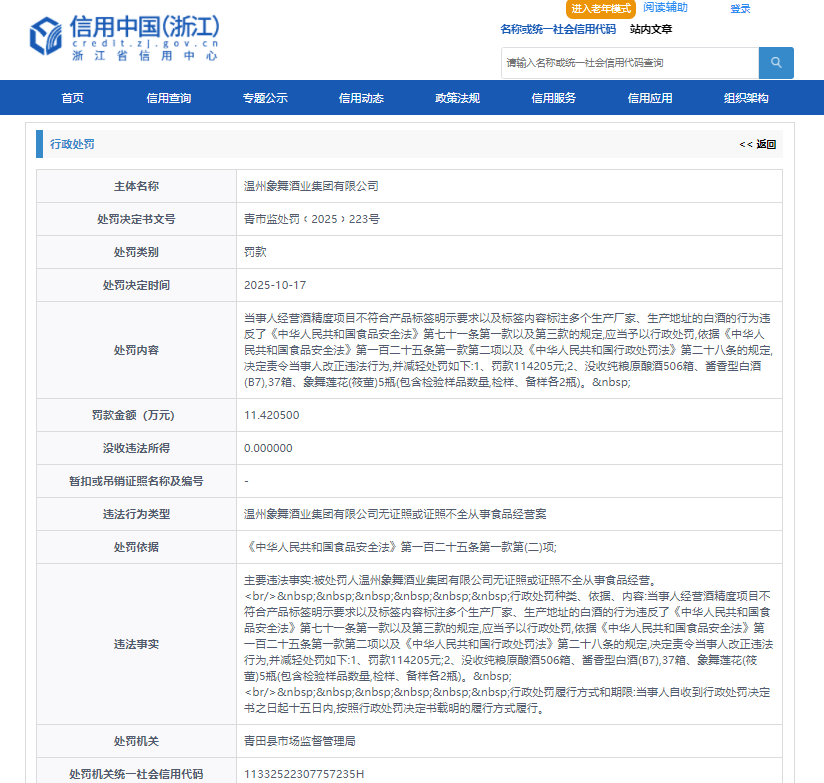
温州象舞酒业集团因产品标签不符及无证或证照不全经营被处罚
Qi Lu Wan Bao· 2025-10-20 03:58
Core Viewpoint - Wenzhou Xiangwu Liquor Group Co., Ltd. has been fined 114,205 yuan and had a batch of non-compliant liquor products confiscated due to violations of the Food Safety Law of the People's Republic of China [1][2]. Group 1: Administrative Penalty Details - The administrative penalty decision was issued by the Qingtian County Market Supervision Administration on October 17, 2025 [1][2]. - The company was found to have discrepancies in the alcohol content of its products compared to what was indicated on the labels, and the labels included multiple manufacturers and production addresses [1][2]. - The penalty includes a fine of 114,205 yuan and the confiscation of 506 boxes of pure grain liquor, 37 boxes of sauce-flavored liquor (B7), and 5 bottles of Xiangwu Lotus (Xiaodong) [1][2]. Group 2: Legal Basis and Compliance - The violations were deemed to contravene Article 71 of the Food Safety Law, which pertains to operating without proper licenses or with incomplete licenses for food business [1][2]. - The company is required to rectify its illegal activities and must comply with the penalty within 15 days of receiving the administrative decision [1][2]. Group 3: Company Information - Wenzhou Xiangwu Liquor Group Co., Ltd. was established on September 6, 2022, with a registered capital of 1 billion yuan [2]. - The legal representative of the company is Cheng Qi, and it is located in Ouhai District, Wenzhou, Zhejiang Province [2].
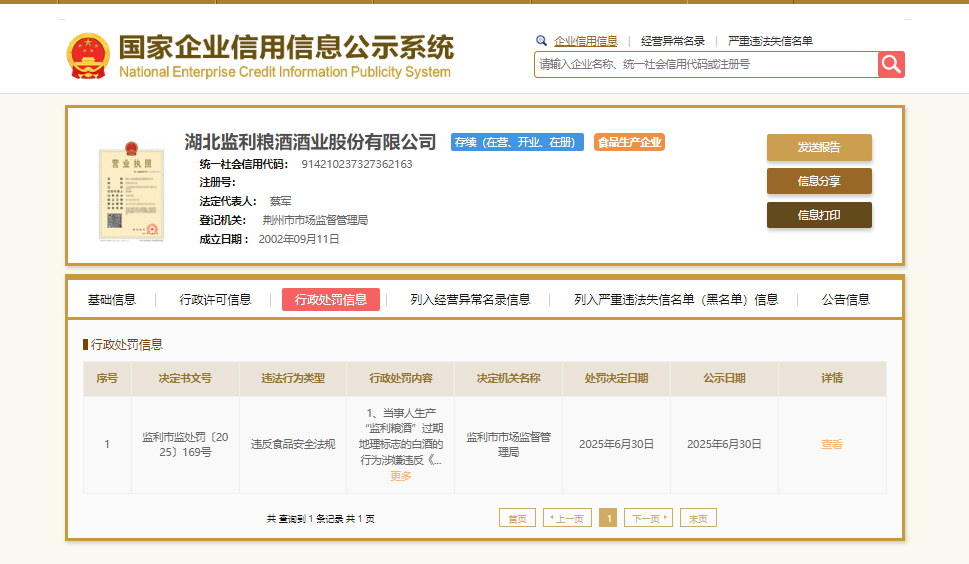
九类白酒产品标签标识违规!湖北监利粮酒酒业被罚2.8万元
Qi Lu Wan Bao· 2025-07-04 03:01
Core Viewpoint - Hubei Jianli Grain Wine Co., Ltd. has been fined 28,000 yuan for multiple violations of food safety regulations, including the use of expired geographical indications and misleading labeling on its products [1][4]. Company Information - Hubei Jianli Grain Wine Co., Ltd. was established on September 11, 2002, with a registered capital of 80 million yuan. The legal representative is Cai Jun, and the company is located in the Dong Industrial Park of Jianli County [4][2]. - The company is classified under the food production industry, specifically in the manufacturing of alcoholic beverages [2][4]. Regulatory Actions - The administrative penalty was issued by the Jianli Market Supervision Administration on June 30, 2025, due to violations of the Food Safety Law [1][8]. - The company was found to have produced nine types of liquor products with various labeling issues, including the use of expired geographical indications and false quality grade markings [4][6]. Violations and Penalties - The violations include: 1. Use of expired geographical indications on products sold from 2016 to 2024. 2. Misleading labeling, such as using outdated quality marks and failing to provide essential product information [4][6]. - The total fine of 28,000 yuan includes: - 8,000 yuan for barcode violations. - 20,000 yuan for labeling that does not meet national food safety standards [4][8]. Product Details - Specific products involved in the violations include: 1. "Jianli Grain Wine" (50% vol, 450ml) - 764 units sold. 2. "Jianli Grain Wine" (42% vol, 450ml) - 482 units sold. 3. "Chudu" fragrant liquor (42% vol, 1.5L) - used incorrect barcode. 4. Other products with issues related to labeling and expired patents [6][8].