酒

Search documents
2026年第13周:酒行业周度市场观察
艾瑞咨询· 2026-03-29 00:07
Industry Overview - The Chinese liquor industry is shifting from "volume and price increase" to "stock game," with a focus on "full-domain collaboration" and "scene innovation" [3][4] - Major platforms like Taobao, JD, Douyin, Meituan, and Xiaohongshu are adopting differentiated strategies to target various consumer segments, emphasizing youth narratives and emotional value [3][4] Trends in Liquor Categories - The category of "lu liquor" is entering a golden window, with expectations of 3-5 billion-level brands emerging in the next five years, driven by health demand and policy support [5] - The market for lu liquor is characterized by a "head concentration and regional dispersion" pattern, with a projected profit growth of nearly 200% from 2020 to 2024 [5] Health and Wellness in Alcohol - The trend of "alcohol + health" is becoming a highly certain direction, with a shift in drinking culture towards healthier options, particularly appealing to younger consumers and middle-aged health needs [6] - The rise of "health-conscious" drinking is leading to significant growth in products that combine taste and health attributes, with major liquor brands and pharmaceutical companies entering this space [6] Female Consumer Influence - Female consumers are becoming a significant driving force in the liquor market, with projections indicating that by 2025, women will account for 50% of online liquor consumption [7] - The focus is shifting towards low-alcohol, health-oriented products, with brands actively developing new offerings to cater to female preferences [7] New Beverage Trends - The new beverage market is expected to see explosive growth, with a projected scale of 135.1 billion yuan by 2025, driven by young consumers' preferences for low-alcohol and convenient products [8] - The industry anticipates 2026 to be a breakout year for low-alcohol beverages, with a shift in focus from storytelling to product quality and supply chain efficiency [8] Pricing Dynamics - The white liquor market is experiencing a "two ends heavy" consumption pattern, with high-end brands dominating while the 100-200 yuan price range becomes the mainstay for mass consumption [9][10] - Major liquor companies are adjusting factory prices to address inventory issues, marking a shift from "controlling volume to protecting price" to "lowering prices to maintain volume" [10] Consumer Sovereignty - The liquor industry is transitioning to a consumer sovereignty era, where the focus is on understanding and meeting consumer needs rather than supply-driven strategies [11][12] - Companies are increasingly emphasizing consumer-driven product development, with trends towards low-alcohol, small packaging, and scene-based innovations [12] Regional Market Strategies - Regional liquor companies are seeking breakthroughs in county markets, learning from successful models like Jinmailang's "four-in-one" partnership approach to enhance channel efficiency [13] - The focus is on leveraging local market characteristics and consumer preferences to drive growth and operational efficiency [13] Product Innovation - The liquor industry is witnessing a significant shift towards low-alcohol, lightweight, and health-oriented products, with brands launching new offerings to meet diverse consumer needs [14] - The rise of "meal liquor" and fruit liquor is becoming a new growth point for companies, aligning with the health and micro-drinking trends among younger consumers [14] Brand Dynamics - Major brands are increasingly focusing on cultural narratives and emotional connections with consumers, moving from product-centric to experience-centric marketing strategies [19][28] - The integration of cultural elements into product offerings is becoming a key strategy for brands to enhance market penetration and consumer loyalty [28]


酒行业周度市场观察:行业环境头部品牌动态投资运营产品技术营销活动-20260328
Ai Rui Zi Xun· 2026-03-28 15:20
Investment Rating - The report indicates a positive investment outlook for the liquor industry, highlighting emerging trends and growth opportunities in various segments [2][5]. Core Insights - The liquor industry is transitioning from a phase of "volume and price increase" to "stock game," focusing on "full-domain collaboration" and "scene innovation" as key competitive strategies [3]. - The category of "exposed liquor" is entering a golden window, with expectations of 3-5 billion-level brands emerging in the next five years due to increasing health demands and policy support [2][5]. - The integration of liquor with health trends is identified as a highly certain growth path, appealing to both younger consumers and older demographics seeking health benefits [5]. - Female consumers are becoming a significant driving force in the liquor market, with their preferences shifting towards lower-alcohol and health-oriented products [5]. - The new beverage market is expected to experience explosive growth, with a projected scale of 135.1 billion yuan by 2025, driven by younger consumers' preferences for low-alcohol and convenient products [5]. Industry Trends - The report outlines several key trends in the liquor industry: - The rise of "exposed liquor" as a new growth point, driven by health attributes and cultural heritage [2]. - The increasing importance of female consumers, who are expected to account for 50% of online liquor consumption by 2025 [5]. - The emergence of new beverage categories, including low-alcohol and fruit-flavored drinks, which cater to diverse consumer preferences [5]. - The shift towards consumer sovereignty, where companies are focusing on consumer needs rather than traditional supply-driven models [8]. - The competitive landscape is evolving, with head brands adjusting pricing strategies to maintain market share and address inventory issues [8]. Brand Dynamics - Major liquor brands are actively adjusting their strategies to adapt to market changes: - Brands like Moutai and Wuliangye are reducing factory prices to stimulate sales and address inventory pressures [8]. - New product launches are focusing on health-oriented and culturally resonant offerings, such as the introduction of low-alcohol and herbal liquors [5][8]. - Companies are leveraging cultural narratives and emotional connections in their marketing strategies to resonate with consumers [8]. - The report highlights the importance of innovation and differentiation in product offerings to capture market share in a competitive environment [8].





601899,拟分红超100亿元!多家A股公司也发预案
证券时报· 2026-03-21 14:04
Core Viewpoint - Multiple A-share companies have announced cash dividend plans, indicating a trend of returning profits to shareholders while showcasing their financial performance for 2025 [1][2][3][4]. Group 1: Company Announcements - Zijin Mining (601899) plans to distribute a cash dividend of 3.8 yuan per 10 shares, totaling approximately 101.04 billion yuan, with a revenue of 349.08 billion yuan and a net profit of 51.78 billion yuan for 2025, reflecting a 14.96% and 61.55% year-on-year growth respectively [1]. - Longjing Environmental Protection (600388) aims to distribute a cash dividend of 3.8 yuan per 10 shares, reporting a revenue of 11.87 billion yuan and a net profit of 1.11 billion yuan, with year-on-year growth of 18.49% and 33.95% respectively [2]. - Jinpan Technology (688676) proposes a cash dividend of 6.8 yuan per 10 shares, with a revenue of 7.30 billion yuan and a net profit of 660 million yuan, showing a 5.71% and 14.82% increase year-on-year [2]. - Chifeng Gold (600988) plans to distribute a cash dividend of 0.32 yuan per share, achieving a revenue of 12.64 billion yuan and a net profit of 3.08 billion yuan, with year-on-year growth of 40.03% and 74.7% respectively [3]. - Lexin Technology (688018) intends to distribute a cash dividend of 5 yuan per 10 shares, reporting a revenue of 2.57 billion yuan and a net profit of 498 million yuan, with year-on-year growth of 27.82% and 46.72% respectively [3]. - Shede Spirits (600702) proposes a cash dividend of 3.1 yuan per 10 shares, with a revenue of 4.42 billion yuan and a net profit of 223 million yuan, reflecting a year-on-year decline of 17.51% and 35.51% respectively [3]. - China Resources Sanjiu (000999) plans to distribute a cash dividend of 5.9 yuan per 10 shares, achieving a revenue of 31.60 billion yuan and a net profit of 3.42 billion yuan, with year-on-year growth of 14.43% and 1.58% respectively [4]. Group 2: Financial Performance Highlights - Zijin Mining's basic earnings per share (EPS) is 1.95 yuan, with significant increases in mineral production, including 90 tons of gold and 109,000 tons of copper [1]. - Longjing Environmental Protection's EPS is 0.88 yuan, indicating strong profitability growth [2]. - Jinpan Technology's EPS is 1.44 yuan, reflecting solid financial health [2]. - Chifeng Gold's EPS is 1.69 yuan, with a notable increase in cash flow from operating activities by 69.97% [3]. - Lexin Technology's EPS is 1.44 yuan, showcasing robust growth in both revenue and profit [3]. - Shede Spirits' EPS is 0.6803 yuan, despite a decline in revenue and profit [3]. - China Resources Sanjiu's EPS is 2.06 yuan, with significant investment in R&D amounting to 1.73 billion yuan [4].


财信证券晨会纪要-20260312
Caixin Securities· 2026-03-11 23:36
Market Overview - The Shanghai Composite Index closed at 4133.43, up 0.25%, while the Shenzhen Component Index rose by 0.78% to 14465.41. The ChiNext Index increased by 1.31% to 3349.53, and the STAR 50 Index fell by 1.37% to 1401.08 [1][8] Industry Dynamics - Nylon Technology Company has achieved full production capacity for its caprolactam green transformation project, reaching a daily output of 1200 tons. The project is expected to save approximately 80 million yuan annually in steam costs alone [27] - In February, the production of iron phosphate was 333,700 tons, remaining stable month-on-month. The production capacity utilization rate was 81.7%, indicating a high level of operational efficiency [29] - The price of polysilicon continues to be under pressure, with a reported average price drop of 6.42% to 45,200 yuan per ton. The market is experiencing low activity levels, and high inventory levels are contributing to the downward price trend [31][32] - Omdia forecasts a 12% decline in global PC shipments in 2026, primarily due to rising memory and storage prices, which have increased by 60% in the first quarter of 2026 [33] Company Tracking - Tangrenshen (002567.SZ) reported a February pig sales volume of 429,500 heads, a year-on-year increase of 7.80%. However, the total sales revenue decreased by 19.31% year-on-year to 549 million yuan [35] - Shengnong Development (002299.SZ) achieved a sales revenue of 1.317 billion yuan in February, reflecting a year-on-year growth of 15.10%. The poultry segment saw a decline in sales volume, while processed meat products experienced significant growth [37] - Chongqing Beer (600132.SH) reported a revenue of 14.722 billion yuan for 2025, a year-on-year increase of 0.53%, with a net profit attributable to shareholders rising by 10.43% to 1.231 billion yuan [39]
开年利是!头部基金给出马年投资“寻宝图”
Zhong Guo Jing Ji Wang· 2026-02-24 05:13
Core Viewpoint - The A-share market is expected to focus on technology as the main theme for 2026, with attention also on consumer and dividend sectors as investment opportunities [1] Group 1: Investment Strategies and Themes - E Fund emphasizes the increasing value of dividend assets in a low-interest-rate environment, with dividend yields around 5% and a potential influx of funds into these assets in 2026 [1] - 华夏基金 suggests that concerns over tightening overseas liquidity may be overestimated, and long-term investors could find attractive entry points in sectors like AI, media, and lithium batteries [2] - 富国基金 predicts a "central oscillation upward" trend for the A-share market in 2026, driven by recovery opportunities in consumption and real estate [3] - 汇添富 identifies A-shares as the most promising asset for 2026, highlighting the clear trend in the AI industry and the potential for valuation increases [8] - 博时基金 recommends focusing on emerging industries, resource upgrades, and domestic demand recovery as key investment directions for 2026 [10] Group 2: Sector-Specific Insights - 国泰基金 notes a policy shift towards domestic demand, which is expected to enhance China's economic outlook and asset returns, suggesting a good time for mid-term adjustments in sectors like AI and power equipment [5] - 鹏华基金 highlights the wine sector's potential for valuation recovery in 2026, while also emphasizing the attractiveness of the tourism sector in Hong Kong stocks [6][7] - 景顺长城 focuses on the long-term structural benefits for the equity market, particularly in technology sectors like AI, semiconductors, and consumer electronics [9] - 银河基金 discusses the commercial viability of space solar power and the need for domestic companies to overcome challenges in reusable rocket technology [11] - 东方红 suggests that cyclical sectors have high potential but require supply-side adjustments, while advocating for a bottom-up approach to identify undervalued stocks [12]
2025年1-12月酒、饮料和精制茶制造业企业有5965个,同比下降1.08%
Chan Ye Xin Xi Wang· 2026-02-22 03:35
Group 1 - The core viewpoint of the article highlights a slight decline in the number of enterprises in the liquor, beverage, and refined tea manufacturing industry in China, with a total of 5,965 companies reported for the year 2025, which is a decrease of 65 companies or 1.08% compared to the previous year [1][1][1] - The data indicates that the proportion of these enterprises within the total industrial enterprises stands at 1.13%, reflecting the industry's share in the broader industrial sector [1][1][1] - The report is based on statistics from the National Bureau of Statistics and compiled by Zhiyan Consulting, a leading industry consulting firm in China, which specializes in providing in-depth industry research reports and tailored consulting services [1][1][1] Group 2 - The article references a specific report titled "Analysis of the Market Operation Pattern and Future Prospects of the Beverage Industry in China from 2026 to 2032," indicating ongoing research and analysis in the beverage sector [1][1][1] - The report emphasizes the importance of market insights and comprehensive industry solutions to empower investment decisions, showcasing the consulting firm's expertise in the field [1][1][1]

2026年第7周:酒行业周度市场观察
艾瑞咨询· 2026-02-19 00:05
Group 1 - The white liquor industry is experiencing a structural adjustment characterized by "reduced volume, lower prices, and shrinking profits," despite surface-level prosperity expected in 2025 [3][4] - High-priced low-alcohol liquor is seen as a trap, as it may weaken the social attributes of liquor consumption, while the trend of light bottle liquor should focus on cost-effectiveness [3] - The market is shifting from extensive growth to a consumer-centric approach, requiring companies to meet differentiated demands accurately [4] Group 2 - The 2026 Spring Festival will see a late start in sales, with a shift in consumption scenarios from business banquets to family gatherings and self-drinking [5] - Price differentiation is evident, with stable demand for mid-range liquor (50-350 RMB) and volatility in high-end liquor (above 600 RMB) [5] - The market is adjusting, leading to product structure optimization and improved channel efficiency, laying a foundation for long-term industry development [5] Group 3 - Over the past decade, the Chinese liquor industry has undergone a significant supply-demand revolution, with white liquor production down 74% and beer production stabilizing at 35 million kiloliters [6] - The industry is transitioning from scale expansion to value competition, with leading companies maintaining resilience while smaller players exit the market [6] - The concentration in the white liquor industry is accelerating, with the number of large-scale enterprises decreasing by 43.8% [6] Group 4 - The white liquor industry is undergoing a transformation with new brand ambassadors aimed at enhancing brand positioning and attracting younger consumers [7] - This shift reflects a response to market competition and consumer differentiation, promoting brand rejuvenation and cultural storytelling [7] Group 5 - Female consumers are becoming a significant driving force in liquor consumption, with brands like Jinjiu and Wuliangye seeing substantial growth in female users [8] - The rise of female consumption is attributed to social and economic changes, necessitating higher demands on marketing strategies and product innovation [8] Group 6 - The white liquor market is experiencing price fluctuations ahead of the Spring Festival, with brands like Feitian Moutai seeing price increases due to strong demand [9] - Despite promotional efforts, actual sales growth remains limited, indicating a "busy season not being busy" characteristic in the market [9] Group 7 - The white liquor production is expected to continue declining, with a 12.1% year-on-year decrease projected for 2025, marking a 74% drop from peak levels in 2016 [10] - The industry is entering a deep adjustment phase, focusing on "reducing quantity while improving quality" and optimizing structure [10] Group 8 - The industry is witnessing a return to product-centricity, with new demands for low-alcohol and health-oriented products emerging from various consumer segments [11] - The 2026 China Liquor Annual Product Festival aims to promote high-quality development centered around product innovation [11] Group 9 - Leading liquor companies are emphasizing consumer-centric strategies through scene innovation to deepen emotional connections with consumers [12] - Successful scene innovation requires sincerity and alignment with brand core values, focusing on consumer emotional resonance [12] Group 10 - Guizhou Dukang is accelerating its national strategy with the opening of a cultural museum in Nanjing, aiming to strengthen its brand presence in the Jiangsu market [28] - The company is leveraging its cultural IP and diverse product strategies to enhance competitiveness in the liquor market [28]

负债行为跟踪:两融资金继续退潮,宽基ETF流出放缓
ZHONGTAI SECURITIES· 2026-02-08 13:39
Report Industry Investment Rating No relevant content provided. Core Viewpoints of the Report - This week, the A-share market declined on low volume, with the non-ferrous and TMT sectors leading the decline. The sharp drop in the non-ferrous sector was due to the "squeezing out of water" after the previous high consensus and excessive concentration of leveraged funds. The decline in the TMT sector was affected by the panic spillover from the non-ferrous sector and the lower-than-expected overseas technology performance. However, on Tuesday, most sectors rebounded from oversold conditions, indicating that bottom-fishing funds had started to enter the market [6]. - The characteristics of liability behavior this week include the continued ebb of margin trading funds, the significant slowdown in the outflow of index ETF funds, and the "freezing point" of market sentiment on Monday, followed by some recovery [7][11][12]. - With the release of market sentiment on Monday, the risk of extreme overheating has been alleviated. The market has returned from an overheated state to a rational or even locally oversold range. In the future, the market may face an environment with a narrowing of the main line, accelerated rotation, and increased divergence, but the time for the spring rally may be extended [13]. Summary According to Relevant Catalogs 1. Asset Performance - **Global Assets**: This week, A-shares, US technology stocks, and Hong Kong stocks declined. The Shanghai Composite Index fell 1.3%, the ChiNext Index in A-shares dropped 3.3%, and the STAR 50 Index declined 5.8%. The Nasdaq fell 1.8%, and the Hang Seng Index dropped 3.0%. Global risk aversion increased, and bond markets generally strengthened. Precious metals, led by silver, tumbled, with SHFE silver down 32.7% and SHFE gold down 6.1% for the week. The US dollar index rebounded, but the RMB did not appreciate against the US dollar [17]. - **A-share Market**: The performance of broad-based indexes was divided. The technology sector declined significantly, with the ChiNext Index and the STAR 50 Index leading the decline, down 3.3% and 5.8% respectively. The micro-cap index performed well, rising 1.9%, while the other broad-based indexes declined to varying degrees. The trading volume of broad-based indexes decreased significantly, with the average daily trading volume dropping from 3.1 trillion yuan to 2.4 trillion yuan. The trading volume of the entire A-share market decreased daily from Monday to Friday, from 2.6 trillion yuan on Monday to 2.2 trillion yuan on Friday [19][24]. - **A-share Industries**: The non-ferrous metals (-15.6%) sector led the decline this week, followed by steel (-6.1%), computer (-5.2%), electronics (-4.6%), communication (-3.8%), and media (-3.4%). The top five rising industries were beauty care (2.1%), power equipment (1.7%), transportation (1.7%), comprehensive (1.6%), and light industry manufacturing (1.5%) [31]. 2. ETF Funds - The outflow of index ETF funds slowed down significantly. The average daily net outflow of the CSI 300 ETF decreased from over 14 billion yuan in the previous two weeks to 1.14 billion yuan this week, and there were net inflows on Thursday and Friday. The average daily net outflow of the SSE 50 ETF was 330 million yuan, compared with over 5 billion yuan in the previous two weeks. The average daily net outflows of the CSI 1000 ETF and the CSI 500 ETF also decreased significantly, while the ChiNext and STAR 50 ETFs had net inflows [11][14][41]. 3. Leveraged Funds - The proportion of margin trading turnover decreased from 9.71% last week to 9.32%. The margin trading balance decreased from 2.73 trillion yuan last week to 2.70 trillion yuan, and it decreased daily from Monday to Friday [48]. - From Monday to Thursday, margin trading funds in the constituent stocks of broad-based indexes had a net outflow. Among them, the large-cap stocks such as the CSI 300, the Shanghai Composite Index, and the SSE 50 had a relatively large outflow of margin trading funds. The small and medium-cap and GEM sectors also accelerated their net outflows [50]. - Most industries deleveraged this week. The banking, food and beverage, commercial retail, non-ferrous metals, and non-bank financial industries had a relatively large deleveraging amplitude. The comprehensive, building decoration, public utilities, and power equipment industries added leverage [56]. - Stocks of all market capitalization gradients deleveraged this week, with stocks with a market capitalization of over 500 billion yuan having a relatively large deleveraging amplitude. Most popular stocks deleveraged, especially non-ferrous and electronic popular stocks [61][65]. 4. Quantitative Funds - In January, the excess returns of the CSI 500 and CSI 1000 quantitative index enhancement products rebounded to positive values, with medians of 0.47% and 0.39% respectively. Since February, the excess returns of the CSI 500 and CSI 1000 quantitative index enhancement products have continued to rebound, with medians of 0.66% and 0.55% respectively [73]. 5. Main Funds - The main funds in the CSI 300, ChiNext, and STAR markets continued to have a net outflow this week, accelerating compared with last week. Specifically, the main funds in the three sectors had a net outflow every day [79]. - This week, the main funds flowed out of most industries, with the electronics industry having the largest outflow, followed by non-ferrous metals and communication. The main funds flowed into the coal and comprehensive sectors [87]. 6. Northbound and Southbound Funds - **Northbound Funds**: The total trading volume of northbound funds decreased this week, with the average daily trading volume dropping from 389.1 billion yuan to 319.9 billion yuan, and the proportion of A-share trading volume increased from 12.7% to 13.3%. Since December, the trading activity of northbound funds has significantly rebounded [91]. - **Southbound Funds**: The average daily trading volume of southbound funds increased from 216.3 billion yuan to 220.6 billion yuan, and the proportion increased from 49.0% to 49.4%. The average daily net purchase amount increased from -400 million yuan to 7.9 billion yuan. This week, southbound funds flowed into the banking, non-bank financial, media, and commercial retail sectors in large amounts and flowed out of the electronics and communication industries [93][97].
公司互动丨这些公司披露在芯片、机器人等方面最新情况
Di Yi Cai Jing· 2026-02-06 14:10
Key Insights - Multiple listed companies disclosed their latest developments in the fields of chips and robotics through various channels on February 6 [1] Group 1: Chips - Huahai Chengke stated that the storage industry is currently entering a super cycle driven by AI, which has a positive impact on the company's operations [1] Group 2: Robotics - Xinsida confirmed that the company has not yet produced space robots [1] - Ruihu Mould is collaborating with Yaskawa Electric to develop high-end composite mobile collaborative robots [1] Group 3: Other Developments - Zhongmi Holdings reported that its overall business performance remains robust with full order books [1] - Victory Precision has obtained technical authorization for composite copper foil products from a leading customer, and both parties are actively promoting subsequent cooperation [1] - Shenjian Co., Ltd. is engaged in business collaborations with CAS Space, Xinghe Power, and Beijing Blue Arrow Hongqing [1]

今日十大热股:白银有色连续霸榜热股第一,白酒板块久违大涨贵州茅台、五粮液上榜
Jin Rong Jie· 2026-01-30 01:20
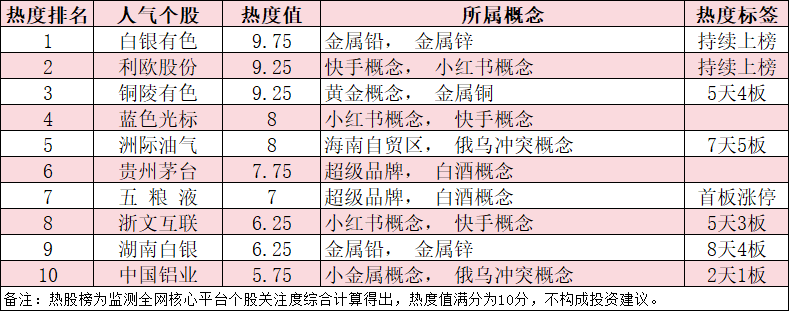
Core Insights - The A-share market showed significant divergence on January 29, with the Shanghai Composite Index slightly up by 0.16% to 4157.98 points, while the ChiNext Index fell by 0.57% and the STAR Market dropped by 3.03% [1] - The total trading volume in the Shanghai and Shenzhen markets reached 3.23 trillion yuan, an increase of approximately 264.6 billion yuan compared to the previous day, indicating a weak market sentiment with more stocks declining than rising [1] Hot Stocks Overview - The top ten popular stocks included Baiyin Nonferrous Metals, Liou Co., Tongling Nonferrous Metals, BlueFocus Communication Group, Intercontinental Oil & Gas, Kweichow Moutai, Wuliangye Yibin, Zhejiang Wenhu Interconnect, Hunan Baiyin, and China Aluminum [2] - Baiyin Nonferrous Metals ranked first with a heat value of 9.75, driven by external factors such as rising international gold and silver prices and internal strategic developments in gold business [2][3] - Liou Co. saw a heat value of 9.25, benefiting from its dual business focus on "smart pumps and systems" and "digital marketing," aligning with market trends [2][3] - Tongling Nonferrous Metals also had a heat value of 9.25, reflecting macroeconomic trends and improvements in the company's fundamentals [2][3] Sector Analysis - BlueFocus Communication Group's performance was boosted by the high demand in the AI marketing sector, with the company actively engaging in AI transformation [3] - Intercontinental Oil & Gas benefited from geopolitical tensions driving oil price expectations higher, along with favorable domestic policies and successful overseas project developments [4] - Kweichow Moutai's rise was attributed to positive changes in its fundamentals and market capital flow, with the price of its flagship product stabilizing above 1600 yuan [4] - Wuliangye Yibin's surge was linked to strong demand during the Spring Festival and significant purchases by well-known investors [4] - Zhejiang Wenhu Interconnect, Hunan Baiyin, and China Aluminum experienced increased market attention due to various factors including technological breakthroughs and policy-driven changes [4]