
首相指名选举

Search documents
日本国会首相指名选举投票开始
Xin Lang Cai Jing· 2026-02-18 04:58
Group 1 - The voting for the Prime Minister nomination in Japan's National Diet began on February 18, with high expectations for Kishi Nobuo to be elected as Prime Minister [1] - Kishi Nobuo's cabinet collectively resigned on the same day, and both houses of the National Diet will hold the Prime Minister nomination elections sequentially [1] - In the first round of voting, a candidate needs to secure a majority of votes to win directly; if no candidate achieves this, the top two candidates will proceed to a runoff [1] Group 2 - The ruling coalition, formed by the Liberal Democratic Party and the Japan Innovation Party, secured a majority of seats in the recent House of Representatives election [1] - Although the ruling coalition does not hold a majority in the House of Councillors, the opposition parties have not unified around a single candidate, which favors Kishi Nobuo's chances [1] - Even if the first round does not yield a winner, Kishi Nobuo is expected to receive the most votes in the subsequent runoff [1]
日本将举行首相指名选举
券商中国· 2026-02-10 05:37
Group 1 - The Japanese government has scheduled a special Diet session on the 18th of this month to hold a prime ministerial election, as mandated by the constitution within 30 days after the House of Representatives election [1] - On the day of the special Diet session, the current cabinet led by Prime Minister Kishi will collectively resign, and new members of the House of Representatives will vote alongside the existing members of the House of Councillors to elect a new prime minister [1] - In the first round of voting for the prime ministerial election, a candidate needs to secure a majority to win outright; if no candidate achieves this, the top two candidates will proceed to a second round [1] Group 2 - The media widely anticipates that Prime Minister Kishi will win the election due to the ruling Liberal Democratic Party holding more than two-thirds of the seats in the House of Representatives [1] - Following the Diet session, Prime Minister Kishi expressed intentions to push for the approval of the 2026 budget and related legislation [2]


日本将举行首相指名选举
Xin Hua She· 2026-02-10 04:01
Group 1 - The Japanese government has scheduled a special Diet session on February 18 for the prime ministerial election [1] - The current cabinet led by Prime Minister Kishi will resign collectively on the same day, and new members of the House of Representatives will vote alongside the existing members of the House of Councillors to elect a new prime minister [1] - The election process allows for a first round where a candidate must secure a majority to win; if no candidate achieves this, the top two candidates will proceed to a second round [1] Group 2 - In the event of a disagreement between the House of Representatives and the House of Councillors, the decision will ultimately be based on the House of Representatives' results, as stipulated by the constitution [1] - The ruling Liberal Democratic Party (LDP) holds more than two-thirds of the seats in the House of Representatives, making it highly likely that Kishi will win the election [1] - Kishi has expressed intentions to push for the approval of the 2026 budget and related legislation following the convening of the Diet [1]
日本维新会称与自民党磋商有“大幅进展”
Xin Jing Bao· 2025-10-17 12:50
Core Points - The political negotiations between Japan's ruling Liberal Democratic Party (LDP) and the opposition Japan Innovation Party (JIP) have made significant progress [1] - A key condition for reaching an agreement is the reduction of seats in the National Diet [1] - The negotiations are ongoing, and full consensus has not yet been achieved [1] - The recent withdrawal of the Komeito party from the ruling coalition adds uncertainty to the prime ministerial election [1] - If the LDP and JIP form an alliance, the likelihood of Sanae Takaichi being elected as Japan's prime minister will significantly increase [1]
日本执政联盟突然破裂,带来哪些变数
Xin Hua She· 2025-10-11 08:39
Group 1 - The Komeito party has decided to withdraw from the ruling coalition with the Liberal Democratic Party (LDP) due to unsatisfactory responses regarding the reform of "black money politics" [1][2] - Komeito's leader, Saito Tetsuo, stated that the party will not take a purely oppositional stance towards the LDP but will evaluate policies on a case-by-case basis [1] - The LDP, despite the withdrawal, remains the largest party in the Diet, with a significant number of seats in both the House of Representatives and the House of Councillors [3] Group 2 - High-profile political dynamics are at play as Komeito's exit may complicate the election of new Prime Minister Kishi Nobuo, although he still has a considerable chance of succeeding [3][4] - The Constitutional provisions for the Prime Minister's election indicate that if no candidate receives a majority in the first round, a second round will determine the winner [3] - The opposition parties, particularly the Constitutional Democratic Party, express that a change in government is possible if they can unite, but face challenges in collaboration due to differing policy positions [4] Group 3 - The withdrawal of Komeito could lead to increased challenges for the new Prime Minister in both domestic and foreign policy, particularly if a new coalition cannot be formed [5] - A potential delay in the Prime Minister's election could extend a "political vacuum," complicating the transition of power and the ability to implement effective policies [6] - The instability in the political landscape may adversely affect Japan's foreign relations, especially with upcoming diplomatic engagements [6]
公明党宣布退出执政联盟,公明党党首:选首相时不会投票给高市早苗
Huan Qiu Wang· 2025-10-10 08:19
Core Points - The Komeito party, led by Tetsuo Saito, has decided to withdraw from the ruling coalition in Japan, indicating that its members will not support the nomination of new Liberal Democratic Party (LDP) president Sanae Takaichi for Prime Minister [1][3] - There are significant disagreements between Komeito and LDP regarding the "political money" issue, with Komeito demanding stricter rules on corporate and group donations, which LDP has not adequately addressed [3] - The withdrawal of Komeito from the ruling coalition marks a significant turning point in Japanese politics, leading to increased political contention surrounding the Prime Minister nomination election [3] Political Landscape - Currently, the LDP holds 196 seats in the 465-seat House of Representatives, while Komeito has 24 seats [3] - The opposition parties, including the Constitutional Democratic Party, the Democratic Party for the People, and the Japan Innovation Party, are negotiating for the Prime Minister nomination, with the Constitutional Democratic Party agreeing to support the Democratic Party for the People's leader, Yuichiro Tamaki [3] - The combined seats of the three opposition parties total 210, surpassing the LDP's 196 seats, which could impact the outcome of the Prime Minister nomination [3]
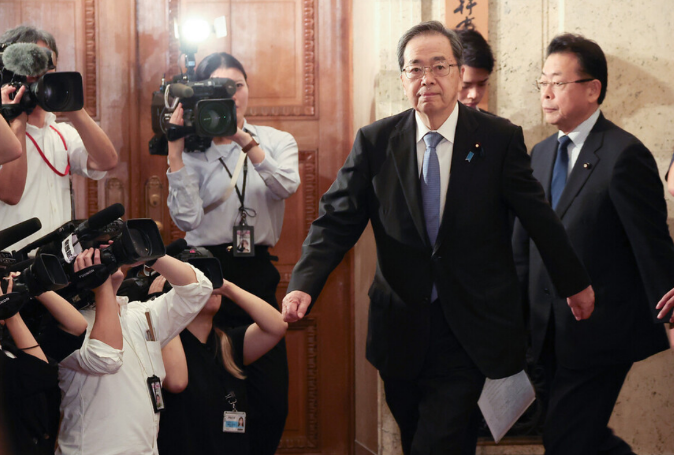
公明党党首:将不会在首相指名选举中把票投给高市早苗
Huan Qiu Wang· 2025-10-10 07:28
Group 1 - The core point of the news is that the Komeito party, led by Saito Tetsuo, has decided to leave the ruling coalition in Japan, indicating a significant political shift [1][3] - Komeito's members of parliament will not support the nomination of the new Liberal Democratic Party (LDP) president, Takashi Saito, in the prime ministerial election, opting instead to vote for their own leader [1][3] - The split is attributed to serious disagreements over the "political money" issue, with Komeito demanding stronger regulations on corporate and group donations, which the LDP has not adequately addressed [3] Group 2 - Analysts suggest that Komeito's departure from the ruling coalition marks a turning point in Japanese politics, leading to intensified political battles surrounding the prime ministerial election [3] - The uncertainty surrounding Takashi Saito's potential appointment as prime minister has increased due to Komeito's withdrawal from the coalition, making the outcome of the prime ministerial election unclear [3]
热点问答|石破茂后,谁接任日本首相
Xin Hua Wang· 2025-09-07 17:52
Core Points - Japanese Prime Minister and ruling Liberal Democratic Party (LDP) President Shigeru Ishiba announced his resignation, which implies he will also step down as Prime Minister [1] - Ishiba took responsibility for the LDP's loss in the July 2023 House of Councillors election, marking the first time since the party's establishment in 1955 that it failed to secure a majority in both houses of the National Diet [1] - The new LDP president will face challenges, including a minority government situation in both houses, requiring cooperation with opposition parties to pass legislation [4] Ishiba's Statements - Ishiba stated that the U.S.-Japan tariff negotiations have reached a pause, and he believes it is the right time to step down and allow a successor to take over [2] - He emphasized his commitment to fulfilling his responsibilities to the public until a new president is elected [3] Challenges for the New President - The new LDP president will inherit a challenging political landscape, with the ruling coalition lacking a majority in both the House of Representatives and the House of Councillors [4] - There is a risk that opposition parties could unite to nominate a non-LDP candidate, potentially disrupting the long-standing dominance of the LDP [4] - Ongoing issues such as rising prices and sluggish economic growth continue to pose challenges for political stability in Japan [4] Potential Successors - Possible candidates to succeed Ishiba as LDP president include former Minister of Economic Security Sanae Takaichi, Koizumi Shinjiro, and Chief Cabinet Secretary Yoshihide Suga [5][6] - Takaichi is known for her right-wing stance and has previously participated in the LDP presidential election, while Koizumi is the son of former Prime Minister Junichiro Koizumi [5][6] - Yoshihide Suga, aged 64, has held multiple ministerial positions and is referred to as a "firefighter" in Japanese politics [6]