高净值人群入市

Search documents
中金:在基准情形下,预计居民新增入市资金体量可能与去年相比变化不太大
Jin Rong Jie· 2026-01-29 00:24
Group 1 - The core concept of "deposit into the market" emphasizes the importance of "net new funds" rather than just "new funds," as net new funds have a stronger correlation with stock prices [1][3][5] - The willingness of residents to enter the market is closely related to income expectations, which are expected to stabilize or improve, potentially leading to an increase in the growth rate of new funds entering the market, although it may be lower than in 2025 [1][6][11] - The analysis framework for income expectations includes employment and service inflation indicators, as well as leading indicators such as resident credit pulses and housing prices [1][15][44] Group 2 - The relationship between new funds and stock market performance is weak; however, the growth rate of new funds shows a better correlation with stock market fluctuations [6][9][11] - The investment willingness of residents is a decisive factor for market dynamics, with a strong connection to income expectations; if investment willingness declines, even with high levels of deposits, market entry funds may not increase significantly [21][23][28] - High-net-worth individuals and insurance funds may contribute to market support, but their impact may diminish in 2026 as their investment willingness may not be as influenced by broader income expectations [36][39][41]

中金:宏观视角下的存款搬家与股市定价——存款到期的股债汇影响(一)
Xin Lang Cai Jing· 2026-01-27 23:53
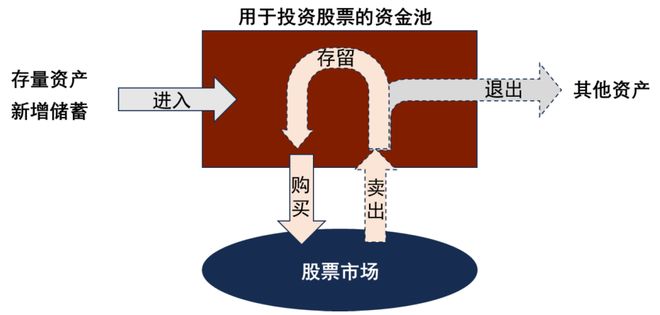
Core Insights - The concept of "deposit into the market" emphasizes the importance of "new funds" while also considering "exit funds" to determine "net new funds," which have a greater correlation with stock prices. Ultimately, this reflects the willingness of residents to invest in the market, which is strongly correlated with income expectations [3][70][71] - The growth rate of new funds is more significant than the absolute amount of new funds, as it has a stronger correlation with stock market performance. High-net-worth individuals and insurance funds may provide independent support to the market in 2025, but this influence may diminish in 2026 [3][70][71] - The analysis framework for income expectations is based on employment and service inflation, with indicators such as resident credit pulses and housing prices leading to income expectations. In the baseline scenario, the amount of new funds entering the market is expected to remain relatively stable compared to the previous year [3][70][71] Group 1 - New funds do not equate to net new funds; stock price increases are more closely related to the growth rate of new funds. The relationship between new funds and stock market performance is not strong, as evidenced by fluctuations in new funds from 2015 to 2025 [4][7][75] - The correlation between the growth rate of new funds and stock market performance is more significant. For instance, in 2016, new funds reached 4.9 trillion yuan, but the market declined by 12.9%, while in 2019, lower new funds coincided with a 33% market increase [7][75][78] - The willingness of residents to invest in the stock market is a decisive factor, closely linked to income expectations. A decline in investment willingness can lead to reduced market participation, as seen in 2022 when a 14% increase in maturing deposits did not translate into increased market investment [21][25][90] Group 2 - The investment willingness of residents is significantly influenced by income expectations. As of Q3 2025, the tendency to save remains high, indicating potential for increased risk asset allocation if saving tendencies normalize [25][94] - Employment perceptions are closely tied to income expectations, which in turn affect stock market trends. Historical data shows a negative correlation between unemployment rates and stock market performance in the U.S. and Japan [30][99] - High-net-worth individuals' willingness to invest in the stock market may not be significantly affected by broader income expectations, and insurance funds may contribute to market investments, although their growth may be limited compared to 2025 levels [34][35][106]