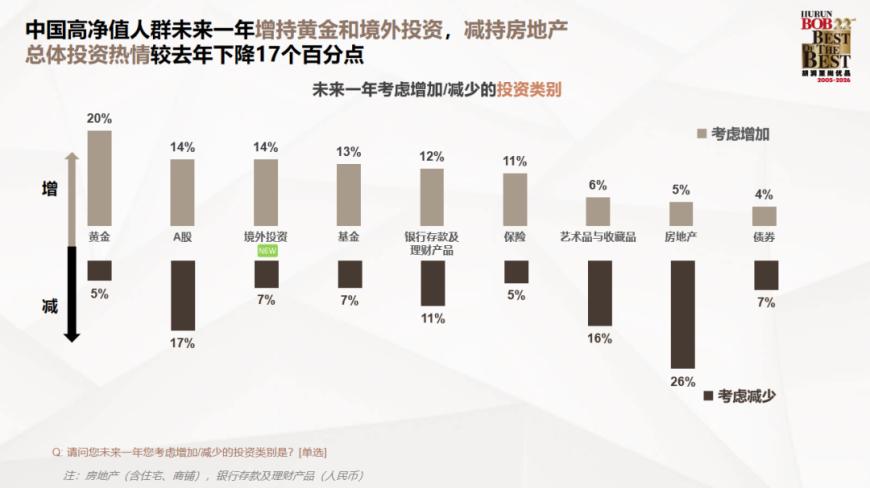
高净值人群投资偏好

Search documents
胡润报告:黄金连续三年位列中国高净值人群投资偏好首位
Guo Ji Jin Rong Bao· 2026-01-30 12:16
Core Insights - The report reveals the changing lifestyle, consumption habits, and brand preferences of China's high-net-worth individuals (HNWIs) [1] - The average total family assets of respondents are 61 million yuan, a 38% increase compared to the past five years [1] - The report indicates a shift in investment preferences, with a focus on gold and overseas investments, while real estate and collectibles are being reduced [4] Demographics - The survey included 470 high-net-worth individuals, with 70 being ultra-high-net-worth individuals (assets over 100 million yuan) [1] - 78% of respondents are from first-tier cities, with an average age of 36 years [1] - Gender distribution is 47% male and 53% female, with 41% being married with children [1] Wealth Sources - Wealth sources include investments (28%), salary (22%), business dividends (21%), inheritance (16%), and rental income (13%) [1] - The average investable assets amount to 23 million yuan [1] Living Conditions - The average living area for HNWIs is 205 square meters, with an average of 4.1 residents per household [1] - Respondents report an average of 6.7 hours of sleep per day and over 2 hours of exercise per week, with hiking and running being the most favored activities [1] Investment Trends - HNWIs show a preference for increasing investments in gold and overseas markets, while reducing exposure to real estate and collectibles [4] - Gold has been the top investment preference for three consecutive years, with prices rising from over 600 yuan to 1,100 yuan per gram [4] - The predicted year-end Shanghai Composite Index is 3,820 points, with 13% of respondents expecting it to exceed 4,500 points [4] Economic Confidence - 26% of respondents express "very high confidence" in the Chinese economy, while 59% have "some confidence" [5] - The economic confidence index is higher among respondents under 40 and those over 45 [5] Overseas Assets - The average proportion of overseas assets in investable assets is 15%, a decrease of 1.1 percentage points from the previous year [5] - First-tier city respondents have a slightly higher overseas asset proportion (16%) compared to new first-tier cities (15%) [5] - Ultra-high-net-worth individuals have a higher overseas asset ratio of 26%, with those having investable assets over 50 million yuan reaching 30% [5]

胡润报告:高净值人群未来一年对黄金投资的净增长意向达15%,对A股的净减少意向为3%
Jin Rong Jie· 2026-01-30 07:32
Core Insights - The report by Hurun Research Institute indicates a significant shift in investment preferences among high-net-worth individuals in China, with a notable increase in gold investment intentions and a decline in real estate investments [1][5]. Investment Preferences - High-net-worth individuals show a net increase intention of 15% for gold investments, while intentions for overseas investments stand at 7%, and both fund and insurance investments at 6% [1]. - Real estate investment intentions reflect a net decrease of 21%, with art and collectibles also seeing a reduction of 10% in investment intentions [1]. - The net decrease intention for A-shares is 3%, while bank deposits and wealth management products show a slight net increase intention of 1% [1]. Changes Over Time - Since 2020, there has been a clear shift in investment preferences, with gold investment intentions reaching a new high this year, while real estate investment intentions have dropped to their lowest point in 2024 [1]. - The net decrease intention for art and collectibles is at 9.8%, marking the highest level of reduction intentions in nearly seven years [1]. Overseas Investment Trends - 84% of surveyed high-net-worth individuals are considering overseas investments, with the highest enthusiasm among those under 35 years old, while those over 45 show the least enthusiasm [5]. - The net increase intention for U.S. stock investments is 17%, and for Hong Kong stocks, it is 10%, indicating a strong inclination to increase holdings [5]. - Real estate investment intentions abroad show a net decrease of 6%, reflecting a clear trend towards reducing exposure in this area [5]. Preferred Overseas Investment Locations - The most favored overseas investment location remains Hong Kong at 43%, with a slight increase of 2 percentage points from last year, followed by the U.S. at 26%, which also saw a small rise [7]. - Investment enthusiasm for Southeast Asia (Singapore, Malaysia, Thailand) and EU countries has significantly declined, with both regions dropping 14 percentage points in ranking [7]. Overseas Asset Allocation - The average proportion of overseas assets among high-net-worth individuals is 15%, which is a slight decrease of 1.1 percentage points from the previous year [9][10]. - Respondents from first-tier cities have a slightly higher overseas asset proportion (16%) compared to those from new first-tier cities (15%) [10]. - Ultra-high-net-worth individuals have a much higher overseas asset proportion of 26%, with those having investable assets over 50 million reaching 30% [10].