高效快充技术

Search documents
【联合发布】重点新车预告(2026年3月)
乘联分会· 2026-03-06 08:49
Core Viewpoint - The article highlights the upcoming launch of four significant new energy vehicles in March 2026, emphasizing their advanced driving systems, fast charging technologies, and spacious, comfortable interiors aimed at the mainstream family market [1][10]. Group 1: Vehicle Summaries - **Chery iCAR V27**: Positioned as the flagship smart hard-core SUV, it features a retro design, a 1.5T range extender engine, and a comprehensive range of over 1200 km with a price range of 200,000 to 250,000 yuan. It includes advanced driving systems and a high-performance cabin [3][5][10]. - **GAC Toyota BZ7**: A mid-large pure electric sedan built on the e-TNGA platform, it offers fast charging capabilities, a spacious interior, and a price starting at 189,800 yuan. The vehicle supports a range of up to 710 km and features advanced driving technologies [4][6][10]. - **Leap Motor A10**: This compact pure electric SUV targets the budget segment with a price range of 70,000 to 100,000 yuan. It boasts a unique design, a range of 403 km to 505 km, and advanced smart features, including a high-performance chip and laser radar [7][8][10]. - **Arcfox Alpha S5**: A mid-size range-extended sedan designed for family and long-distance travel, it features a 1.5L range extender and offers a comprehensive range exceeding 1200 km. The expected price is between 117,800 and 130,800 yuan [9][10]. Group 2: Technological Highlights - All four vehicles are equipped with high-level intelligent driving systems and efficient fast-charging technologies, ensuring they meet modern consumer demands for safety, comfort, and performance [10]. - The vehicles feature flagship-level cabin chips, enhancing the overall user experience with advanced infotainment and connectivity options [10].


行业聚焦:全球无人机电池充电器行业头部生产商市场份额及排名调查
QYResearch· 2026-01-16 03:24
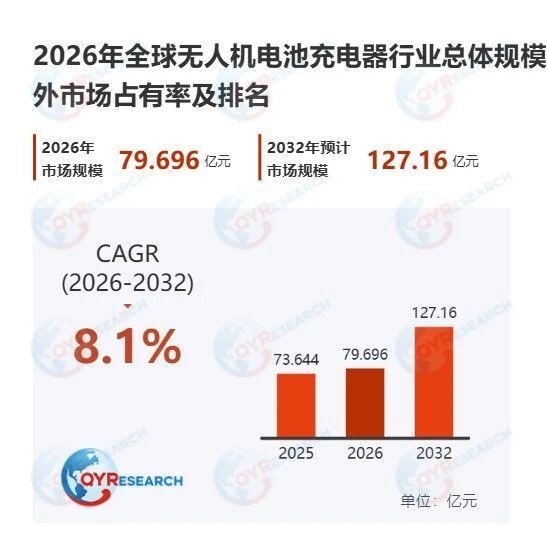
Core Viewpoint - The global drone battery charger market is projected to reach $1.87 billion by 2032, with a compound annual growth rate (CAGR) of 8.1% in the coming years [3]. Market Size and Industry Landscape - The global drone battery charger market is expected to grow significantly, reaching $1.87 billion by 2032, driven by increasing demand for drone applications [3]. - Major manufacturers in the drone battery charger market include DJI, YUNEEC, Shenzhen Grepow Battery Co., Ltd., and others, primarily concentrated in East Asia, North America, and Western Europe [5][6]. Industry Chain Analysis - The industry chain includes upstream component suppliers, midstream manufacturers, and downstream users, with specific roles such as charging control chip manufacturers and software developers [7]. - Upstream suppliers provide essential components like charging control chips and PCB circuit boards, while midstream manufacturers focus on charger assembly and integration [7]. Industry Policy Analysis - Recent regulations on lithium battery transport and safety compliance, such as the UN 38.3 rule, impact charger design and packaging to reduce logistics delays and compliance risks [8]. - The EU Battery Regulation (EU) 2023/1542 will be implemented in phases starting February 2024, emphasizing sustainability and compliance in the battery and charger ecosystem [8]. Industry Development Trends - There is a trend towards high-efficiency fast charging technology, aiming to reduce charging times by over 40% and optimize energy conversion efficiency [10]. - Customization for specific user needs is becoming prevalent, with designs focusing on portability for personal use and multi-port charging stations for commercial applications [10][11]. Industry Development Opportunities - Compliance-driven demand for certified chargers is increasing, particularly among commercial drone operators and search and rescue teams [12]. - The growth of niche markets driven by specific user needs, such as portable chargers for personal drones and robust chargers for emergency response, presents significant opportunities [12]. Challenges in the Industry - The lack of standardization in battery specifications leads to high R&D costs for manufacturers aiming for compatibility across various drone models [14]. - Cost pressures from low-cost, unregulated chargers challenge the market for compliant, high-quality products, impacting profit margins for established companies [14].