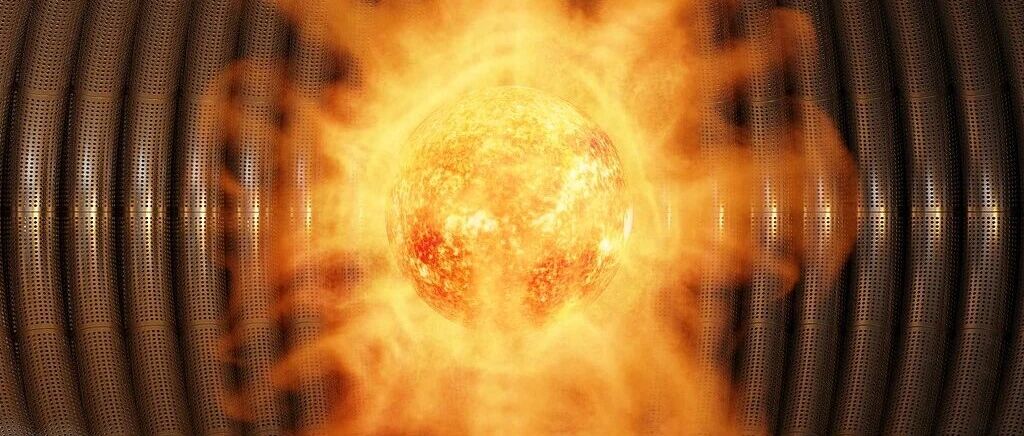
高温超导带材

Search documents
国际高温超导带材战略研究报告发布
Zhong Guo Jing Ji Wang· 2026-01-27 06:15
Core Insights - The report released by the Chinese Academy of Sciences focuses on the development of REBCO high-temperature superconducting tapes, outlining the current state of research, industrialization, and application globally, and identifies ten key scientific and technological challenges in the field [1] Group 1: Applications and Potential - Superconducting materials, including REBCO tapes, are considered strategic materials with vast application potential in energy, transportation, medical, and scientific fields, serving as a cornerstone for future technological breakthroughs [1] - REBCO tapes have shown significant application potential in areas such as magnetic confinement fusion, high-end medical equipment, large scientific installations, and superconducting power devices, primarily focusing on power systems and magnet systems [1][2] Group 2: Current Challenges and Future Directions - Despite entering the early stages of commercialization, there is substantial room for performance improvement in REBCO high-temperature superconducting tapes, which consist of a multi-layer composite structure [2] - The report emphasizes the need for collaborative innovation in materials, processes, and applications, focusing on optimizing the internal structure of the superconducting layer, improving the balance of strength and toughness in the base, buffer, and protective layers, and developing scalable, consistent manufacturing processes to meet growing application demands [2] Group 3: Key Scientific and Technological Issues - The report identifies ten critical scientific and technological issues hindering the large-scale application of REBCO tapes, including enhancing the yield strength and fatigue resistance of alloy substrates, overcoming inherent limitations of buffer layer materials, and achieving stability and uniformity in IBAD texture under thin thickness conditions [3] - Other issues include understanding the growth dynamics of different cap layers in high-speed deposition environments, improving the bonding strength between cap and superconducting layers, and clarifying the multi-physical field coupling mechanisms in MOCVD preparation to enhance the uniformity of superconducting layer thickness and composition [3]
今年首个核聚变大会来了
Xin Lang Cai Jing· 2026-01-04 05:00
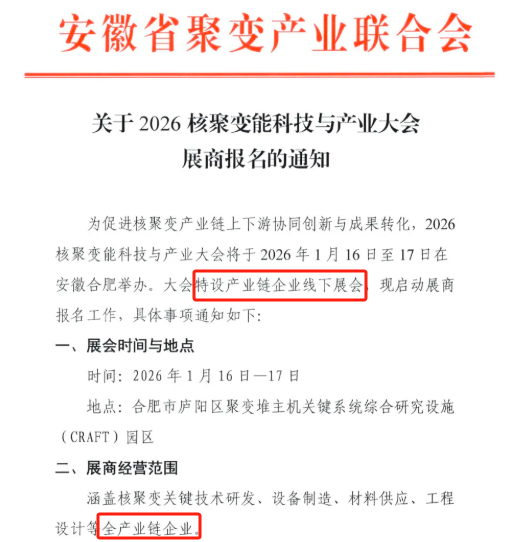
Core Insights - The 2026 Nuclear Fusion Energy Technology and Industry Conference will be held on January 16-17, 2026, in Hefei, Anhui, focusing on promoting collaboration and innovation in the nuclear fusion industry [1][9] - Hefei is recognized as a leading city for venture capital and is becoming a model for China's nuclear fusion industry, with a cluster of advanced fusion devices [4][12] - The region holds 37% of the national total of fusion-related patents, indicating a well-formed industrial chain [5][13] Industry Developments - The nuclear fusion sector is entering a capital expenditure expansion phase, with expected investments reaching 146.5 billion yuan in major domestic projects from 2025 to 2028 [7][14] - The demand for controllable nuclear fusion is increasing due to rising electricity needs driven by advanced technologies like AI [6][13] - Recent bidding statistics show a total of 117.4 million yuan in contracts awarded, with significant projects including a 6.3 million yuan contract for ITER PF converter control modules [6][14] Market Opportunities - The superconducting magnet segment is expected to benefit significantly, with a projected market size of nearly 30 billion yuan for superconducting magnets and over 10 billion yuan for superconducting materials [7][14] - Key projects such as BEST, Spark One, and others are anticipated to commence, leading to a continuous release of core component orders [7][15] - Recommended investment targets include companies involved in magnets, vacuum chambers, power systems, and detection equipment, such as Western Superconducting, YD Group, and Aikang Cyber [7][15]

今年首个核聚变大会来了
财联社· 2026-01-04 04:54
Core Viewpoint - The 2026 Nuclear Fusion Energy Technology and Industry Conference will be held in Hefei, Anhui, aiming to promote collaboration and innovation in the nuclear fusion industry chain [3][6]. Group 1: Conference Details - The conference will take place from January 16 to 17, 2026, at the CRAFT facility in Hefei, focusing on the theme "Nuclear Power, Creating the Future" [3]. - The event is guided by several organizations, including the Chinese Physical Society and the Anhui Provincial Development and Reform Commission, and will gather leaders from various sectors, including government, academia, and industry [6]. Group 2: Hefei's Role in Nuclear Fusion - Hefei is recognized as a leading city for venture capital and is becoming a model for China's nuclear fusion industry, with a cluster of advanced fusion devices [7]. - The region has established a comprehensive innovation chain covering key technology areas in magnetic confinement nuclear fusion, supported by major facilities like EAST and BEST [7][8]. Group 3: Industry Trends and Projections - In 2025, nuclear fusion energy will be included in national planning as a key future industry, reflecting its growing importance [9]. - The demand for controllable nuclear fusion is increasing due to rising electricity needs driven by advanced technologies like AI, with the industry entering an "engineering feasibility verification" phase [10]. - A significant capital expenditure expansion cycle for controllable nuclear fusion is expected from 2025 to 2028, with projected investments reaching 146.5 billion yuan [11]. Group 4: Market Opportunities - The superconducting magnet segment is anticipated to benefit significantly, with the market size for high-temperature superconducting magnets estimated at nearly 30 billion yuan [11]. - Key projects such as BEST and others are expected to commence, leading to a continuous release of core component orders [11]. - Companies in various segments, including superconducting materials, vacuum chambers, and power systems, are highlighted as potential beneficiaries of the nuclear fusion industry's growth [11].