
REBCO高温超导带材

Search documents
核聚变产业进度分享
2026-03-30 05:15
Summary of Fusion Industry Conference Call Industry Overview - The conference call focused on the **nuclear fusion industry**, particularly advancements in high-temperature superconducting tokamaks and other fusion technologies [1][2][3]. Key Points and Arguments Technological Advancements - High-temperature superconducting tokamaks are identified as a **deterministic trend**, with magnetic field strength improvements potentially leading to a **fourfold increase** in device performance, significantly reducing size and cost [1]. - The **superconducting magnet** is a core value component, accounting for **40%-50%** of total investment, with **REBCO high-temperature superconducting tape** being the most critical cost item [1][13]. - The **stellarator route** shows potential for long-pulse steady-state operation, especially with breakthroughs in domestic 3D manufacturing technology, positioning it as a potential competitor to tokamaks [1]. Commercialization Progress - Overseas private companies have ambitious goals for power generation by **2030**, which may be overly optimistic, while the domestic **BEST device** is expected to achieve plasma discharge around **2028-2029** [1][2][12]. - The evolution of the technical path follows a clear sequence: **plasma discharge** -> **deuterium-tritium combustion experiments (BEST/ITER)** -> **demonstration reactors (DEMO)** -> **commercial power plants** [1][3]. Key Projects and Timelines - The period from **2026 to 2029** is anticipated to be a peak for nuclear fusion device tenders, with projects like **BEST** and **Honghuang 170** expected to reach scales of **1 billion to 10 billion** [1][12]. - The **BEST project** has already released over **2 billion yuan** in tenders, with future tenders expected to reach several billion [12]. Industry Dynamics - Domestic capabilities in high-precision component manufacturing and a low-cost industrial chain provide a competitive advantage in areas such as magnets, vacuum chambers, heating, and cryogenic systems [1][10]. - The **commercialization potential** of various routes, including the stellarator, is highlighted, with the latter benefiting from the advantages of tokamak technology while also presenting unique engineering challenges [5][8]. Investment and Financing Environment - Domestic private fusion companies have secured financing in the range of **hundreds of millions to billions**, often backed by government support [11]. - The optimistic timelines proposed by U.S. commercial fusion companies may contain elements of **bubble** due to the challenges of execution and the complexity of fusion systems [12]. Additional Important Insights - The **Lawson criterion**, which measures the ability to maintain fusion reactions, is a critical standard for evaluating technology routes, with traditional low-temperature superconducting tokamaks currently being the most mature [5][6]. - The **REBCO tape** is a significant cost driver within the superconducting magnet category, with domestic companies actively developing this technology [14]. - The potential for shared systems across different fusion technologies, such as superconducting magnets and heating systems, indicates a level of interoperability that could benefit the industry as a whole [14]. This summary encapsulates the key discussions and insights from the conference call, providing a comprehensive overview of the current state and future prospects of the nuclear fusion industry.
首个高温超导带材发展战略研究报告: REBCO带材发展呼唤协同创新
Zhong Guo Hua Gong Bao· 2026-02-03 07:14
Core Insights - The report released by the Chinese Academy of Sciences focuses on the strategic development of REBCO high-temperature superconducting tapes, marking the first international strategic research report on this topic, which aims to provide a clear roadmap for large-scale applications of high-temperature superconducting materials [1][2] Group 1: REBCO High-Temperature Superconducting Materials - Superconducting materials are recognized for their unique properties of zero electrical resistance and complete magnetic field expulsion, making them highly valuable in various fields such as energy, transportation, medical, and scientific research [1] - Traditional superconductors require extremely low temperatures (-269°C) for operation, leading to high cooling costs and reliance on scarce helium resources, which limits their widespread application [1] - The introduction of REBCO high-temperature superconductors, which operate above the liquid nitrogen temperature (-196°C), significantly reduces cooling costs and maintains excellent current-carrying capacity in high magnetic fields, laying the foundation for broader practical applications [1] Group 2: Challenges and Future Directions - Despite entering the early commercialization phase, the overall performance of REBCO materials has significant room for improvement, necessitating a systematic advancement in materials, processes, and applications [2] - The report identifies ten key scientific and technical issues that hinder the large-scale application of REBCO tapes, derived from comprehensive research on the entire development and application chain [2] - The report emphasizes the need for collaborative innovation to address performance bottlenecks and improve the balance of strength and toughness, structural conduction efficiency, and interlayer bonding in the composite structure of REBCO tapes [2][3]
中国首发高温超导发展路线图
Xin Lang Cai Jing· 2026-02-01 20:19
Core Viewpoint - The report by the Chinese Academy of Sciences presents a strategic roadmap for the development of REBCO high-temperature superconducting materials, identifying ten key scientific and technological challenges that hinder large-scale application [1][2]. Group 1: Overview of REBCO High-Temperature Superconductors - REBCO (Rare Earth Barium Copper Oxide) high-temperature superconductors operate at temperatures above liquid nitrogen levels (approximately -196 degrees Celsius), significantly reducing cooling costs compared to traditional superconductors that require liquid helium temperatures (around -269 degrees Celsius) [1]. - Since its commercialization in 2006, REBCO materials have shown potential in various critical fields, particularly in power systems and magnet systems [1][2]. Group 2: Applications in Power Systems - In power systems, REBCO materials can be utilized in superconducting cables and fault current limiters, enabling efficient, low-loss power transmission suitable for urban grid upgrades [1]. - Fault current limiters can quickly limit current during short circuits, enhancing grid safety [1]. Group 3: Applications in Magnet Systems - REBCO materials maintain high current-carrying capacity in strong magnetic fields, making them suitable for advanced applications such as nuclear fusion devices, high-field magnetic resonance imaging (MRI), and superconducting motors [2]. - The materials require high strength and stability, necessitating systematic optimization of their multi-layer composite structure [2]. Group 4: Future Development and Challenges - The report emphasizes the need for systematic optimization of the superconducting layer, buffer layer, and substrate to achieve low-cost, stable mass production [2]. - There is significant room for performance improvement in REBCO materials, with specific challenges identified to transition from "usable" to "highly usable" [3]. - The ten scientific challenges outlined in the report connect material research to engineering applications, aiming to bridge the gap between fundamental research and practical use [3].
瞄准大规模应用:中国首发高温超导发展路线图
Huan Qiu Wang Zi Xun· 2026-01-29 01:29
Core Insights - The report by the Chinese Academy of Sciences presents the first systematic strategic research on REBCO high-temperature superconducting materials, identifying ten key scientific and technological issues hindering large-scale application [1][2] Group 1: Overview of REBCO High-Temperature Superconductors - REBCO (Rare Earth Barium Copper Oxide) superconducting materials operate at temperatures above liquid nitrogen levels, significantly reducing cooling costs and enhancing current-carrying and magnetic properties [1] - Since its commercialization in 2006, REBCO materials have shown potential in critical areas such as power systems and magnet systems [1][2] Group 2: Applications of REBCO Materials - In power systems, REBCO can be utilized for superconducting cables and fault current limiters, enabling efficient, low-loss power transmission suitable for urban grid upgrades [1] - In magnet systems, REBCO maintains high current-carrying capacity in strong magnetic fields, making it applicable in advanced devices like nuclear fusion reactors and high-field MRI machines [2] Group 3: Key Scientific and Technological Issues - The report outlines ten critical scientific and technological challenges that need to be addressed to enhance the performance and scalability of REBCO materials, including improving yield strength, thermal and electrical performance of buffer layers, and stability of IBAD textures [4][5] - The challenges span the entire development chain from material research to engineering applications, aiming to connect fundamental research with practical uses [3] Group 4: Future Prospects - With ongoing improvements in material performance and manufacturing processes, high-temperature superconducting technology is expected to play a significant role in future energy, medical, transportation, and large scientific installations [3] - The report emphasizes the need for collaboration across various sectors to transition from following to leading in the high-temperature superconducting field [3]
国际高温超导带材战略研究报告发布
Zhong Guo Jing Ji Wang· 2026-01-27 06:15
Core Insights - The report released by the Chinese Academy of Sciences focuses on the development of REBCO high-temperature superconducting tapes, outlining the current state of research, industrialization, and application globally, and identifies ten key scientific and technological challenges in the field [1] Group 1: Applications and Potential - Superconducting materials, including REBCO tapes, are considered strategic materials with vast application potential in energy, transportation, medical, and scientific fields, serving as a cornerstone for future technological breakthroughs [1] - REBCO tapes have shown significant application potential in areas such as magnetic confinement fusion, high-end medical equipment, large scientific installations, and superconducting power devices, primarily focusing on power systems and magnet systems [1][2] Group 2: Current Challenges and Future Directions - Despite entering the early stages of commercialization, there is substantial room for performance improvement in REBCO high-temperature superconducting tapes, which consist of a multi-layer composite structure [2] - The report emphasizes the need for collaborative innovation in materials, processes, and applications, focusing on optimizing the internal structure of the superconducting layer, improving the balance of strength and toughness in the base, buffer, and protective layers, and developing scalable, consistent manufacturing processes to meet growing application demands [2] Group 3: Key Scientific and Technological Issues - The report identifies ten critical scientific and technological issues hindering the large-scale application of REBCO tapes, including enhancing the yield strength and fatigue resistance of alloy substrates, overcoming inherent limitations of buffer layer materials, and achieving stability and uniformity in IBAD texture under thin thickness conditions [3] - Other issues include understanding the growth dynamics of different cap layers in high-speed deposition environments, improving the bonding strength between cap and superconducting layers, and clarifying the multi-physical field coupling mechanisms in MOCVD preparation to enhance the uniformity of superconducting layer thickness and composition [3]
【新华社】中国科学院报告提出高温超导带材领域十大关键科学技术问题
Xin Hua She· 2026-01-27 02:36
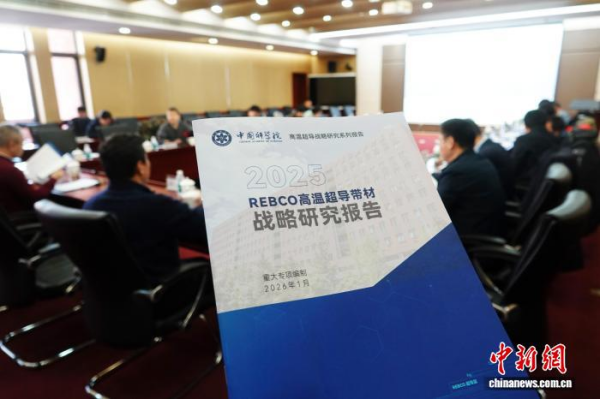
Core Insights - The report titled "2025 REBCO High-Temperature Superconducting Tape Strategic Research Report" was released by the Institute of Physics, Chinese Academy of Sciences, highlighting ten key scientific and technological issues in the field of high-temperature superconductors [1] - High-temperature superconductors, particularly REBCO, are identified as core materials for various applications, including controlled nuclear fusion, magnetic resonance imaging, and superconducting cables due to their low production costs [1] - Despite commercial production being achieved, the complex multi-layer composite structure of REBCO high-temperature superconducting tapes presents challenges in stability and performance enhancement [1] Group 1 - The report identifies critical issues such as improving the yield strength and fatigue resistance of alloy-based tapes to meet high-field application demands [1] - It also addresses the need to overcome inherent limitations in the electrical and thermal properties of buffer layer materials [1] - The ten key issues were derived from in-depth research on the entire industry chain, from R&D to application, analyzing the structure of REBCO high-temperature superconducting tapes [1] Group 2 - The director of the Institute of Physics, Fang Zhong, expressed the hope that revealing these core scientific and technological issues will unite innovation forces from academia, industry, and research to collaboratively drive the large-scale application of high-temperature superconducting materials [1]
【中国新闻网】中国发布国际首个聚焦高温超导带材发展战略研究报告
Zhong Guo Xin Wen Wang· 2026-01-27 02:24
Core Insights - The report titled "2025 REBCO High-Temperature Superconducting Tape Strategic Research Report" was officially released by the Chinese Academy of Sciences, focusing on the development of REBCO (Rare Earth Barium Copper Oxide) high-temperature superconducting tape [1][2] - The report outlines the current state of research, industrialization, and application of REBCO globally, identifying ten key scientific and technological challenges that need to be addressed for large-scale application of high-temperature superconducting materials [1][3] Industry Overview - Superconducting materials are recognized for their zero electrical resistance and complete diamagnetism, making them strategically valuable in various fields such as energy, transportation, medical, and scientific research [3] - Traditional superconductors operate at extremely low temperatures, leading to high cooling costs and reliance on scarce helium resources, which has limited their application to specialized areas like particle accelerators and high-end medical devices [3] - REBCO high-temperature superconductors, with critical temperatures above liquid nitrogen levels, significantly reduce cooling costs and enhance performance in carrying current and resisting magnetic fields, paving the way for broader applications since their commercialization in 2006 [3][4] Applications - In the power system, REBCO tapes can be used to manufacture superconducting cables and fault current limiters, which are essential for urban grid upgrades and ensuring grid safety during short circuits [4] - In magnetic systems, REBCO tapes are applicable in nuclear fusion devices, high-field magnetic resonance imaging, and superconducting motors, which require high mechanical strength and stability [4] Key Scientific and Technological Challenges - The report identifies ten critical scientific and technological issues hindering the large-scale application of REBCO tapes, spanning from the base layer to the superconducting functional layer [5] - These challenges include improving the yield strength and fatigue resistance of alloy substrates, overcoming limitations in buffer layer materials, achieving stability and uniformity in thin-film deposition, and enhancing the bonding strength between layers [5][6] Future Directions - The report emphasizes the need for collaborative innovation in materials, processes, and applications to enhance the performance of REBCO tapes [7] - Key areas for future development include optimizing the internal structure of the superconducting layer, improving the balance of strength and toughness in the substrate and buffer layers, and developing scalable and consistent manufacturing processes to meet growing application demands [7]

明确稀土钡铜氧从“能用”到“好用”路线图
Ke Ji Ri Bao· 2026-01-27 02:24
Core Insights - The report released by the Chinese Academy of Sciences focuses on the development of REBCO high-temperature superconducting tapes, outlining the current state of research, industrialization, and application globally, and identifies ten critical scientific and technological issues that need to be addressed for large-scale application [1][2]. Group 1: REBCO High-Temperature Superconducting Tapes - REBCO high-temperature superconducting materials have a critical temperature above the liquid nitrogen range (-196°C), significantly reducing cooling costs and enabling broader practical applications compared to traditional superconductors that require extremely low temperatures (-269°C) [1]. - Since its commercialization in 2006, REBCO tapes have shown great potential in key areas such as magnetic confinement nuclear fusion, advanced medical imaging, large scientific installations, and superconducting power equipment [2]. Group 2: Applications and Systems - In the power system sector, REBCO tapes are primarily used in superconducting cables and fault current limiters, which enhance the safety and stability of power grids by allowing high-capacity, low-loss transmission [2]. - In the magnet system sector, REBCO tapes are applied in high-end equipment such as nuclear fusion devices and high-field magnetic resonance imaging, where high mechanical strength and operational stability are critical [2]. Group 3: Challenges and Future Directions - The report identifies ten key scientific and technological challenges that hinder the large-scale application of REBCO tapes, emphasizing the need for improvements in material performance, processing techniques, and application integration [3]. - Future development should focus on optimizing the internal structure of the superconducting layer, improving the balance of strength and toughness in the composite structure, and developing scalable, consistent manufacturing processes to meet the growing demand for large-scale applications [3].
中科院报告提出高温超导带材领域十大关键科学技术问题
Xin Lang Cai Jing· 2026-01-27 00:11
Core Viewpoint - The report by the Chinese Academy of Sciences outlines ten key scientific and technological issues in the field of REBCO high-temperature superconducting materials, aiming to guide large-scale applications of these materials [1] Group 1: Superconducting Materials - Superconducting materials exhibit zero electrical resistance and can withstand magnetic forces, showing significant potential in applications such as controlled nuclear fusion, magnetic resonance imaging, and superconducting cables [1] - REBCO, a type of high-temperature superconducting material, is highlighted for its relatively low production costs, making it a core material in current superconducting technology research and applications [1] Group 2: Challenges in Production - Despite achieving commercial production, REBCO high-temperature superconducting tapes have a complex multi-layer composite structure, leading to challenges in stable mass production and significant room for performance improvement [1] - The report identifies specific challenges such as enhancing the yield strength and fatigue resistance of alloy-based tapes to meet high-field application requirements and overcoming inherent limitations in the electrical and thermal properties of buffer layer materials [1] Group 3: Collaborative Innovation - The report emphasizes the need for collaboration among industry, academia, and research institutions to address these core scientific and technological issues, aiming to promote the large-scale application of high-temperature superconducting materials [1]
中国科学院报告提出高温超导带材领域十大关键科学技术问题
Xin Hua She· 2026-01-26 10:41
Core Viewpoint - The report by the Chinese Academy of Sciences outlines ten key scientific and technological issues in the field of REBCO high-temperature superconducting materials, aiming to guide large-scale applications of these materials [1] Group 1: Superconducting Materials - Superconducting materials exhibit zero electrical resistance and can withstand magnetic forces, showing significant potential in applications such as controlled nuclear fusion, magnetic resonance imaging, and superconducting cables [1] - REBCO, a type of high-temperature superconductor, is highlighted for its relatively low production costs, making it a core material in current superconducting technology research and applications [1] Group 2: Challenges in Production - Despite achieving commercial production, REBCO high-temperature superconducting tapes have a complex multi-layer composite structure, leading to challenges in production stability and significant room for performance improvement [1] - The report identifies specific challenges such as enhancing the yield strength and fatigue resistance of alloy-based tapes to meet high-field application requirements and overcoming inherent limitations in the electrical and thermal properties of buffer layer materials [1] Group 3: Collaborative Innovation - The report emphasizes the need for collaboration among industry, academia, and research institutions to address these core scientific and technological issues, aiming to drive the large-scale application of high-temperature superconducting materials [1]